
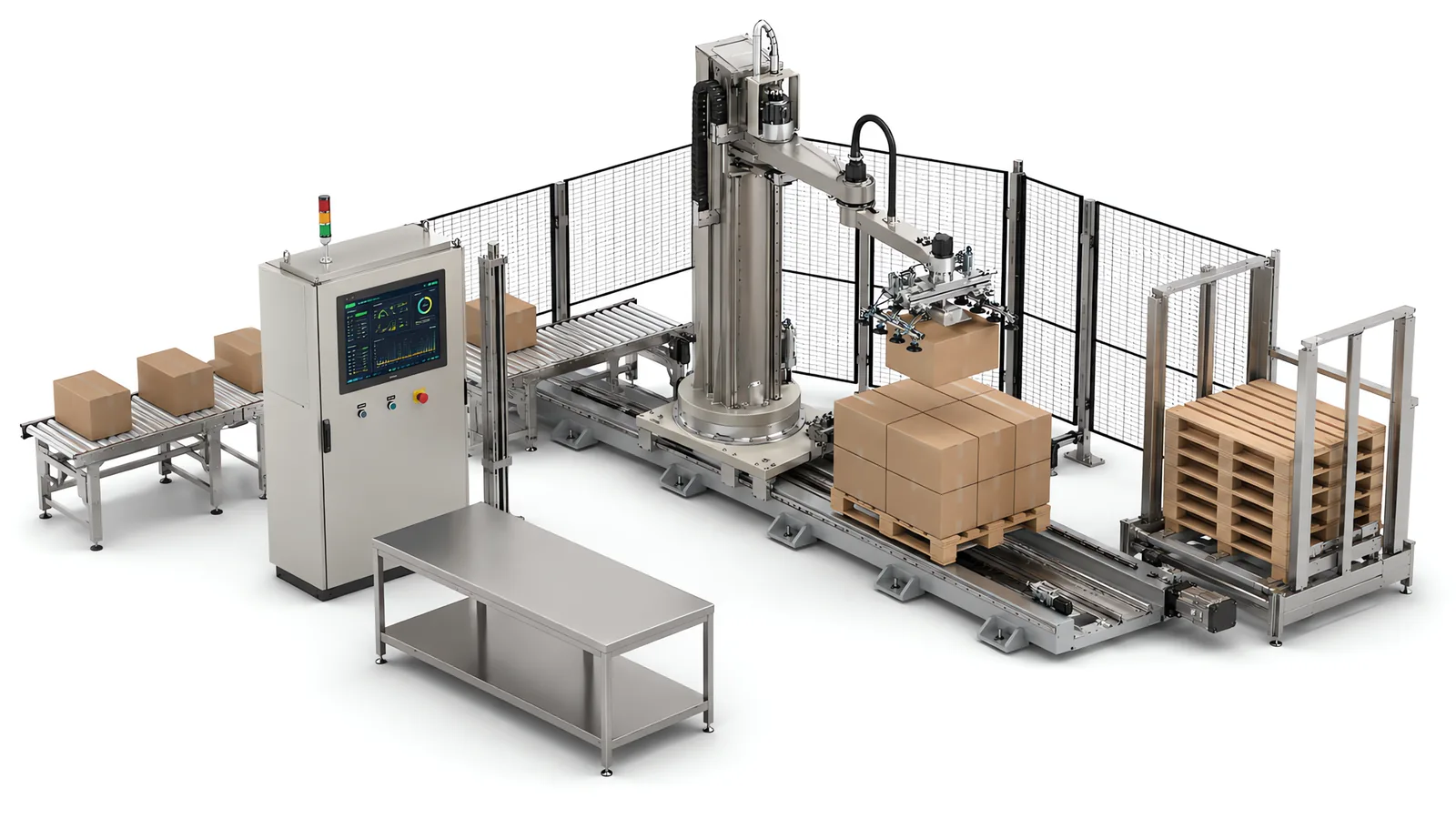
Motionwell Automation designs and builds production machines in Singapore, and an automation ROI calculation is the arithmetic that decides whether one of those machines should be bought at all. This page is the method: what belongs on each side of the ledger, why the labour line is rarely the term that decides the answer, how payback, net present value and internal rate of return answer three different questions, and where a case falls over under challenge. Every figure below is a placeholder for one of yours, because your loaded labour cost, your scrap valuation and your baseline utilisation can move the payback on a machine as far as the equipment price does. The machines that decision is made about range from a four-axis column palletizing platform stacking cartons onto pallets at a rate set by your case weight and pallet pattern, to a multi-station rotary indexing assembly machine with vision inspection at several stations, a 12-station dial for example; the design method behind the latter is set out in how we design multi-station rotary assembly machines. Our machines are designed, assembled and tested at our Woodlands Link facility, and the company has delivered more than 150 special purpose machines since 2014 under ISO 9001:2015 and bizSAFE Level 3.
The short version, before the detail. A defensible case has four parts: a baseline that closes arithmetically, a benefit list where every line has an owner who will sign for it, a cost list that includes the work after delivery, and one sensitivity test naming the assumption the answer hangs on. An automation payback in Singapore has to clear all four, and a case missing any one of them tends to be argued about. The fully worked example with every input visible is the warehouse automation ROI model, which carries one facility to a break-even month; this page is the general method behind it.
Why Does a Labour-Hours Calculation Give the Wrong Answer?
Because labour is an easy term to measure and one of the least likely to move on its own, so a case built from it alone fails in both directions at once.
The arithmetic looks harmless. Annual labour benefit is R multiplied by L multiplied by twelve, where R is the number of roles that leave payroll and L is the loaded monthly cost of one of them. Two words carry the whole calculation, and neither is a machine specification.
Loaded means built up from payroll, and never taken from a wage figure. Gross pay is the visible part; employer contributions, levies where they apply, insurance, protective equipment and the supervision share sit on top of it, and the build-up for a Singapore facility is set out line by line in the warehouse automation ROI model. Using a wage understates the benefit, which is the one error in this whole document that works in your favour.
Leave is the harder half, and it is where cases go wrong in the expensive direction. R is not the number of operators standing at the station today. It is the number whose cost leaves the business, through attrition without backfill, a redeployment into work somebody would otherwise have been hired for, or a contract that is not renewed. An emptied station is an operational fact. A closed requisition is a financial one. If nobody will put the second in writing before capital is committed, the case has to survive at a lower R, and it is cheaper to find that out during concept review than during the first post-implementation review.
The second failure direction is quieter. On plenty of machines the labour line is simply not the largest term, and building the case from it alone leaves real money uncounted. On the end-of-line palletizing work we publish the position beside the delivered cell: labour hours are what everyone counts, while rework and damaged loads are frequently the bigger number, and stack quality that drifts across a shift produces pallets that have to be re-squared before they can be wrapped or racked. The palletizing robot case study sets out that cell; the terms that outrank labour on it are in the benefit table below.
Where Does the Baseline Come From, and Why Is One Downtime Bucket Not Enough?
A benefit is a difference between two states, and the weaker measurement is almost always the one describing the process you already run. That makes the baseline the first thing to fix and the first thing a finance reviewer should challenge.
Start with the closure test. Operators multiplied by productive minutes, divided by minutes per unit of work, has to reproduce the output you actually observe. Where it does not, the error is usually in assumed utilisation, and every saving downstream inherits it. That check costs an afternoon, and it is cheap insurance against an error every later line inherits.
Then separate the losses, because this is where our OEE guide makes the argument this page depends on. Overall equipment effectiveness compresses three separate failures into one score, and the categories underneath matter more than the score, because they tell you who owns the fix. Availability losses filed into a single bucket called downtime hide the thing you are trying to fix. Three mechanisms do the hiding, and all three are common:
- Stop reasons collected at the end of the shift. The PLC already knows which interlock, which alarm word and which starved sensor stopped the machine. Where those bits are not mapped to loss categories, an operator picks from a dropdown hours later and the largest category becomes “Other”.
- Micro-stops below the collector threshold. Most collectors only log a stop past a threshold, often 60 seconds. A jam cleared in fifteen seconds disappears from availability and reappears as a performance shortfall nobody can locate.
- Planned downtime absorbing everything inconvenient. Reclassify a slow changeover as planned maintenance and availability improves with no physical change on the floor.
The consequence for an ROI model is direct. One aggregate downtime figure cannot be converted into a benefit, because the fix is different for every category underneath it, and so is the machine that delivers it.
| Largest loss category once it is separated | Where the money usually is | What buying a faster machine does not fix |
|---|---|---|
| Changeover and setup | Tool-free format parts, kitting at the station, recipe-driven setup, cleaning and first-article checks moved off the critical path | Cycle speed, when the line is losing its week to format changes |
| Material starvation and waiting for an operator | Feeding, presentation, buffering and internal transport | Anything at all, because the machine was never the constraint |
| Micro-stops at a feeder or escapement | Feeder tuning, escapement and track geometry, orientation verification before the pick | The arm, which will idle more precisely at higher cost |
| Startup scrap after a changeover | Stored parameters and a first-article check inside the sequence | The quality factor, because the cause sits in availability |
| Defects found at final inspection | Inspection moved to the station that creates the defect | Downstream capacity, which is being consumed by parts already scrap |
| Breakdowns on an obsolete control platform | A control-system retrofit that keeps mechanics you already paid for | The mechanics, where those are still sound |
One more baseline discipline decides whether any of this converts to cash. Lifting a station that is not the constraint produces inventory, so instrument the bottleneck first and model that. And where the plant is regulated, there is a sequencing argument worth borrowing: in medical device production the recommended first step is inline verification and inspection, ahead of assembly stations, precisely because it is the step that produces the baseline data the later business cases need. Counting every part is also what makes an escape rate knowable.
Which Benefit Terms Are Usually Larger Than the Labour Line?
They are usually the ones sitting in another cost centre. Scrap tends to land with materials, rework with production, returns with quality or after-sales, and overtime with payroll. Each is real money and none of it appears in a headcount saving.
| Benefit term | The arithmetic, with your inputs | What makes it defensible |
|---|---|---|
| Scrap | Units scrapped per period, multiplied by the loaded cost of the unit at the point it was scrapped | A scrap record by station and cause |
| Rework | Rework hours per period at the loaded labour rate, plus material, plus the line time the rework occupies | A rework log kept separately from scrap, because reworked units are usually counted as good |
| Damaged product and damaged loads | Units damaged per period at loaded cost, plus the labour to re-handle, re-square or re-pack them | Damage recorded where it happens |
| Warranty and field returns | Returns attributable to the process, multiplied by the cost of one return including handling and investigation | An attribution rule agreed with quality before the case is written |
| A quality escape | Escapes per period, multiplied by the cost of one escape in your market | An escape rate that comes from counting |
| Overtime | Overtime hours per period, multiplied by the premium rate | Payroll data for the affected cost centre, which shows hours the headcount line never does |
| Giveaway on a filled product | Average overfill per container, multiplied by containers per period, multiplied by material cost | Checkweigher or weigh-fill data |
Four notes on that table, because the arithmetic is the easy part.
Scrap is more often costed wrong than missed. Valuing a scrapped unit at material cost understates it, because a unit rejected at the end of the line has already spent time at every station between the defect and the reject gate, where the same defect caught at the station that created it costs one part and nothing else. The valuation basis is what moves this line.
Rework hides inside the quality figure. First-pass good is the only count that means anything here, because parts reworked and later passed keep quality reading high while the rework bench fills up. Two plants with the same reported yield can have completely different rework costs.
Escape cost is asymmetric, and the asymmetry decides the machine. Where an escape can reach a patient or trigger a recall, the threshold sits tight and scrap is accepted as the price of that. On high-volume consumer goods a false-reject rate of a few percent eats the margin, so the same defect carries a different price in two plants. That is why our machine vision inspection page treats the operating point as a cost decision, and why the surface defect inspection page argues that a false reject rate is what gets a station switched off.
Some benefits outweigh the labour they replace on specific machines, and it is worth saying which. On drum and pail filling we publish that a semi-automatic weigh-fill station can be justified on giveaway alone, while a full automatic line is justified on labour, safety and throughput together. That is a statement about one class of station in the drum and pail filling range, and it is worth borrowing only in the sense that the term which carries a case differs by machine.
Which Costs Are Missing From the Cost Side?
They are the ones that arrive after the purchase order. A quotation prices the machine; the project costs the machine plus everything needed to make it produce, and the gap between those two numbers moves a payback estimate more than people expect.
| Cost line | When it applies | Where it lands if you leave it out |
|---|---|---|
| Installation and site work | Always | Electrical supply, compressed air, floor levelling, foundation and anchoring, all discovered on site |
| Integration into an existing line | Whenever the machine joins a line | Getting signals out of a legacy control is a cost per machine that the equipment choice rarely removes |
| Validation and qualification | Regulated production | IQ, OQ and PQ with protocol authoring is a documentation project running alongside the build |
| Requalification of what the change touches | A validated line already through PQ | Change control and an impact assessment, where the hardware is rarely the expensive half |
| Conformity work on a retrofit | Modernisation of an existing machine | A modification large enough to make the machine new in the regulatory sense moves conformity duties onto whoever did it |
| Training | Always | Operators, changeover, first-line fault finding, and the same again for the next intake |
| Spares and consumable holding | Always | Wear items with a replacement interval become a running cost you did not budget |
| Production lost during the transition | Where the machine replaces a running process | Dual running while both processes are carried, then a ramp before rated output |
| Safety scope | Always | Guarding, interlocks, scanners, measured stopping performance and the validation evidence behind them |
| Network and IT scope | Connected machines | Segmentation, access control and whoever owns the interface at the next upgrade |
Three of those rows deserve their own paragraph.
Consumables move cost off the capital sheet without removing it. Contacts, nests, seals, gripper fingers and coupler halves all wear, and a specification that lists none of them has simply relocated the money. Ask any supplier, including us, for four things before signing: the consumable list, the replacement interval for each item, the re-verification routine an operator runs on shift, and which spares are worth holding in Singapore. Our own integrator selection checklist sets the support bar at critical spares stocked locally or available within 3 to 5 business days, and the full version of that question set is in the guide to choosing an automation system integrator. The consumable argument as it applies to test fixtures is on the automated test equipment page.
On a validated line the regulatory scope can be larger than the mechanical scope. After PQ, adding a change part set is a change control with an impact assessment and requalification of everything it touches, and changing something inside a qualified filling machine can drag requalification across the whole machine. Where that scope can be bounded by making the new work a separate machine, bounding it is often cheaper than the integration it costs. The computer system validation page covers what each qualification stage actually has to evidence.
A retrofit carries a conformity question a new build does not. The European Commission states that the Machinery Directive applies to products placed on the EU market for the first time or where existing machinery is modified to such an extent that it becomes de facto new machinery, and it publishes that position on its machinery page. For a modernisation project that judgement sets the cost: crossing the line puts the party doing the work in the position of placing new machinery on the market, with the conformity work that follows, and staying below it does not. Where the line sits is decided per project, and it belongs in the scope conversation.
Timing belongs on the cost side too, because capital commits well before benefit starts. Lead time here runs 16 to 24 weeks from concept approval to factory acceptance testing on a standard build, and 24 to 32 weeks where cleanroom compatibility or full validation documentation applies, with a further 2 to 4 weeks of testing and commissioning after that, covering installation, site acceptance testing on real production material, operator training and the documentation pack. A model that starts booking benefit on the day the invoice is paid is wrong by that whole period plus the ramp behind it. The way a build of this shape is scoped and phased is in our guide to special purpose machine design.
What Is the Difference Between Payback, NPV and IRR?
They answer three different questions, and a case that quotes only the first is answering the least useful one.
| Measure | The arithmetic | What it answers | What it ignores |
|---|---|---|---|
| Payback period | Total month-0 capital C, divided by net annual benefit B, then extended by the dual running and ramp period | How long the money is out | Everything after break-even, the cost of capital, and how long the asset lives |
| Net present value | Minus C, plus the sum of each year’s net benefit discounted at your cost of capital r over the horizon N | Whether the project adds value at your own cost of money | Nothing structural, provided N and r are realistic |
| Internal rate of return | The discount rate at which that net present value equals zero | What rate the project earns, for comparison against a hurdle | Project size, and it misbehaves where cash flows change sign more than once |
Payback alone favours the wrong projects for a specific reason: it stops reading at the break-even month. Two projects with identical payback and different asset lives rank identically, which systematically flatters the cheap short-lived one and penalises the machine that keeps producing for years after it has paid for itself. Asset life is exactly the variable in play on the work we do most of. A control-system retrofit keeps mechanics you have already paid for and restarts the clock on the controls; a new build starts a new life for both. Those are different horizons, and payback cannot see the difference.
It has a second weakness that matters more in practice. Payback is easy to improve without touching anything on the floor, because shrinking the numerator does it. Leave installation, integration, validation and training off the capital line, as the section above describes, and the payback shortens on paper while the project stays exactly as it was. Any measure that improves when you count less is a poor measure to rank by.
Internal rate of return has its own traps, and they arrive precisely on the projects that most need care. It ranks by rate, so a small project can outrank a larger one that adds more value; it assumes intermediate cash is reinvested at the same rate, which is rarely true; and where the cash flow changes sign more than once, which is what a mid-life rebuild or a second phase does, more than one rate can satisfy the equation. Use net present value to decide, internal rate of return to test against a hurdle, and payback to describe risk exposure.
Whichever measure your finance function wants, state N and r explicitly and put them where they can be argued with. An automation case that hides its horizon is asking to be discounted by a reviewer who cannot see it.
How Do You Handle a Benefit You Cannot Price?
Handle it carefully, and preferably by not pricing it at all. A safety exposure removed, floor space recovered, flexibility retained and data you do not yet have a use for are all real, and each of them risks being discounted to zero by a reviewer the moment the number attached to it looks invented. Three treatments survive contact with a finance committee.
Book it at zero and say that you did. This is the strongest version, and it is what the worked warehouse model on this site does with error reduction and recovered space. The effect is not modesty. It is that every number above the line then stands on its own, so the challenge conversation is about inputs you can evidence, and never about the one line nobody believes.
Invert the question. If the priced case falls short of your hurdle by an amount D over the horizon N, the unpriced benefit only has to be worth more than D across that horizon for the project to clear. That is a question a manager can actually answer, and minute, without pricing an injury. The same inversion works on any soft term: compute the shortfall first, then ask whether the thing you cannot price is worth at least that much.
Treat it as a constraint, and never as a benefit line. This is the right answer for most safety cases, and the standards are explicit about it. The Annex A risk graph in ISO 13849-1 rates a hazard on three parameters: severity of injury, frequency and duration of exposure, and possibility of avoiding the hazard. None of the three is a price, and the required performance level that comes out of the graph is not negotiable against a payback figure. Where the risk assessment says a function is needed, the safeguarding is the cost of running the process at all.
The Singapore version of that point is worth stating plainly, because it changes which column the money goes in. This country does not require CE marking, but the Workplace Safety and Health Act requires dangerous parts of machinery to be securely fenced and places duties on the occupier and on anyone supplying machinery for use at work, and machines incorporating lifting equipment must be examined and certified by an approved authorised examiner before use, with periodic re-examination afterwards. Those are obligations. An obligation does not have a payback period, and putting one into the benefit column of an automation case is how a compliance project ends up competing for capital against a throughput project. How that scope is derived and evidenced is on our machine safety and CE marking page.
Which Single Assumption Is Your Case Most Exposed To?
It is the one that changes the answer most per unit of uncertainty, which is not necessarily the one that gets negotiated hardest. Run the test in two passes.
The first pass is one input at a time: change a single assumption, hold everything else, and re-read the answer. The second pass is more useful and takes no longer. For each input, solve for the value at which the project stops clearing your hurdle, and then ask whether that value is inside or outside the range you would defend.
The labour version of that solve is short enough to do on paper. With capital C, horizon N and annual operating cost A, the annual benefit needed to return the capital undiscounted is C divided by N, plus A. Divide that by the loaded annual cost of one role and you have the number of roles that must genuinely leave payroll for labour alone to carry the case. If that number is larger than anyone will commit to in writing, labour alone does not carry it, and the difference has to come from the benefit terms above or the project does not go ahead. Discount the flows at your own r if finance requires it; the conclusion moves in the same direction, only further.
| Input | Which way it moves the answer | Why it is usually the exposed one |
|---|---|---|
| Roles that actually leave payroll | Down, and further than expected | It is an organisational decision recorded outside the model |
| Baseline utilisation | Down, if the baseline never closed | Every benefit line inherits the error, so it moves the whole case at once |
| Ramp and dual running length | Down, in whole months | Benefit is booked from a date, and that date is set by commissioning reality |
| Scrap and rework valuation basis | Up, usually | Material cost understates a unit that has already consumed downstream capacity |
| Sustained rate | Down | Vision acquisition, gripper actuation, settling and the PLC handshake usually decide whether a station makes rate |
| Consumable and spares interval | Down, slowly | It is a running cost, so it compounds across the horizon |
| Horizon and discount rate | Either | They are assumptions about your business, and they belong in the open |
| Equipment price | Least, on the model we publish | It is negotiated hardest and moves the answer least there, which is worth knowing before the negotiation |
That last row is the one worth testing on your own numbers before you spend a month on it. On the fully worked warehouse automation model the headcount conversion assumption moves the break-even month several times as far as the equipment price does, and the equipment price is the line item that gets the meetings.
When Do the Numbers Say Do Not Automate?
Nobody will commit to the headcount change. If the case only clears when roles leave payroll and no manager will write that down before capital is committed, model it at the number they will commit to. If it does not clear there, the project is not ready, and no amount of equipment discount fixes an organisational decision.
The station is not the constraint. Lifting a machine that is not the bottleneck converts capital into inventory. Measure the constraint, automate the constraint, and revisit the rest afterwards.
The volume does not justify a station. Where a technician with a calibrated hand gauge and a documented sampling plan covers the requirement, that is cheaper than a machine and easier to defend. The same logic scales: a semi-automatic station that leaves handling to an operator often does the useful half of the job for a fraction of the capital.
A standard machine covers it. Catalogue equipment with stocked spares and a known support path usually beats a designed-from-scratch machine on both price and risk where it genuinely covers your duty, and that comparison is worth running before either option is engineered.
The presentation problem is unsolved. Part presentation, feeding and fixturing decide whether a pick is repeatable at all, and they are usually the largest single risk in a cell. A business case built on a cycle time that assumes presented parts, where parts are not yet presented, is a case for a different project.
The product will change inside the horizon. If the part, the pack or the process is going to change before the machine pays for itself, the horizon in the model is longer than the horizon in the business. Either shorten N and re-run, or specify for the change and price that flexibility properly.
The controls are obsolete and the mechanics are sound. Then the cheapest available improvement is often a control-system retrofit, keeping the mechanics you already paid for. Modernisation work of that kind is the largest line of work here this year, and it is the option worth pricing before a new build is.
The regulatory change is bigger than the mechanical change. On a validated line, a small improvement that reopens qualification across a machine is not a small project. Price the change control before deciding it is the cheap option.
The horizon, the hurdle rate and the depreciation policy stay with your finance function. What a machine builder can put under the terms above is engineering numbers: a measured cycle on your parts, a scope that names what is inside a fixed price and what would be a variation, and a consumable schedule with intervals against it.
Machines are designed, fabricated, assembled and tested at Woodlands Link with an in-house design team of eight, which is why a Singapore buyer attends the factory acceptance test without flying to it. That matters to an ROI case more than it looks: the cycle time in your model is either a number somebody measured on your parts in front of you, or it is a number from a datasheet, and only one of those survives a post-implementation review. Where the arithmetic points at internal transport, the warehouse and intralogistics page is the better starting point, and where it points at changeover, the filling line changeover page sets out the short version of the same calculation applied to format changes.
Standards Used in Machine Design and Validation
These references inform the design, testing and documentation described on this page. Each row links to its primary source and records the edition checked.
| Standard | Current edition | What it means for your machine |
|---|---|---|
| Modified machinery as new machinery: Machinery Directive 2006/42/EC scope rule | Directive 2006/42/EC (applies until 19 January 2027) | For EU-market retrofits, review the proposed changes to function, performance and safety to establish whether the modified equipment is treated as new machinery. Record that assessment during scope definition and assign responsibility for the risk assessment, technical file and conformity documentation.Checked 1 Sep 2026 against European Commission, Machinery page (single-market-economy.ec.europa.eu/sectors/mechanical-engineering/machinery_en) |
| ISO 13849-1: Safety of machinery, safety-related parts of control systems | ISO 13849-1:2023 | Provides the design method for safety-related control functions, including architecture, component reliability, diagnostic coverage and common-cause failure measures. The machine risk assessment establishes the required Performance Level; design calculations and validation provide the evidence for each function.Checked 1 Sep 2026 against ISO 10218-1:2025 normative references |
Frequently Asked Questions
Why is payback period a poor way to rank automation projects?
Because it stops reading at break-even. Payback is capital divided by net annual benefit, so it says nothing about what happens after the money comes back, nothing about the cost of capital, and nothing about how long the asset lives. Two projects with the same payback and different lives rank identically, which flatters the cheap short-lived one. It is also the easiest measure to improve without touching the machine: leave installation, integration, validation and training off the capital line and the payback shortens on paper. Use net present value to decide, internal rate of return to test against a hurdle, and payback to describe how long the money is out.
Which inputs decide an automation payback in Singapore more than the machine price does?
The two that sit either side of the equipment quotation. First, whether the labour actually leaves payroll, because a station standing empty is not a cost removed until a role or a requisition closes. Second, the baseline you are measuring against, which is usually the weaker of the two measurements in the case. Loaded labour cost matters too, built up from payroll and not from a wage. The equipment price is the number everyone negotiates hardest, and on the worked warehouse model published on this site it is not the input the answer hangs on.
How should a business case treat a safety exposure that automation removes?
Not as an invented cash line. Three treatments survive review. Book it at zero and say you did, so every number above the line stands on its own. Or invert the question: work out the shortfall the priced case leaves, and ask whether removing the exposure is worth more than that over the same horizon, which is a question a manager can answer and minute. Or treat it as a constraint, because ISO 13849-1 rates a hazard on severity, exposure and avoidability, none of which is a price, and a legal duty has no payback period.