
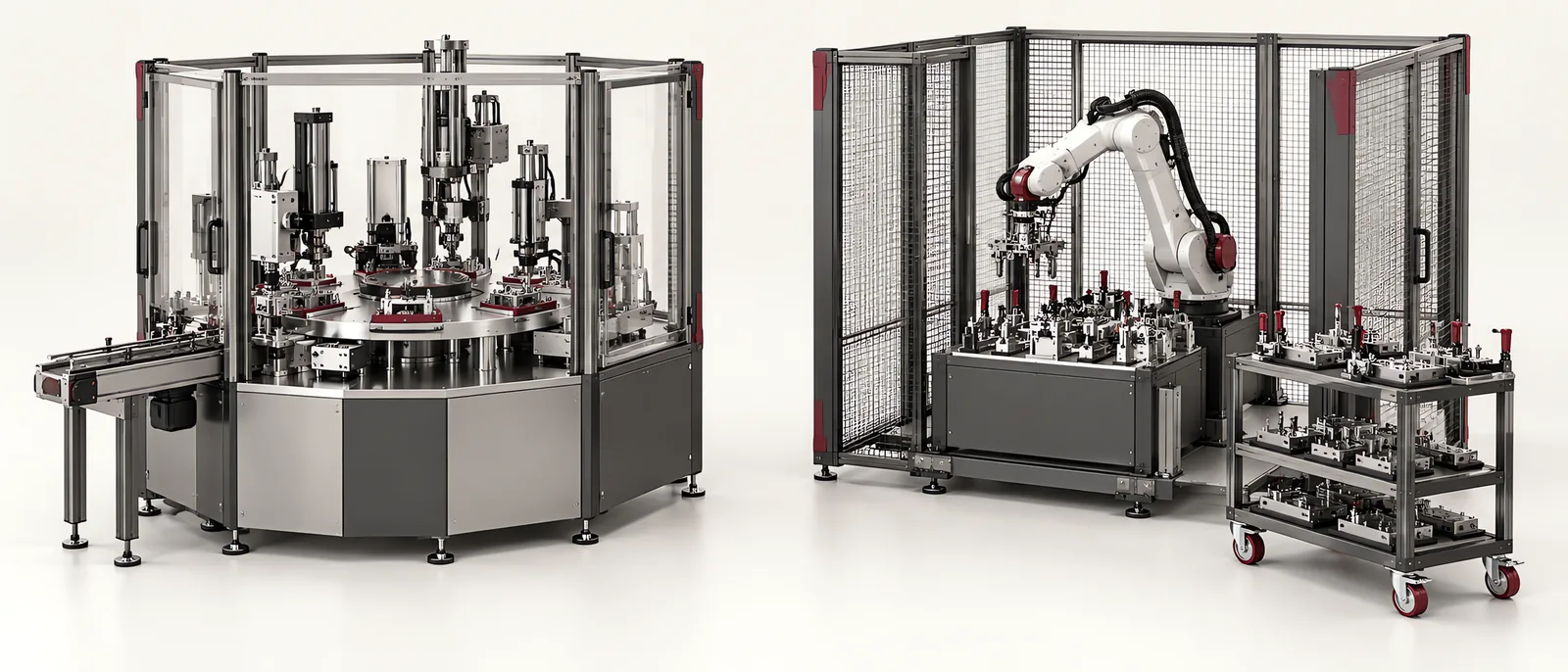
Conceptual equipment illustration.
Flexible vs fixed automation is a question of what the equipment must change, how often it must change and what that change costs in production time. Fixed automation dedicates a machine sequence and tooling to a defined task. Flexible automation provides planned ways to accommodate product or process variation.
The choice is rarely all-or-nothing. A line can use a dedicated joining station, interchangeable fixtures and programmable handling. Each part of the system can have a different degree of flexibility.
List the Changes That Matter
Product count is a weak starting point on its own. Ten products that share the same locating features may be easier to automate together than two products with different assembly directions.
For each expected change, record what moves physically and what changes in software:
- Product dimensions and locating surfaces.
- Components, feeders and gripping points.
- Operation sequence and processing time.
- Inspection method and acceptance limits.
- Required tooling, cleaning and first-piece checks.
Then separate routine production changes from possible future redesigns. Designing for a named next product is more concrete than asking a machine to handle any future product.
Compare Three Architectures
| Architecture | Where it can fit | What to verify |
|---|---|---|
| Dedicated fixed sequence | Stable product geometry and sustained demand | Capacity, fault recovery and the cost of later physical changes |
| Dedicated process with change parts | Product families share the main operations | Tooling replacement, locating repeatability and recipe control |
| Programmable or modular sequence | Routing, handling or product mix changes materially | Programming, validation and changeover work as well as equipment capability |
A rotary indexing assembly machine can include interchangeable nests and programmable process stations. Conversely, a robot cell can remain highly product-specific if its gripper, feeders and fixtures are dedicated.
Modular transport offers another design option. Bosch Rexroth’s TS 1 system combines transfer and positioning components around workpiece pallets. Whether such an arrangement improves a particular line depends on its actual station and routing requirements.
Count the Lost Production Time
Use the same demand and staffing assumptions for each proposal. Include normal cycling, planned changes, first-piece checks and recovery from common interruptions.
For a simple planning calculation:
Changeover time per week = number of changes × time from the last accepted old-format part to the first accepted new-format part.
If an illustrative schedule has 15 changes and each takes 20 minutes, it contains 300 minutes of changeover time. Before counting those five hours as recoverable production, separate tasks that overlap with planned downtime or remain necessary after an upgrade.
The changeover reduction guide helps break that time into preparation, physical adjustment and verification. A recipe change that takes seconds can still sit inside a much longer mechanical changeover.
Do Not Confuse Flexible With Standard
A custom machine can be designed for multiple products. Standard equipment can require significant dedicated tooling. The custom machine vs standard equipment comparison addresses the procurement choice; this page addresses the production architecture.
Compare proposals using a specific change scenario. Ask each supplier to show the removed tooling, new setup, software selection and verification sequence. Include where unused tooling is stored and how the wrong combination is detected.
Select Flexibility Where It Has a Job
Keep stable, demanding processes tightly controlled. Add flexibility where a known variation would otherwise create recurring downtime or a costly rebuild. Record the supported product range and the work required to add another product.
This produces a clearer specification for custom automation solutions than a general request for a future-proof line. Discuss your product mix with Motionwell.