
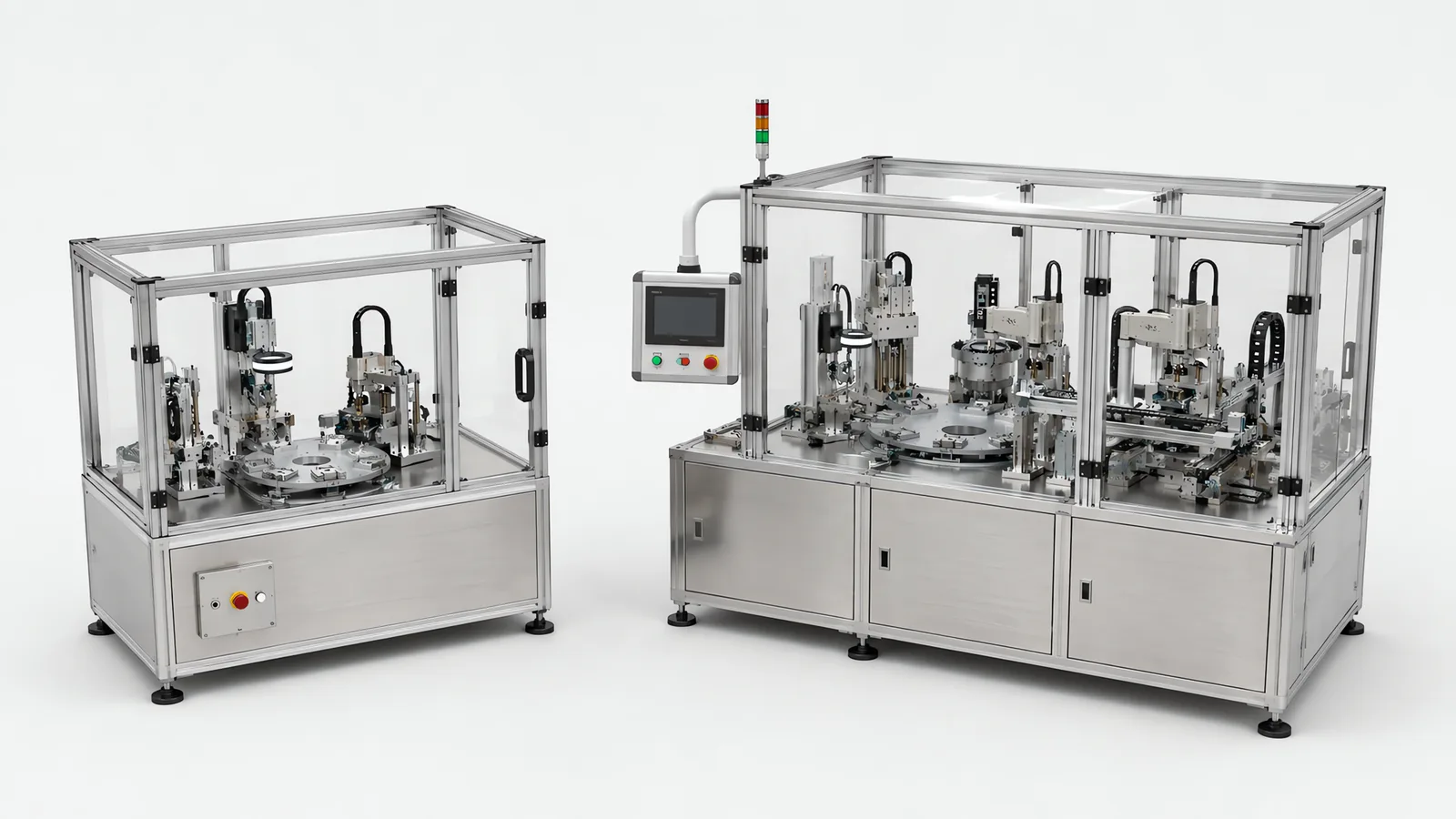
Motionwell Automation designs and builds custom automation solutions in Singapore, and the custom machine vs standard equipment question is the first one a buyer faces, usually before a layout exists or a price has been discussed. The answer is a standard machine often enough to be worth stating in the first paragraph: induction sealing, can seaming, stretch wrapping and high-speed rotary labelling are settled products made in quantity, so those get specified and integrated. What does get designed here is equipment nobody sells from a catalogue. A 5-axis CNC shot peening machine moving X, Y, Z, B and C simultaneously at 0.3 to 0.6 MPa for 100 to 200 per cent coverage on a turbine blade. A GMP filling and sealing platform with the capping torque curve logged for every container. Cleanroom automated test equipment running 4 to 6 stations under fan filter units that hold ISO Class 7/8. Machines are designed, assembled and tested at our Woodlands Link facility, and the company has delivered more than 150 special purpose machines since 2014 under ISO 9001:2015 and bizSAFE Level 3.
How a custom machine is then scoped, engineered and commissioned is a separate subject, set out in our special purpose machine design guide; this page stops at the decision. The same decision one level down, once a custom cell is agreed, is on the cobot and industrial robot comparison and the gantry and six-axis machine tending comparison.
What Actually Forces a Custom Build?
The following five conditions justify comparing custom engineering with available catalogue equipment. For each one, establish whether a standard machine, a configurable option or a small integration package already meets the requirement. A custom build becomes the stronger option when the complete alternative cannot meet the duty or costs more over the planned operating life.
Product geometry outside any standard envelope. Turbine blades are the clearest case we have delivered: the comb-shaped rack fixture on the shot peening machine is cut to the blade profile and loads from both sides, holding each blade clear of its neighbours, because a blade does not sit in a tray and no standard carrier presents it to a nozzle. Packaging carries the same constraint more quietly. On a rotary machine the star wheel, container guides and capping chuck geometry are tied to one container envelope, so a container outside it is a change part set, and a container outside every available envelope is a machine.
A process needing a purpose-built arrangement. On our turbine blade machine, five-axis nozzle control holds the programmed angle and standoff around the aerofoil, with G-code paths and collaborative-robot loading. Qualification separates Almen-strip intensity verification from coverage inspection on the component, as explained on the automated shot peening page. On the SCARA sensor panel line, vacuum handling supports the thin panel before vision-guided placement and torque-controlled fastening. In both cases, the part geometry and process determine the fixture and sequence.
A rate, or an envelope, that no catalogue unit hits in the space you have. This is the condition most often mistaken for the previous one, because the process is ordinary and only the constraint is not. Our own low-profile robot track exists for exactly that reason: a conventional seventh axis consumes 200 to 400 mm of vertical working height before the arm has done anything, and ours is 100 mm overall on adjustable feet with no floor pit, at plus or minus 0.5 mm repeat positioning. The inverse holds just as firmly, and it is stated on our robot seventh axis page: where a catalogue travel unit from your robot vendor covers the stroke, the payload and the height you have available, buy it.
Integration into a line you already run. A large share of end of line palletizing work is a retrofit, and the machine has to accept whatever the existing line hands it: conveyor height and case pitch as they are, a handshake with the upstream controller covering case ready, accumulation full, pallet in position, pallet complete and fault, and a reject that has somewhere to go. None of that is a catalogue specification, because it is a specification about your plant.
A record requirement, and not a process requirement. Where the line is regulated, the machine has to be provable as well as working. On the GMP filling and sealing platform the servo capping heads log the full torque curve for every container, and once that log is evidence that a cap was applied correctly it falls under 21 CFR Part 11, which decides where it is stored, who may alter it and what audit trail follows. A machine bought without that capability cannot be talked into it afterwards, which is why compliance is a common driver behind the control system retrofit work that is now our largest project line, as set out on our electronic batch record page.
What Does Standard Equipment Buy That a Custom Machine Cannot?
Four things, and a custom builder who will not name them is not worth trusting on the rest.
A part number on a shelf. A catalogue model has an installed base, so the manufacturer holds an assembly under an order code and can ship it. On a one-off machine there is no such code; the spares are the components inside it. That is workable, and it is why every delivery includes mechanical drawings, electrical schematics, PLC program documentation, operator training, maintenance schedules and spare parts lists. It is still a real difference, and the way to close it at purchase is to ask for the list and hold the items that matter locally.
A service network. On a standard machine somebody other than the builder can be called. On a custom machine the people who know it are the builder plus your own maintenance team, so the handover has to carry more. Our answer is proximity: design, fabrication, assembly and testing happen across five units at 20 Woodlands Link, which is why a Singapore buyer attends the factory acceptance test without flying to it. Proximity is not the same thing as a service network, and it is worth saying so.
A price you can compare. A catalogue machine has a list price against a model number, so two offers can be lined up item by item. A custom quotation follows a concept review, because a nominal machine of the same description moves a long way on decisions taken before hardware is ordered. A published number you can argue with is a genuine advantage of the standard route, and a custom builder who pretends otherwise is selling.
Somebody else’s debugging. Where a model has a long production history, failure modes surface across that installed base and a manufacturer that acts on them folds the fixes into later builds. On a one-off machine the first hundred hours of running is the first hundred hours anyone has run it. That is what factory acceptance testing is for, and why the test happens at our facility with the customer present before the machine ships.
| What you are buying | Catalogue machine | Custom machine |
|---|---|---|
| Spares | An assembly with its own order code | The components inside it, listed in the handover pack |
| Who can service it | The manufacturer, their agent, and often a third party | The builder and your own maintenance team |
| Price discovery | A list price against a model number | A quotation after concept review |
| Failure modes | Found by the installed base before you | Found at factory acceptance testing and early production |
| Fit to your process | What the model does, and what it does not | Designed against the process sheet |
| Documentation | The manual for the model | Drawings, schematics, program documentation, maintenance and spares list for your machine |
Where Do We Say the Standard Machine Is the Right Answer?
Regularly, and the list is specific, because processes that are settled commodities do not get designed twice.
| Where the standard unit wins | What we do instead |
|---|---|
| Induction sealing heads | Integrate a proven unit; the result is decided by the cap, the liner and the application torque |
| Can seaming | Integrate a proven seamer, because seaming a can lid is a specialised machine |
| Stretch wrappers, shrink tunnels, carton erectors, case sealers | Integrate proven standard machines |
| High-speed rotary roll-fed labelling, shrink sleeve with steam tunnel | Select a standard machine for the container, output rate, label or sleeve material and available services |
| Electric rod actuators, catalogue linear stages, screw jacks, packaged lift columns | Specify one where it covers the stroke, load and duty, as on the servo lift and positioning page |
| Catalogue grippers | Specify a catalogue unit wherever the part fits its jaw travel and grip force, because a gripper machined here has no spares channel except us |
| Off-the-shelf gauges and sensors with their own bracket | Point you at the instrument |
| Robot arms, controllers, cameras, drives | Buy and integrate them; we manufacture none of these |
| A single benchtop instrument that is the bottleneck | Buy the instrument, as set out on the laboratory automation page |
| Conveying, drum motors, cable carrier | Catalogue components sized for the load and the duty, because these are wear items and the replacement has to be orderable without us |
Two of those rows carry the argument. An induction sealing head and a can seamer are settled products where the engineering that matters happens elsewhere in the pack, so designing one here would cost money and buy nothing. And where your closure, container or part runs at a rate a catalogue machine already covers at a lower price, the catalogue machine is the purchase, and the comparison belongs at concept review before anything is drawn. The same position on the packaging side, including which parts of a line we build and which we integrate, is on the case packing and wrapping page.
Is the Real Answer Standard Modules Inside a Custom Frame?
Often, yes, and reading the choice as pure custom against pure catalogue misdescribes what actually ships. A Motionwell machine combines bought components arranged and controlled in a way nobody sells: precision parts machined to our own drawings by qualified machining partners, standard components sourced from approved suppliers, assembled and integrated in our own facility.
| Layer of the machine | Where it comes from |
|---|---|
| Robot arm, controller, drives, cameras | Bought, and matched to the platform your plant already runs |
| Control platform | Bought, and chosen against your site standard, because the spares shelf and the programming skills already exist there |
| Pneumatics, vacuum, cable carrier, conveying | Bought as catalogue items, so a failed one is a distributor order, with no drawing and no machining lead time |
| Grippers where a catalogue unit fits the part | Bought, because a catalogue unit arrives with a published grip force, a mounting pattern and a spares path |
| End-of-arm tooling where no catalogue unit fits | Designed: the plate, the fingers, the cup layout, the compliance, the sensing |
| Part presentation, fixtures, frame, station sequence | Designed: this is the part that decides whether the cell makes rate |
| Safety architecture, guarding, interlocks | Designed against the risk assessment for your installation |
| Recipes, handshakes, data and records | Designed: shipped with the machine |
The consequence is that the components carry their own support and the arrangement carries ours, which is why we ask which control platform and which robot brand your maintenance team already stocks spares for before selecting anything. Where two platforms both clear payload, reach, speed, precision and safety mode, the existing plant standard wins on cost of ownership, because spares, training and support already exist.
There is a second hybrid that deserves a warning: buying a standard machine and modifying it. The engineering objections are in the special purpose machine design guide. The one that guide does not cover is regulatory. For machinery placed on the EU market, the European Commission states the Machinery Directive applies to products placed on the market for the first time, or when existing machinery is modified to such an extent that it becomes de facto new machinery. Cross that line and whoever did the modification is in the manufacturer’s position, with the conformity work that follows. Where the line sits is a judgement made per project, which is why it belongs in the kickoff meeting. Regulation (EU) 2023/1230 then applies to machines placed on that market from 20 January 2027 with no transitional period, so a machine being specified now for European sites should be documented against the edition that will be in force when it ships. How that scope is handled is on our machine safety and CE marking page. On a machine we build, we work to a specification and support the conformity work behind it, including LVD and CE testing and Ministry of Manpower lifting certification where the machine includes lifting equipment.
The separate flexible vs fixed automation comparison asks how products change on that equipment. Catalogue components can support either a dedicated sequence or a changeable one; buying standard modules does not, by itself, make the complete machine flexible.
How Do the Two Lead Times Actually Differ?
A custom build runs 16 to 24 weeks from concept approval to factory acceptance testing on a standard build, and 24 to 32 weeks where cleanroom compatibility or full GMP validation applies. The clock starts at concept approval, and how that time is spent is broken down by machine complexity in the design guide.
A catalogue machine quotes a delivery date, and it is normally shorter. The comparison run against it is the wrong one, because a delivery date is not the date you make sellable parts. On the standard route the work after arrival is integration into your line, and none of it is on the distributor’s schedule: conveyor heights that have to match, a handshake with the existing controller that somebody has to own, guarding of the combined installation, and whatever the part presentation turns out to need. Compare first-good-part to first-good-part and the gap narrows, sometimes to nothing.
The schedule risks are also different in kind, which matters more than the weeks. On a custom build the recurring one is late finalisation of the product design, because a geometry change after detail engineering has started changes the machine, which is why the product design is frozen before that phase begins. On a standard machine the equivalent risk arrives after delivery: the unit does not accept your container or your part as it stands, and the modification that follows is a project with its own schedule, its own cost and, on a validated line, its own change control.
What Does the Comparison Look Like Over a Decade, Not at Purchase?
An automation system operates for 10 to 15 years, so the purchase price is one input among many. The worked payback model on our warehouse automation ROI page puts a number on that: halving the equipment price improved payback by eight months, while failing to convert the assumed headcount reduction into a payroll change cost twenty-eight. The equipment quotation is the line everyone negotiates and, in that model, one of the least sensitive inputs in it. Run the same sensitivity on your own case before letting a price difference settle the decision.
What belongs in the ten-year picture is the set of costs that arrive after the invoice, and they arrive on both options.
| Cost line over the life | On a catalogue machine | On a custom machine |
|---|---|---|
| Consumables | The manufacturer’s list, if one is published | Named at concept stage: on our cleanroom test equipment the engineering-plastic nests are consumables with a defined replacement interval |
| Recalibration routine | The model’s procedure | Defined per station: the collaborative loading on that same equipment is calibrated against a reference pin at the start of every batch |
| Spares holding | An assembly under an order code | Components you choose to hold; the handover pack lists them |
| Support response | The manufacturer’s or agent’s terms | The builder’s terms; ours are a Singapore-based team with local spares for specified components |
| Format and product changes | A change part set if the model offers one, otherwise a limit | A change part set, or a recipe where the axes were motorised for it |
| Controls life | Set by the manufacturer’s support for that model | Set by the platform chosen at design stage |
Two items on that table are ones often left out of a quotation. A specification that lists no consumables has moved a running cost off the capital sheet without removing it, so ask any supplier for the consumable list, the replacement interval for each item, the re-verification routine an operator runs on shift, and which spares to hold in Singapore. And ask for the support terms in writing: a benchmark worth holding both routes to is critical spares stocked locally or available within 3 to 5 business days, with engineers who can respond within 24 to 48 hours, which is the standard our integrator evaluation guide sets for any vendor, including us.
Which Side Carries More Obsolescence Risk?
Both carry it, in different places, and neither route escapes it.
On a standard machine the risk sits in the model. When the manufacturer discontinues it, spares thin out on someone else’s schedule and the timing stops being yours. The end of that cycle is visible in our order book: control system retrofit is the largest project line we run in 2026, replacing obsolete PLCs, servo drives and VFDs on legacy machines, mostly onto current-generation controllers, drives and VFDs that are still inside their vendor’s support window, which buys back the spares horizon. A large share of that work has a compliance driver, because the mechanics are still sound and the controller cannot hold a user account.
On a custom machine there is no model to discontinue, so the risk moves to the components and the paperwork. The mitigation is a decision taken years before the problem: build the controls on the platform your plant already standardises on, so the clock you are exposed to is the one your maintenance team already tracks. Where a PC sits in the loop, the point on our smart camera and PC vision comparison applies to either route: the hardware and the operating system age on separate clocks, and the end-of-support date is worth having in writing.
There is a third clock that catches both routes, and it runs on documents. ISO 13849-1:2023 is the edition ISO 10218-1:2025 references for robot control system safety functions, so a design still documented against the 2015 edition will need its performance level calculations restated when the machine is re-assessed. Nothing on the machine changed. What changed is what the file has to say.
When Should You Not Go Custom?
Eight situations point away from a custom build, and each is worth testing before a concept is commissioned.
A standard machine already covers your part at your rate. The clearest disqualifier, and the one to test first. Where a proven catalogue machine does your job at a lower price, that is the purchase, and establishing it costs one conversation.
Volume is low and the format never changes. A semi-automatic filling machine of the tabletop or pneumatic type, bought from a local distributor, costs a fraction of a custom line and works fine when volumes are low, the format never changes and an operator loads each container by hand. The filling machines page sets out where those economics flip.
One bench is the bottleneck. If a single station is the constraint, buy the instrument for that station. A lab-wide transport, scheduling and traceability system is an engineering project, and it is the wrong purchase when one machine is the problem.
The process is a settled commodity. Induction sealing heads are the example we use on ourselves. Where the result is decided by consumables and a process parameter, a bespoke design buys you a longer lead time and no better seal.
The product design is not frozen. A geometry change after detail engineering begins changes the machine, so a product still moving is a reason to wait. Buy a flexible standard unit for the interim if you need capacity now.
You need it next month. Sixteen weeks is the short end of a custom build, so a delivery date inside that window is a requirement for something you can buy. Compressing a custom schedule to meet it produces a machine debugged in production.
Nobody will own the machine after handover. A custom machine assumes a maintenance team that reads schematics and holds spares. Where a site has no such team and no plan to build one, the supported catalogue product is the safer choice regardless of fit.
You are buying flexibility you will not use. A machine designed for six formats when one will ever run costs more to build, more to change over and more to validate. Specify the range you have plus the one genuinely on the roadmap, and no more. The same discipline applies at component level: where a catalogue travel unit, actuator or gripper clears the stroke, payload, height and duty, buying it beats designing around it, and it arrives with stocked spares.
Which Questions Settle It for Your Line?
Run these in order. The first that gives a hard answer usually settles it, and if two disagree, price standard modules inside a custom frame against both.
- Is there a product that does this at all? Not one that could be adapted. One that does your process, on your part, at your rate. If yes, price it before anything else.
- What is the sustained rate, and in what footprint? Rate on its own rarely forces a custom build. Rate inside a fixed height, floor area or aisle frequently does.
- Does the part fit any standard envelope? Check the carrier, the nest and the fixture first. Geometry is the condition that cannot be negotiated later.
- Does it have to join a line you already run? If it does, list the existing conveyor height, the controller, the handshake signals and where a reject goes, because that list is the specification.
- Does every unit have to be provable afterwards? A record requirement is architecture, and it cannot be added to a machine that was not built for it.
- Is the product design frozen? If not, the working sequence is to freeze it, or to buy something standard for the interim.
- Who maintains it in year seven? Name the team, the platform they already stock spares for, and the response time you need. That answer often decides the control system before the mechanism is drawn.
| Your situation | Start from | Why |
|---|---|---|
| A catalogue machine does your process at your rate | The catalogue machine | Spares, service, a published price and somebody else’s debugging |
| Low volume, one format, an operator loads by hand | A semi-automatic unit from a distributor | The custom economics have not flipped yet |
| Ordinary process, but it has to fit a height or footprint nothing clears | Custom, or a custom carrier around a standard unit | Envelope is structural |
| The part fits no standard carrier, nest or star wheel | Custom | The envelope is designed in |
| Sequence exists in your process sheet and in no brochure | Custom | There is no installed base to buy from |
| Retrofit into a running line with existing controls | Custom station around standard modules | The interface is the project |
| Regulated line where every unit must be provable | Custom, with the record architecture set at concept | Logging depth and access control cannot be retrofitted cheaply |
| Settled commodity process inside a bespoke line | A proven standard unit, integrated | Nothing left for a custom design to improve |
| Product design still moving | Wait, or buy standard for the interim | A geometry change after detail engineering changes the machine |
Standards Used in Machine Design and Validation
These references inform the design, testing and documentation described on this page. Each row links to its primary source and records the edition checked.
| Standard | Current edition | What it means for your machine |
|---|---|---|
| Modified machinery as new machinery: Machinery Directive 2006/42/EC scope rule | Directive 2006/42/EC (applies until 19 January 2027) | For EU-market retrofits, review the proposed changes to function, performance and safety to establish whether the modified equipment is treated as new machinery. Record that assessment during scope definition and assign responsibility for the risk assessment, technical file and conformity documentation.Checked 1 Sep 2026 against European Commission, Machinery page (single-market-economy.ec.europa.eu/sectors/mechanical-engineering/machinery_en) |
| Regulation (EU) 2023/1230: the EU Machinery Regulation | (EU) 2023/1230 (changeover pending) | Applies on a mandatory basis from 20 January 2027, replacing Machinery Directive 2006/42/EC. Project planning should align the intended EU market date with the conformity assessment and technical documentation, including relevant software integrity and connected-function requirements. The European Commission permits voluntary declarations against the Regulation before that date, while the Directive remains applicable.Checked 1 Sep 2026 against European Commission, Machinery page (single-market-economy.ec.europa.eu/sectors/mechanical-engineering/machinery_en); EU-OSHA legislation register |
Frequently Asked Questions
When is a custom machine genuinely cheaper than standard equipment?
Compare total installed and operating cost against the same requirements. A custom machine can earn its cost where standard equipment needs extensive handling changes, several separate stations or recurring manual work to meet your rate and quality targets. Throughput, format range, validation and automatic rejection are comparison inputs, not universal cut-offs. Include tooling, integration, qualification, maintenance and changeover in both quotations.
What do I give up by going custom?
Four things, and they are worth naming before you sign. A part number on a shelf, because spares on a one-off machine are the components inside it, and never an assembly with its own order code. A service network, because only the builder and your own team know the machine. A published price you can line up against a competitor's. And an installed base that has already found the failure modes, which on a one-off machine are found during factory acceptance testing and the first weeks of production instead. Ask any builder, including us, how each of those four is covered.
Can we buy a standard machine now and modify it later?
Sometimes, but the limit is regulatory, and it is the reason this route is cheaper at purchase than over the life of the machine. Modify a standard machine far enough and, on the EU market, you are the manufacturer of a new machine and carry the conformity work. On a validated line the same modification is also a change control with its own requalification. Both costs land on you later, and neither appears in the quotation you are comparing today.