
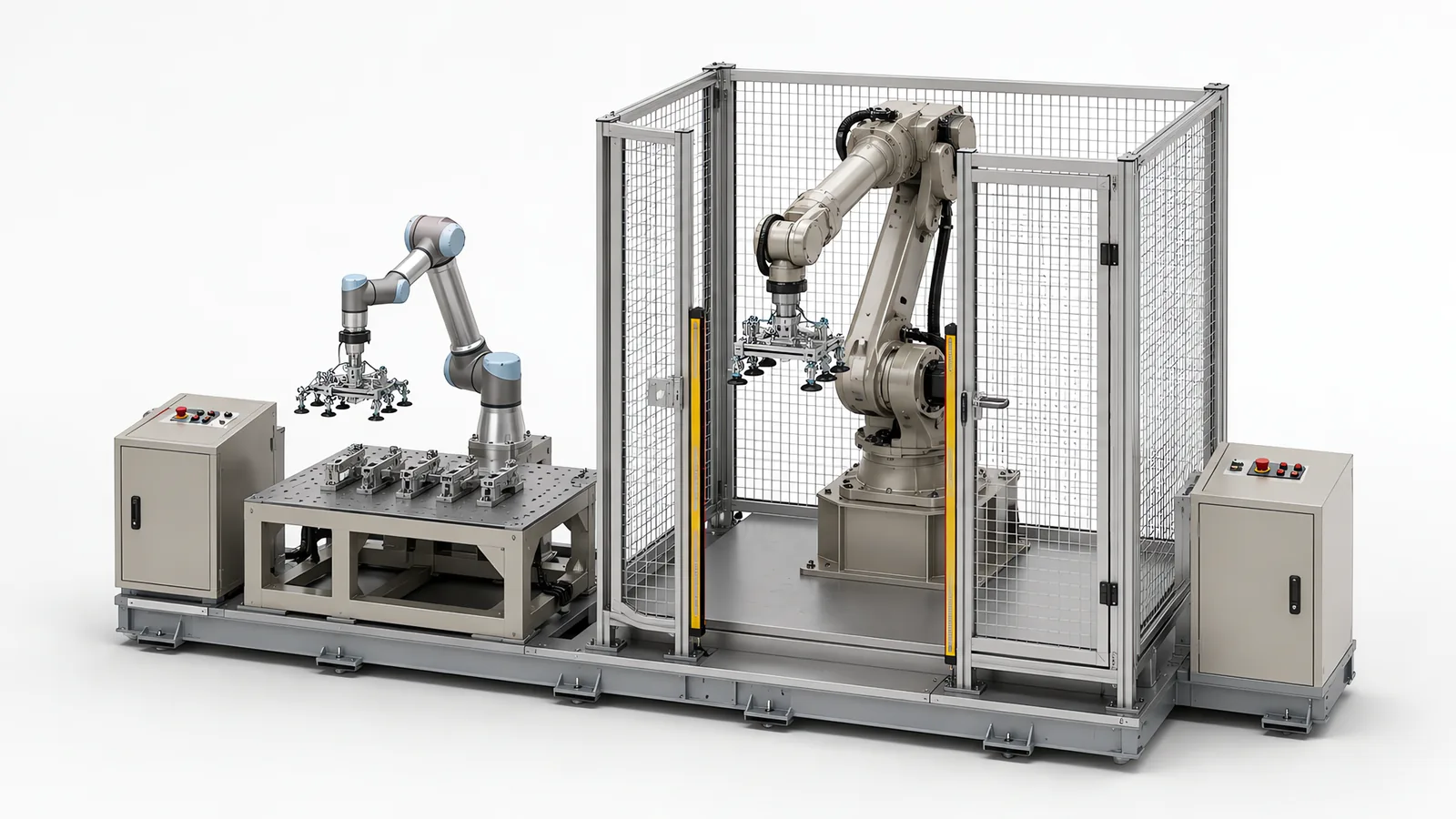
Motionwell Automation builds both kinds of robot cell in Singapore, and the cobot vs industrial robot question usually arrives before a layout has been drawn. Both classes are in regular production use here, and the reason for keeping both available is that the arm is the part of a cell least likely to decide the outcome: the tooling, the part presentation and the safeguarding are where the rate and the risk actually come from. The headline is this: the decision is made by rate, payload, reach, duty cycle and how often a person is genuinely inside the space, and never by which technology sounds more modern. Machines are designed, assembled and tested at our Woodlands Link facility, and the company has delivered more than 150 special purpose machines since 2014 under ISO 9001:2015 and bizSAFE Level 3.
What we design is everything between the arm and your product: the tooling, the frame, the feeding and presentation, the safeguarding, the control system and the recovery logic. The arm is bought, which is why the comparison below turns on rate, payload, reach and duty cycle.
The end-of-line version of the same argument is on our automated palletizing systems page, the reasoning behind a collaborative application is in our guide to collaborative robot safety standards, and the guarding work that follows either choice is on the machine safety and CE marking page.
If the mechanical arrangement is still open, compare industrial robot types and workspace shapes first. SCARA, delta, Cartesian and articulated mechanisms solve different reach and orientation tasks; the collaboration decision then determines how people interact with the selected system.
What Is a Collaborative Robot, and How Does It Differ From an Industrial Arm?
Cobot is a contraction of collaborative robot, and the two words name the same machine. A collaborative robot is an industrial robot arm that carries safety-rated functions in the arm itself, sold and certified to work in a shared space with people.
The difference in the arm is smaller than the marketing suggests, and the difference in everything around it is larger. Set out as collaborative vs industrial robot, both are articulated machines with servo joints, an encoder per axis and a controller. The difference is that a collaborative arm carries safety-rated functions intended for working close to people as standard, while an industrial arm is specified for a guarded cell unless safety-rated speed, standstill and axis limiting are added on its controller.
| Selection factor | Collaborative arm | Industrial arm |
|---|---|---|
| Operating speed | Set by the selected mode; contact-based PFL can impose a substantial reduction | Set by the robot, process and safeguarding arrangement |
| Payload | Check the selected model’s load curve with tool mass and centre of gravity | Check the same load conditions; heavy-duty models extend the available range |
| Reach | Size from the furthest pick and place, including wrist orientation | The same layout check applies; long-reach and application-specific models provide more options |
| Repeatability | Compare the model specification, then verify at the part interface | Compare under the same load, pose and test conditions |
| Duty cycle | Verify continuous operation, temperature limits and maintenance for the chosen model | Verify the same conditions against the production cycle |
| Guarding | Possibly none, decided by the risk assessment | Fence, interlocked doors, scanners or light curtains |
| Footprint | May allow a compact shared station; tooling hazards can still require separation | Include guarded working space and operator or material access |
| Redeployment | Portable mounting and simple tooling can ease relocation; reassess the new application | Installation and tooling changes determine relocation effort |
| Installed cost | Include the arm, tooling, safeguarding, integration and validation | Compare the same complete scope and sustained rate |
Payload and reach belong to a specific model, not a fixed boundary between robot classes. Compare the load curve at the working pose and leave capacity for the tooling and expected variants. Verify placement at the finished assembly: robot repeatability alone does not include gripper slip, part tolerance, fixture wear or thermal drift.
The last row is easy to misread. On the class comparison published on our SCARA robot selection guide, a six-axis industrial arm is the highest relative cost at equal payload and a collaborative arm sits one class below it. That is an ordinal ranking: it tells you which class is dearer at equal payload, and it says nothing at all about the cell built around the arm. The cost list in that same guide is the more useful part of it: end-of-arm tooling, part feeding, vision, fixturing and safeguarding, none of which changes because the arm has a force limit. Compare the cells before you compare the arms.
One more difference no datasheet states. Rated payload is measured at the tool flange and assumes the load sits close to it, so the tooling comes out of the budget left for the part, and at reach the moment is what limits the arm. Read the payload-versus-centre-of-gravity chart before choosing a model.
What Are the Integrated Safety Features of a Collaborative Robot?
Four sit in the arm as it is sold and certified: safety-rated monitored speed, monitored position, monitored force or torque, and a stop architecture that is safety-rated. Each is a safety function in its own right, so each carries a performance level under ISO 13849-1 and is documented with that rating. Power and force limiting is the feature usually meant by the question, and the one that caps your cycle time. Hand guiding is the other arm-side feature: motion commanded through a guiding device with an enabling switch and a safety-rated speed limit, which suits teaching and setup.
Two things people expect in the arm are not there. Presence sensing is cell equipment: speed and separation monitoring needs scanners, zoning and a measured stopping distance, none of which arrives with the robot. And the arm’s rated figures are established bare, before your gripper and your part are on the flange, so the contact limits that decide the safety case are measured on the built cell. What each mode permits and costs is on our collaborative robot applications page.
How Much Throughput Does a Force Limit Actually Cost You?
This is the arithmetic that decides most of these projects, and it is usually done too late. A collaborative arm run as a power-and-force-limited application has its speed capped so any contact stays within the contact limits. That cap is the technology working as intended, and it is also the rate ceiling. You do not get around it by buying a faster collaborative arm.
Put numbers on the other end of the range. On the palletizing work we have delivered, a four-axis column platform runs at continuous duty behind a fence with no contact limit capping its speed, and where a line needs more than 12 cartons per minute that duty belongs to a dedicated articulated palletizing platform. A cobot palletizer is the right choice when your case rate sits in the low single digits per minute. Those are not adjacent numbers, and the gap is a multiple, which is why this decision cannot be deferred until after the layout is drawn. Take your own anchor from the arm you are actually considering and ask for sustained cycles per hour at your case weight and your pick and place heights, sustained, because peak is quoted on a short stroke with a light dummy load and neither of those is your line.
Now the part that gets missed: floor area belongs inside the comparison. A fenced cell needs the cell area plus safe operator and forklift access, which is genuinely more square metres than an arm standing beside a conveyor. But throughput per square metre is a ratio, and the fenced cell can be several times larger in the numerator. Work it out on your own layout: sustained parts per hour on top, and underneath the whole floor area the option occupies including access and aisle. A cell that takes more floor and produces far more per hour can still win in a plant paying Singapore rent, and it cannot win at all in a plant with no aisle to spare, because it does not fit.
One caution on the numerator. A datasheet cycle time is measured gate to gate with a dummy load and nothing else happening. Your real cycle adds vision acquisition and processing, settling before the vacuum releases, gripper actuation, the PLC handshake and any wait on a conveyor. Those additions usually decide whether a station makes rate, which is why we time them on the actual parts before quoting either class.
Is the Fence Cheaper Than the Speed You Give Up?
Often, and it is worth seeing why the two costs are not the same shape.
Guarding is a one-time bill of materials plus engineering: fence panels and posts, an interlocked access door, safety laser scanners or light curtains, the safety circuit, the stopping distance measurement and the validation evidence. It is bought once. Lost throughput is recurring. It lands on every shift for the life of the machine, and if the line is capacity-constrained it does not appear as a cost at all, it appears as revenue you never booked.
The same nominal cell moves a long way on decisions taken before hardware is ordered, so the useful comparison is where the two bills separate.
| Line item | Collaborative cell | Fenced industrial cell |
|---|---|---|
| The arm | High relative cost at equal payload | Highest relative cost at equal payload |
| Perimeter guarding | Possibly none, decided by the risk assessment | Fence, posts, interlocked doors, scanners or light curtains |
| Safety engineering | Contact assessment against the real tooling and workpiece, measured force and pressure readings, validation records | Risk assessment, performance level architecture, measured stopping distance, validation records |
| End-of-arm tooling | Rounded edges, limited protrusions, controlled pinch points, compliant features where suitable | Sized for payload and cycle, without a contact constraint on its geometry |
| Floor area | Working envelope plus the space a person occupies beside it | Cell area plus safe operator and forklift access |
| Feeding, presentation and controls | The same problem either way, and engineered against the part | As on the left |
Read that table and the conclusion is uncomfortable for both camps. Only the bottom row is genuinely identical: feeding, presentation and controls cost what they cost, and none of it gets cheaper because the arm has a force limit. Two rows differ in kind, since both cells need an arm and both need safety engineering, but neither the work nor the price is the same work and price. The three rows that actually decide the comparison are perimeter guarding, tooling geometry and floor area. That is why we quote after a layout review.
Where the fence stops being the cheaper answer is equally clear. If demand is genuinely below what a force-limited arm delivers, the extra speed buys nothing, and paying for guarding to get throughput you will never sell is the same error in the other direction.
When Is a Cobot Genuinely the Right Answer?
Six situations where a collaborative arm earns its place, four of them carrying delivered work behind them and two of them selection rules we apply before a layout exists.
Low volume with high mix. When changeover cost dominates cycle time, a reprogrammable loading device beats a faster one. On our cleanroom automated test equipment build, a dedicated gantry would have been faster per cycle, but with mixed connector types and modest volume per variant the loading device had to be reprogrammable. The collaborative arm holds ±0.05 mm repeatability at the test fixture interface, calibrated against a reference pin at the start of every batch. What was given up, stated plainly in that project’s own record, is peak throughput on any single high-volume part number, and the build is in the cleanroom ATE case study.
Shared space that cannot be divided. In the QA lab automation programme, re-ordered in four consecutive years by a global medical device manufacturer, technicians work in the same room while a compound AMR and collaborative arm move samples between racks and instruments. Fencing the automated stations would have been simpler to justify in the risk assessment, and would have cut the lab in two. Station-level safeguarding was used instead.
Frequent human intervention. If a person enters twice a shift to reload a tray, a safety-rated monitored stop is simpler, cheaper and faster than tuning force limits. If the operator works next to the robot all shift, power and force limiting is the only mode that will not destroy the cycle time. Which of those applies is a question about your process.
Floor space that cannot take a fence. Where floor area is the binding constraint we mount collaborative arms overhead for pick-and-place and capping, which frees the entire floor for conveyors and operator access while keeping full reach. It costs easy maintenance access, and the mount has to be declared to the controller so gravity compensation works the right way round, so it is a trade.
Short redeployment cycles. A collaborative arm moves to another line and is re-taught in a shift; a fenced cell is a fixed installation. If your plan genuinely moves work between lines, that flexibility is worth real money, and it appears nowhere on a datasheet.
Modest payloads with awkward variety. The cobot unloading station built for a consumer goods distribution centre handles mixed SKUs across beverages, snacks and detergent with a five-magnet electromagnet quick-change end-of-arm tool that switches between gripper and vacuum modes on its own, and X and Y pitch adjustment on stepper motors so one tool covers several pack sizes. The variety is what that cell was designed against. More on the FMCG and co-packing automation page.
When Should You Not Choose a Cobot?
This is the section that decides whether the rest of the page is worth trusting. Cobots are oversold, and these are the situations where a guarded industrial arm is the better engineering answer.
The hazard is the payload. A force limit is irrelevant if the part is a sharpened blade, a hot moulding or a live battery module. On our EV battery dismantlement line the workpiece is energised and cannot be switched off: modules weigh 30 to 80 kg, the pack carries 400 V and above, and the fastener removal, busbar disconnection and module extraction run on heavy six-axis arms inside fenced stations, rated well above the module weight because the tool, the reach at full extension and the moment of a module held out at arm’s length all come out of the same payload budget. Collaborative rules were deliberately not used to justify an open cell there, and the reasoning is in the battery dismantling case study.
The tooling cannot be made safe. Long, thin or pointed end-effectors concentrate force, and some geometries cannot pass a transient contact assessment at all. That constraint usually arrives after the arm is bought, which is why the assessment belongs in concept review: redesigning a gripper after commissioning costs several times more than addressing it during concept design.
Robot motion limits the cycle. Compare the complete operation at the permitted speeds, including vision, gripping and settling. An industrial arm may reach the target rate with less capital or fewer parallel stations. If an instrument or process dwell sets the rate, faster arm motion may bring little benefit.
Production runs without shared access. A cell that only needs entry for loading, recovery and maintenance may suit interlocked guarding and monitored stops. Continuous power and force limiting may add little during unattended production, while access protection and safe restart remain part of the design.
The payload or the reach is out of band. A part plus tooling that only just fits inside the rated payload does not fit, because part weights drift and someone adds a heavier variant next year. Reach fails the same way: an arm at floor level cannot place the top layer of a full pallet, and the usual fix is a lift column or a linear seventh axis, which is added cost and added footprint. Once you are paying for a column, a pedestal and a fence anyway, compare that total against a purpose-built industrial palletizer first.
The duty cycle is continuous. Compare the selected models’ operating limits, thermal performance, lubrication intervals and service requirements against the full shift pattern. Run the proposed cycle long enough to assess temperature and sustained rate. Shift count alone does not decide the robot class.
The environment is harsh. Washdown, dust, chemical splash and temperature have to be checked against the arm’s own ingress rating, and there is a second-order trap: a protective jacket or cover changes the contact geometry the collaborative assessment was based on. A cover is not a neutral accessory on a force-limited arm. It is a change to the safety case.
Can an Industrial Arm Be Made Safe Instead of Replaced?
Yes, and it is the option often missing from a comparison framed as two choices. Safety functions on the robot controller can limit an industrial arm’s speed, standstill and permitted axis range in a safety-rated way, which changes what safeguarding the cell needs without changing the arm.
A robot controller can provide safety-rated speed, standstill and axis-range functions while a separate safety PLC coordinates access doors, scanners and the cell stop request. For each function, document the full input-to-output chain, diagnostic coverage and reliability evidence needed for the required performance level. Measure stopping behaviour with the installed payload and relevant poses; those results set the protective distances and restart conditions.
| Safeguarding route | What limits the robot | What you have to prove | Where it fits |
|---|---|---|---|
| Power and force limiting | Contact energy, so speed is capped by the limits | Measured force and pressure at representative contact points, against the real tooling and workpiece | Close, frequent interaction all shift |
| Speed and separation monitoring | Measured distance to a person, dynamically | Scanner zone verification, and a separation distance calculated from approach speed, robot speed, measured stopping distance and sensor uncertainty | Shared area with predictable traffic |
| Safety-rated monitored stop | The robot stops when someone enters | Stop function performance level and reliable restart logic | Occasional intervention, machine tending |
| Safe speed and axis limiting on an industrial arm | Safety-rated speed, standstill and axis range in the controller | Dual-channel monitoring, stop category and time, performance level for each function | An industrial arm that must slow or restrict itself near people or fixtures |
| Fixed guarding at full speed | Nothing, the arm runs at programmed speed | Guard integrity, interlock performance level, access and recovery procedure | Sustained rate with no routine human entry |
The fourth row is the one worth adding to your shortlist. It lets an arm sized for the payload and the rate run at full speed when the cell is closed, then drop to a safety-rated speed or a restricted envelope when a person needs access. It is not a licence to remove the fence. It changes how much guarding the assessment demands, and where the access points can be.
Is the Hybrid Cell the Right Answer?
On a line running mixed volumes it often is. It belongs on the shortlist beside the two pure options, and it is a design in its own right, never a compromise between them.
The shape is a fenced industrial arm doing the work that needs rate, payload or reach, with collaborative loading stations at the boundary where people hand parts in and take finished work out. The person never enters the fast envelope, and the robot never runs slowly to protect somebody who is not standing next to it. The interface is a buffer, a rack or an indexing table, and the safety case is drawn around that interface.
The battery line is that shape without the label: fenced robot stations do the disassembly, and the risk assessment deliberately separated them from the manual loading area at the head of the line. The palletizing cell follows the same logic differently, guarded to ISO 13849 Performance Level d with safety light curtains at the pallet removal openings, because a guard that has to be opened every time a full pallet leaves stops being a guard, so the forklift driver interacts with the pallet position and never with the arm.
Two conditions have to hold for a hybrid to be worth its extra interface. The manual and automatic work must be genuinely separable, which is a process question. And somebody has to own the handshake between the zones: part present, zone clear, station ready, fault. Every interface is a place where two suppliers each assumed the other owned it.
Which Standards Decide the Guarding Scope?
The assessment decides the design. Start from ISO 12100 risk assessment, which identifies the hazards and sets what has to be reduced. The robot and the integrated system are then covered by ISO 10218-1:2025 and ISO 10218-2, with each safety function rated for performance level under ISO 13849-1:2023.
Two editions matter this year. ISO 10218-1 was published in February 2025 as the third edition and the first substantive revision since 2011, adding robot classifications with matching functional safety requirements, safety-related cybersecurity requirements and end-effector guidance. Most of what ISO/TS 15066:2016 said about collaborative operation has moved into Part 2, and no longer sits in a separate technical specification, so if you are writing a specification or a safety file now, check which document your contract names. ISO 13849-1:2023 is the edition ISO 10218-1:2025 references for robot control system safety functions, so a design documented against the 2015 edition will need its performance level calculations restated when the machine is re-assessed.
Singapore does not require CE marking, but the Workplace Safety and Health Act requires dangerous parts of machinery to be securely fenced and places duties on the occupier and on anyone supplying machinery for use at work. Most multinational manufacturers here specify CE conformity as an internal standard anyway. Motionwell delivers the physical scope that follows either choice: guard fencing and interlocked access doors, safety laser scanners, safety-rated stop circuits, LVD and CE testing, and Ministry of Manpower lifting certification where the machine includes lifting equipment.
Which One Should You Specify for Your Application?
Run these seven questions in order. The first that gives a hard answer usually settles it, and where two disagree the answer is the hybrid cell above.
- What is your sustained rate? The number the line has to hold across a shift. If it needs full robot speed, the guarding decision is already made.
- What is the true payload? Heaviest part plus tooling and cabling, checked against the payload curve at your real centre of gravity and reach. If it only just fits, it does not fit.
- What reach does the layout demand? Furthest pick to furthest place, measured on the drawing including the top of a full stack.
- How many shifts, and how many gaps? Check the chosen model’s operating limits and maintenance plan, then prove sustained rate and thermal behaviour on the proposed cycle.
- How often is a person inside the space, and what for? Twice a shift to reload is a monitored stop. All shift, elbow to elbow, is power and force limiting. Never is a fence.
- Where does the hazard sit? Tool and workpiece hazards may rule out contact-based operation. Assess protective separation, monitored stops and physical guarding for the actual access task.
- How often does the work move? Frequent redeployment between lines is the one advantage a collaborative arm holds that no fenced cell matches.
| Your situation | Start from | Why |
|---|---|---|
| Low volume, many variants, changeover dominates | Collaborative arm | Reprogrammable beats quick when the mix changes more often than the parts |
| Sustained double-digit rate on one part number | Fenced industrial arm | The force limit is the rate ceiling, and you are not using the flexibility |
| Operator works beside the machine all shift | Collaborative arm, power and force limiting | The only mode that survives continuous human presence |
| Heavy parts, long reach, full pallet height | Industrial arm | Payload and reach are out of the collaborative band before safety is discussed |
| Energised, sharp, hot or otherwise hazardous workpiece | Fenced industrial arm | The hazard is the part, so limiting the arm changes nothing |
| Three shifts, unattended running | Industrial arm | Duty cycle, and no person to protect |
| No aisle to spare on an existing line | Collaborative arm, possibly overhead mounted | The fence costs floor area the plant does not have |
| Manual and automatic work genuinely separable | Fenced industrial arm with collaborative loading stations | Rate where it is needed, access where it is needed |
Where the answer comes out mixed, that is not a failure of the checklist. It usually means the cell has two zones in it, and the design question moves to where the boundary sits and who owns the handshake across it.
Standards Used in Machine Design and Validation
These references inform the design, testing and documentation described on this page. Each row links to its primary source and records the edition checked.
| Standard | Current edition | What it means for your machine |
|---|---|---|
| ISO 10218-1: Robotics, safety requirements, Part 1: industrial robots | ISO 10218-1:2025 | Published February 2025, the third edition and the first substantive revision since 2011. It adds robot classifications with matching functional safety requirements and safety-related cybersecurity requirements. Most of ISO/TS 15066:2016 on collaborative operation moved into Part 2.Checked 12 Sep 2026 against ISO 10218-1:2025 (iso.org/standard/73933.html) |
| ISO 13849-1: Safety of machinery, safety-related parts of control systems | ISO 13849-1:2023 | Provides the design method for safety-related control functions, including architecture, component reliability, diagnostic coverage and common-cause failure measures. The machine risk assessment establishes the required Performance Level; design calculations and validation provide the evidence for each function.Checked 1 Sep 2026 against ISO 10218-1:2025 normative references |
Frequently Asked Questions
Is a cobot safer than an industrial robot?
Not by itself. Safety is a property of the application: the workcell, tooling, workpiece and speeds together decide the risk level. A force limit on the arm does nothing about a sharpened blade in the gripper, a hot moulding or a live battery module. Many production cobot cells still end up with safety scanners, light curtains or restricted zones because the hazard sits in the payload. The risk assessment decides the safeguarding, and it has to be run either way.
How much throughput does a cobot give up against an industrial arm?
Compare the complete cycle at the speeds permitted for each application. Power and force limiting can reduce robot speed to keep contact within the assessed limits. A guarded industrial cell can use a different speed profile, still within its load and machine limits. Vision acquisition, gripping, settling and PLC handshakes also consume time, so a faster arm does not automatically produce the same percentage increase in line output.
Can I fence a cobot later and run it faster?
Partly, and it is usually the expensive way round. You get around a force limit by adding guarding and speed, at which point you have built a small industrial cell with an expensive arm in it, and the arm's own rated speed is still the ceiling. Check that rated figure against your target rate before assuming a fence solves the problem. Removing power and force limiting also reopens the safety case: the risk assessment, the safety functions, their performance levels and the validation evidence all have to be redone. Decide the guarding strategy at concept stage instead.