
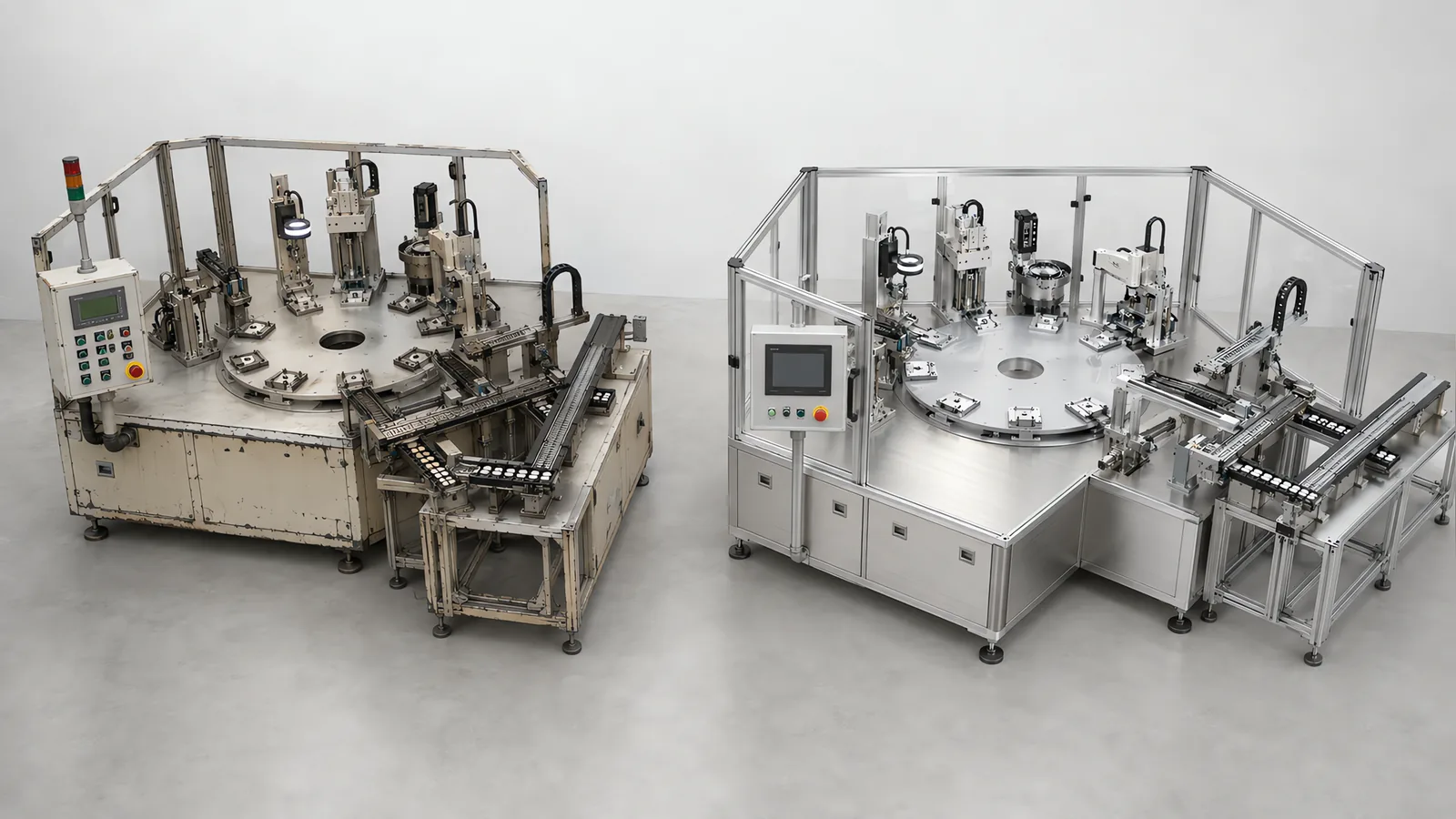
Motionwell Automation builds new special purpose machines and modernises existing ones, so the retrofit vs replace machine decision sits on both sides of our own order book. Control system modernisation of existing production machines is our largest line of work this year, replacing ageing PLCs, servo drives and VFDs onto whichever platform the plant already standardises on, because a rebuilt machine nobody on site can program or stock a spare drive for has only traded one obsolescence problem for another. A new build runs 16 to 24 weeks from concept approval to factory acceptance testing, and 24 to 32 weeks where cleanroom compatibility or full validation documentation applies.
The headline is this. The age of the machine settles none of this on its own, the two quoted figures decide less than people expect, and four specific questions decide almost all of it. Machines are designed, assembled and tested at our Woodlands Link facility with an in-house design team of eight, and the company has delivered more than 150 special purpose machines since 2014 under ISO 9001:2015 and bizSAFE Level 3.
How the modernisation itself is surveyed, staged and documented is on our machine retrofit and modernisation page; the financial method for either option is on the automation ROI page; and if the answer comes out as a new machine, what to buy is worked through in our comparison of custom machines and standard equipment.
Which Four Questions Actually Decide Retrofit or Replacement?
Four, and any one of them can settle the decision on its own before the other three are asked. Two are about the machine, one is about the paperwork, and the fourth is about the line the machine stands in.
Can the mechanism still hold the tolerance the process needs? That is measured on the machine as it stands, against the tolerance you need now and not the one on the original datasheet.
Are the parts still procurable, and for how long? That covers every part the machine will need over the life you are buying, well past the controller.
Does the wanted scope change who carries the manufacturer’s obligations? A modernisation extensive enough to make the machine de facto new machinery moves a block of conformity work onto the party doing it.
Is there a shutdown window long enough for the work the retrofit actually needs? On a running line this can be the largest number in the comparison, and it is regularly left out of both quotations.
| The question | What answers it | What a clear “no” means |
|---|---|---|
| Can the mechanism hold the tolerance? | Measurement on the machine: lost motion, repeatability over a run, drift across a shift, capability against the current tolerance | Include mechanical rebuild or replacement in the comparison |
| Are the parts procurable? | Vendor lifecycle status per part, plus who could make each part from a drawing if nobody sells it | A retrofit that leaves the unobtainable part in place has solved the wrong half of the problem |
| Can the retrofit retain the existing conformity basis? | An assessment of the proposed changes, applicable requirements and manufacturer’s responsibilities at kickoff | Additional conformity work enters the retrofit scope and must be included in the comparison with a new machine |
| Is the window long enough? | Hours the line can stop, in one block or several, set against the work that can only be done on the machine | Retrofit is not the cheaper option, it is an option that does not exist |
Two things that look decisive and are not. Age is a proxy for all four questions and a poor one: a well-maintained machine on a supported controller can fail none of them however old it is, while a much younger machine with a discontinued proprietary drive fails two. And the two quoted prices are the part of this comparison easiest to obtain and least likely to decide it, because the downtime, the conformity work and the parts risk all sit outside both numbers.
Can the Mechanism Still Hold the Tolerance You Need?
This is a measurement, and the useful version of it is a capability study on the machine as it stands, run against the tolerance the product needs today.
That last clause is where the answer usually turns. A machine that was capable when it was installed can fail now without having got worse, because the requirement moved: the drawing tolerance tightened, the customer added an inspection, or a new variant is thinner, smaller or flatter than anything the machine was bought for. Establish which of the two has happened before spending anything, because a worn machine and a machine asked to do a harder job need different purchases and look identical from the quality data alone.
What the test has to reach is the tool point. New drives close a position loop around the feedback device, so an encoder can report an axis arriving perfectly while the part is made somewhere else, and lost motion between the two is invisible to the control system that is being sold as the fix. The specific measurements, and the symptoms each kind of wear produces once new drives are fitted, are set out on our servo and drive retrofit page.
A third route belongs on the shortlist whenever the mechanism is the complaint, and neither word in this page’s title names it. A mechanical rebuild, meaning guides, screws, bearings and alignment restored on the existing frame with the controls left alone, is a different trade from controls work and is usually bought from whoever rebuilds that class of machine. Price it as a third column: it answers a failed tolerance test without buying a control system the machine does not need.
Are the Parts Still Procurable, and for How Long?
Procurability is a hard constraint, and the question is often answered too narrowly, as whether the controller is still supported.
Three groups behave completely differently, and only one of them is fixed by a control retrofit.
| Part group | Who can supply it in five years | What a control retrofit does to it |
|---|---|---|
| Control electronics: PLC, drives, HMI, safety devices, communications cards | The vendor, until a published end-of-support date, then the used market | Resets the clock, on the parts inside the scope, to the new platform’s own end-of-support date |
| Catalogue mechanical parts: bearings, guides, ballscrews, belts, seals, pneumatics | Any distributor, as long as a drawing or a part number exists | Nothing; they were not the constraint |
| Machine-specific parts: change parts, format tooling, castings, proprietary subassemblies | The original builder, or a machine shop working from a drawing you hold | Nothing, and this is the group that ends machines |
Read the third row as the one that decides this question. A part existing only as one supplier’s proprietary subassembly binds the machine to that supplier for as long as it runs, and a modernised control system does not loosen that binding by a single part number. Where drawings exist the position is completely different, because a part with a dimensioned drawing behind it can be made by a machine shop long after its original maker has lost interest. Audit the drawing set before this decision, and ask for the same thing at quotation stage on anything you buy now, as set out on our local versus overseas machine builder page.
Two practical moves follow. Ask for published lifecycle status part by part, since a supported processor can sit in a chassis of modules that are not. And walk the machine listing every part that is not a catalogue item, then ask who makes each one today. That list is short, and it usually ends the argument.
Does the Work Change Who Carries the Manufacturer’s Obligations?
This is the term that can invert the comparison without anything mechanical changing, which is why it is settled at kickoff and never discovered in a change order.
The European Commission states that the Machinery Directive applies to products placed on the EU market for the first time or when existing machinery is modified to such extent that it becomes de facto new machinery. Crossing that line moves the manufacturer’s obligations onto whoever did the modernising. Where the line sits is a judgement made per project.
What matters for a retrofit versus replace comparison is the shape of that cost. It is a step. Below the line the existing technical file is updated; above it, a risk assessment, a safety function register with a required performance level per function under ISO 13849-1:2023, validation evidence and a full technical file all enter the scope at once. A new machine carries every one of those items by definition. So the moment the retrofit crosses the line, the two options are being compared with the same block of work on both sides, and what the retrofit still saves is the mechanism alone.
| Wanted scope | Where it usually sits | What that does to the comparison |
|---|---|---|
| Like-for-like replacement of an obsolete drive or controller, function and performance unchanged | Below the line | The retrofit keeps its advantage; the file is updated |
| New controls plus a guard removed because the new system makes it unnecessary | A judgement, and one to make before ordering hardware | The safety case is reopened regardless of which way the judgement goes |
| An added axis, a raised rate, or a change in what the machine makes | Frequently above the line | Conformity work enters the retrofit scope, so price a new machine alongside it |
Two boundaries are worth stating so nobody scopes around them. Which machinery text the machine will be judged against over its remaining life, including the option of declaring conformity with Regulation (EU) 2023/1230 early, and what applies to a machine that stays in Singapore, are both set out in full on our machine retrofit and modernisation page. And who owns the outcome, between the party that modifies a machine and the party that operates it, belongs in the contract, never in a commissioning conversation. Whichever answer applies, the guarding, validation and documentation that follow are on our machine safety and CE marking page. On a machine we modify, we support the conformity work behind it, including LVD and CE testing and Ministry of Manpower lifting certification where the machine includes lifting equipment.
Why Does the Shutdown Window Sit Outside Both Quoted Prices?
It sits outside them because it is a cost your plant carries, not one either supplier quotes, and it is a term most plants can price from records they already keep. Where an hour of stopped line already carries a number worked out for unplanned breakdowns, that is the same number here. We ask for it at enquiry stage for exactly that reason.
The structural point is that the two options do not spend their hours in the same place, and comparing their headline durations compares two different things.
A retrofit does its work on the machine, so the hours that carry risk are inside your window and on your floor. Everything that can be prefabricated is, and what remains in the window is what cannot be done anywhere else.
A new machine does most of its work somewhere else entirely. It is designed, assembled and tested at Woodlands Link and proven at a factory acceptance test before it ships, which is why 16 to 24 weeks of lead time is calendar time. A buyer weighing a few days of shutdown against that lead time is not comparing like with like at all.
That asymmetry is why a retrofit whose window runs into weeks can lose to a machine that is installed alongside, run in and accepted before the old one stops. Four site conditions decide whether that route is available, and none of them is about the machine:
- floor space beside the running line, including access for installation without crossing the live process
- a feed that can be diverted or split, so the new machine sees real product before it takes the whole flow
- utilities reaching the new position: power, compressed air, extraction, drainage, network
- enough people to run two configurations at once while acceptance evidence is gathered
Where all four hold, the changeover reduces to a tie-in. On our laboratory work, where the lab cannot stop, the cell is built and debugged against instrument surrogates at Woodlands Link and each station runs in parallel with the manual workflow until it is accepted, and the shape of that programme is on our laboratory automation page. Where the conditions do not hold, and a machine is bolted into a fixed footprint between two conveyors, the replacement inherits a removal and re-installation window of its own, and the retrofit’s disadvantage narrows or vanishes.
| Where the hours are spent | Retrofit in place | New machine installed alongside | New machine in the same footprint |
|---|---|---|---|
| Off your floor, line producing | Panel build, software against simulated I/O, prefabricated mountings | Design, build, assembly, factory acceptance test | |
| On your floor, line producing | Survey and as-built capture | Installation, utilities, run-in on diverted product, acceptance | Nothing, until the old machine comes out |
| On your floor, line stopped | Isolation, strip-out, mounting, re-termination, loop checks, dry run, safety validation, product trial | Tie-in and switchover | Removal, installation, utilities, commissioning, acceptance |
| What extends it most | Drawings that do not match the machine, and mechanical condition found on strip-out | Product that behaves differently at full flow than on the diverted feed | The same removal work the retrofit avoided |
One consequence is worth acting on. Where a line can only release short windows, a machine that divides into separable stations can be taken in phases, and that changes which option is feasible more than which is cheaper. Answer that before pricing anything.
What Is the Machine Worth Today, and Why Does That Argument Go Wrong?
Three different numbers get treated as one in many versions of this conversation, and only one of them is money.
Book value is an artefact of a depreciation policy: it describes your accounts, and a fully depreciated machine that holds tolerance is worth more to production than a half-depreciated one that does not.
Resale or scrap value is the only figure that is cash, and it appears on the replacement side of the comparison, because you only realise it if the machine goes. It is also thin for a purpose-built machine, because a catalogue machine has a market while one designed around a single product carries value in fixtures and change parts that fit nothing else. Get a real figure, net of removal and disposal.
Replacement value is what the same capability costs new today, and its role is a sanity check on the retrofit quotation.
Then the trap. “We have already spent a great deal on this machine” is not an argument for either option, because whatever was spent is spent under both, so it cannot differ between them and therefore cannot choose between them. The version of that sentiment which is legitimate looks similar and behaves differently: the process capability the machine has proven, and on a regulated line the validation package you hold for it, are assets, because only one of the two options preserves them. A new machine has to re-earn that ground through qualification against a product you already make, which is real work with no product benefit attached. Whether historical data can carry part of that argument depends on whether the original package was retained, and that reasoning sits on our computer system validation page.
A retrofit becomes sunk the moment it is committed, which produces the one question that catches this decision out. Ask how many years the retrofit is meant to buy, say the number out loud, and check it against two dates: the remaining life of the product the machine makes, and the published end-of-support date of the platform it is landing on. A modernisation that buys fewer years than the product needs is a payment made twice.
Why Can a Retrofit Not Be Fully Priced Until the Machine Is Opened?
The two options carry their unknowns in different places, and this is the risk a comparison of quotations hides completely.
A new machine is priced from a specification. Its unknowns live in that document, which is why a thin requirement set is a common route to a new build overrunning, and why the requirements are worth more attention than the quotations, as set out in our guide to writing an automation URS.
A retrofit is priced from a machine nobody has fully seen. Wiring that does not match the schematics is found by tracing wires; mechanical condition is found on strip-out; undocumented modifications are found by whoever made them, if that person is still on site. Reconstructing what the existing safety circuits actually do is frequently the single largest item in a retrofit’s safety scope, and it happens whether a quotation shows it or not. Pricing it and discovering it are the two available options.
Three contract shapes deal with that openly, and it is worth asking which one you are being offered.
The survey as its own deliverable, bought and paid for separately, producing a documented description of the machine as it exists and a scope that can then be fixed. It is the shape that makes a subsequent fixed price mean something.
Named provisional sums, where the items that genuinely cannot be known before strip-out are listed with a basis for pricing them when they are. What you must not accept is a single unexplained contingency covering everything, since that is a risk premium with no way to release it.
Phased scope, where the machine divides and each phase starts from a working machine, priced with the previous phase’s findings in hand.
When Should Replacement or a Mechanical Rebuild Join the Shortlist?
The following findings broaden the comparison beyond a controls-only retrofit.
Tolerance depends on worn mechanics. Include the guide, screw, fixture or frame work needed to restore capability, then compare the combined rebuild with a new machine against the same part tolerance.
A critical subassembly needs a new supply route. Review format tooling and proprietary assemblies alongside electronic spares. The options may include reverse-engineering a replacement, redesigning the operation or replacing the machine.
The modification changes the safety or conformity scope. Include the assessment, safeguarding, validation and documentation work in both options so the commercial comparison covers the complete deliverable.
The production window is short. Compare a phased retrofit, a new machine installed alongside the existing one and a temporary product route. Each provides a way to organize the cutover around available shutdown hours.
More capacity is required. Establish the achievable rate from a retrofit and compare it with adding a second machine. The second route may also provide backup capacity during installation and maintenance.
The product needs a different process. Evaluate how much of the existing mechanism remains useful for the new variant. Our special purpose machine design guide explains the design process for a new operation.
Several machines need the same change. Develop a common retrofit package and compare it with a fleet replacement standard, including shared spares, training and documentation.
Standard equipment covers the application. Include a catalogue machine in the comparison with the same tooling, integration, output and support requirements as the custom options.
When Does Retaining the Existing Machine Offer More Value?
A capable mechanism, an established process and a trained team can make a targeted upgrade the stronger option.
Where the machine holds tolerance, has an available spares route and meets the current process requirement, a maintenance and lifecycle plan can preserve that capability. Investment can then focus on the operation that limits line output or the new function the plant needs.
The mechanism is genuinely special. A machine built around a mechanism nobody sells any more, holding a process capability that would have to be developed again from scratch, is worth keeping through several generations of electronics. The controls are replaceable; that mechanism is what you are actually buying when you retrofit it.
Requalification would cost more than the machine gains. A new machine on a regulated line has to be qualified against a product you already make, so where the existing machine is capable and the driver is a controller or a record, the retrofit keeps that argument on ground you have already won.
Your team knows this machine: spares held, operators trained, faults understood. That is real value, it appears on no quotation, and it is spent in full on the day a different machine arrives.
The driver is a data or record requirement. Where the machine runs correctly and nothing above it can read a count or hold a named user, the proportionate answer is a controller migration, or a data layer above a controller that is still supported. The controller migration is on our PLC migration and upgrade page, and the data layer is on our legacy machine connectivity page.
Which Way Does the Machine in Front of You Go?
Run these in the order given. The first to produce a hard answer usually settles it, and where two disagree the answer is normally the third column.
- What is forcing the change, in one sentence: spares, safety, a product variant, a data requirement or rate? The driver decides more than the machine’s age does.
- Does the mechanism still hold the tolerance you need now, measured at the tool point against the current drawing?
- Which parts are not catalogue items, and who makes each of them today?
- Does the wanted scope cross the conformity line? If it does, price a new machine alongside the retrofit, with the conformity work counted on both.
- How many hours can the line stop, in one block or several, and does the machine divide? This decides feasibility before it decides cost.
- Is there floor space to install alongside? If yes, the replacement’s downtime argument changes completely. If no, both options need a window of their own.
- How many years is this purchase meant to buy? Check that number against the product’s remaining life and the platform’s end-of-support date.
| Your situation | Route | Why |
|---|---|---|
| Mechanism capable, controller out of support, no scope change | Retrofit | The step change in conformity work is not triggered, and the proven capability is retained |
| Mechanism failing the tolerance test, controls fine | Mechanical rebuild, priced against a new machine | New controls cannot recover accuracy the mechanism has lost |
| Unobtainable machine-specific part with no drawing | Replace | The retrofit cannot reach the part that will end the machine |
| Scope adds an axis, raises the rate, or changes what the machine makes | Price both, conformity work counted on each side | Once the file and the safety case are in both scopes, only the mechanism separates them |
| Line can release days, retrofit needs weeks, floor space available | New machine installed alongside, commissioned before switchover | Downtime is the dominant term and this route moves the work off your floor |
| Line can release days, retrofit needs weeks, no floor space | Phase the retrofit station by station | Several short windows, never one block the line cannot give |
| The constraint is rate | Buy the additional machine, keep the old one as backup | Solves capacity and removes the window problem in one purchase |
| Regulated line, machine capable, driver is a record or a controller | Retrofit, with the validation impact assessed first | Requalification against an unchanged product is work with no product benefit |
A mixed answer usually means one project is carrying two drivers. Split them, buy the one that is setting the schedule, and let the other wait behind it.
Standards Used in Machine Design and Validation
These references inform the design, testing and documentation described on this page. Each row links to its primary source and records the edition checked.
| Standard | Current edition | What it means for your machine |
|---|---|---|
| Modified machinery as new machinery: Machinery Directive 2006/42/EC scope rule | Directive 2006/42/EC (applies until 19 January 2027) | For EU-market retrofits, review the proposed changes to function, performance and safety to establish whether the modified equipment is treated as new machinery. Record that assessment during scope definition and assign responsibility for the risk assessment, technical file and conformity documentation.Checked 1 Sep 2026 against European Commission, Machinery page (single-market-economy.ec.europa.eu/sectors/mechanical-engineering/machinery_en) |
| Regulation (EU) 2023/1230: the EU Machinery Regulation | (EU) 2023/1230 (changeover pending) | Applies on a mandatory basis from 20 January 2027, replacing Machinery Directive 2006/42/EC. Project planning should align the intended EU market date with the conformity assessment and technical documentation, including relevant software integrity and connected-function requirements. The European Commission permits voluntary declarations against the Regulation before that date, while the Directive remains applicable.Checked 1 Sep 2026 against European Commission, Machinery page (single-market-economy.ec.europa.eu/sectors/mechanical-engineering/machinery_en); EU-OSHA legislation register |
| ISO 13849-1: Safety of machinery, safety-related parts of control systems | ISO 13849-1:2023 | Provides the design method for safety-related control functions, including architecture, component reliability, diagnostic coverage and common-cause failure measures. The machine risk assessment establishes the required Performance Level; design calculations and validation provide the evidence for each function.Checked 1 Sep 2026 against ISO 10218-1:2025 normative references |
Frequently Asked Questions
Is retrofitting always cheaper than buying a new machine?
No, and the cases where it is not are predictable. A retrofit saves two things: the mechanism, and the process capability that mechanism has already proven. It does not automatically save the safety case, the documentation set or the conformity work, and once the wanted scope puts the machine over the line into new machinery those items appear on both sides of the comparison. It also spends part of its saving in a currency the new machine does not use, which is hours of shutdown on your own floor instead of weeks of build time on ours. Compare the two on hours the line is not producing, not on the two quoted figures.
Can a new machine be installed without stopping the line?
Sometimes, and whether you can is a site question, not a machine question. Four conditions have to hold: floor space beside the running line, a feed that can be diverted or split, utilities reaching the new position, and enough people to run two configurations while acceptance is gathered. Where they hold, the new machine is built and proven off your floor and the changeover becomes a tie-in. Where the machine is bolted into a fixed footprint inside a line, the replacement inherits a window of its own for removal and re-installation, and the retrofit's disadvantage on downtime narrows or disappears.
How should we value the old machine in the comparison?
Separate three numbers that usually get treated as one. Book value is an artefact of your depreciation policy and describes the accounts. Resale or scrap value is the only one that is cash, it appears only if you replace, and it is thin for a purpose-built machine whose fixtures and change parts were built for one product. Replacement value is what the same capability costs new today. What is genuinely worth carrying forward is not a number at all: it is the proven process capability and, on a regulated line, the validation package you already hold.