
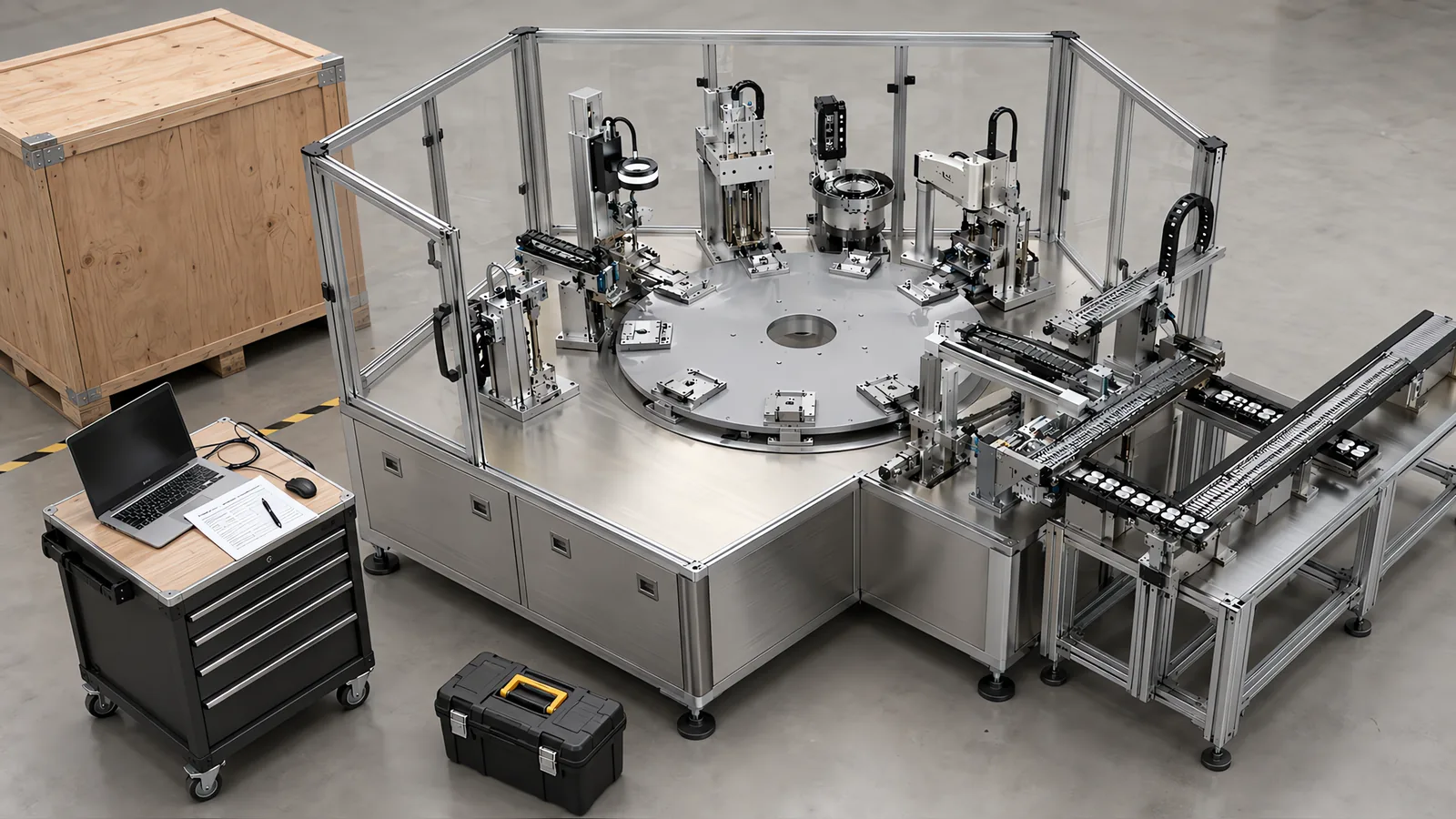
Motionwell Automation is a Singapore machine builder, and the local vs overseas machine builder question usually arrives as a price comparison that is three or four line items short. What the integrator role covers, and where a machine builder differs from a systems house, is set out in what a system integrator does. Our machines are designed, assembled and tested at the Woodlands Link facility, with an in-house design team of eight, lead times of 16 to 24 weeks from concept approval to factory acceptance testing on a standard build and 24 to 32 weeks where GMP or cleanroom validation applies, under ISO 9001:2015 and bizSAFE Level 3. The company has delivered more than 150 special purpose machines since 2014.
The headline is this. The quoted price is the part of this decision that is easiest to compare and decides less of it than its prominence suggests, because freight, duties, installation travel, spares and the hours a line stands still are all outside the number on the first page.
Both routes get used here, including by us: a large share of what goes into a machine is imported. Robot arms, cameras, drives, load cells, flow meters and piston pumps are manufactured at scale by specialists, and so is a family of standard packaging machines listed further down. Those are settled designs made in quantity, and they get specified and bought. What gets designed is the part that has to be drawn against your product.
This is a procurement question. The framework for scoring builders against each other, local or not, is in our guide to choosing a system integrator, and what a single-source scope covers is in our explanation of what turnkey automation actually includes.
Where Does the Price Difference Actually Go?
It goes into four places, and few of them appear on the page you are comparing.
The first is logistics, and it is arithmetic: sea or air freight, marine insurance, port and terminal handling, customs clearance, inland haulage to your estate, and rigging the machine off the truck and into position. A machine built at Woodlands Link makes one road journey. A machine built overseas makes a sea journey with a crate around it, and the crate is not free either.
The second is people. Commissioning engineers who fly in carry flights, accommodation, per diem and a day rate, and whether that rate starts at your gate or at their departure is a term to read. The number to establish before purchase is not the first trip. It is the second one: what a return visit costs, how much notice it needs, and whether it is included at all.
The third is time, and it is the one that separates two quotations that look identical. Every hour the line is not running has a cost you can calculate from your own numbers, and it lands whether the machine is under warranty or not. Availability is the term that carries it, and how to measure it properly on the line being replaced is in our note on what OEE actually measures.
The fourth is scope. A cheaper quotation is sometimes a cheaper machine and sometimes a shorter list, and the way to tell is to compare the two documents item by item.
| Cost line | Machine built in Singapore | Machine built overseas |
|---|---|---|
| Quoted equipment price | Compare directly | Compare directly, in the quoted currency |
| Currency and payment terms | One currency | Exchange movement between order and final payment, plus any hedging or bank charges |
| Freight, insurance, handling | Road delivery within Singapore | Sea or air freight, marine insurance, port and terminal handling, export crating |
| Import formalities | Not applicable | Customs clearance, declarations, and any import taxes or duties as they apply |
| Site rigging and installation | Same problem either way, priced locally | Same problem either way, plus coordination across a supplier who is not here |
| Commissioning labour | Local engineers, day trips | Travel, accommodation, per diem and day rates, with the clock starting where the contract says |
| Return visits during warranty | A drive across the island | A trip that has to be scheduled, and may be chargeable |
| Spares held near the machine | Decided by component choice, discussed below | Decided by component choice, plus a shipping leg |
| Downtime waiting on either | Your own hourly cost, times hours | Your own hourly cost, times the wait imposed by distance |
Two cautions on reading that table. It is a list of where money goes, and no claim about which column totals less: a mature standard machine bought at volume from an overseas manufacturer can win it comfortably, which is the argument set out further down. And several rows are the same problem in both columns. Rigging a machine into a unit with a low door and a lift with a weight limit costs what it costs regardless of where the machine was welded.
What Changes When You Can Attend the Factory Acceptance Test in an Afternoon?
It changes the number of iterations, which is a different thing from the quality of the test.
A factory acceptance test is a defined protocol with acceptance criteria run before shipment, and a competent builder anywhere runs one. Design, fabrication, assembly and testing all happen at Woodlands Link, which is why a Singapore buyer attends the acceptance test without flying to it. That proximity does not make our test more rigorous. It changes what happens either side of it.
What it buys is access before the test. Your process engineer can stand at the machine while it is being built, put a real part into a real fixture, and say that the gripper marks the surface or that the locating pin will not accept the worst case your incoming tolerance actually produces. That is a change made on the shop floor in an afternoon. When the same observation arrives at a scheduled test on the other side of a flight, the machine is finished, and the options narrow to accepting it, delaying shipment, or writing a punch list that follows the machine to your site.
The other thing it buys is the awkward part. Bring the parts nobody wants to run: the underweight one, the one from the end of the tool life, the batch that came back from the supplier out of spec but was used anyway. A machine that handles the nominal part is not the same machine as one that handles your distribution, and tooling is the item that gets adjusted more than any other, as set out on our end of arm tooling page.
| What the acceptance test has to establish | Attended locally, repeatedly | Attended once, after a flight |
|---|---|---|
| Rate against your real parts | Timed, adjusted, timed again in the same week | Timed once, with limited room to adjust and re-time |
| Tooling against your tolerance spread | Worst-case parts brought in as they are found | Whatever parts were shipped in advance |
| Operator handling and recovery behaviour | Your operators try it before the machine is finished | Reviewed by whoever could travel |
| Fault recovery from a real jam | Provoked deliberately, more than once | Demonstrated within the visit window |
| Changes arising from what the test found | Made on the shop floor | Made before shipment if the schedule allows, otherwise on your site |
| Documentation and drawing review | Walked through against the physical machine | Reviewed against the machine or against the file |
One caution against reading this as a verdict. A disciplined overseas builder with a written protocol, video witnessing and shipped-in sample parts runs a genuinely useful test, and a local builder with no protocol runs a demonstration. The protocol is the thing to ask for in both cases. Distance changes how many times you get to run it.
What Does a Time Zone Cost During Commissioning?
During design it costs very little. During commissioning it can cost the schedule, because the two phases have completely different clocks.
Commissioning often produces a chain of dependent questions: a controller fault, a sensor setup issue, a missing upstream handshake or a recipe behaving differently on production material. Waiting for a remote specialist can hold the next test. Compare the supplier’s on-site coverage and escalation windows with the shutdown schedule, including who can authorize and implement changes while the machine is stopped.
Two details affect fault resolution. First, confirm that alarm text, HMI prompts and PLC comments are usable by your maintenance team, as well as the printed manual. Second, assign ownership of interface signals such as part present, cell ready, buffer full, fault and reject. For suppliers in different time zones, agree overlapping support hours, a local escalation contact and who can change each side of the interface. Those arrangements determine the waiting time during commissioning.
Where the machine goes into an existing line, this gets sharper, because the old side is often undocumented. Working out what the existing circuits actually do before anything is replaced is frequently the largest single item in a retrofit safety scope, and it is investigative work that has to happen at the machine. That is a poor fit for a supplier who is present in scheduled visits.
Who Holds the Spare Part When the Line Stops?
This question matters to ownership cost more than it matters at the quotation stage, and it is settled by component selection.
Ask it as a supply-chain question about parts, and never as a service-promise question about the builder. A machine is a bill of materials, and each line on it has its own answer. A catalogue I/O card, a catalogue sensor, a catalogue valve or vacuum cup carries three things: a published part number, a distributor holding stock in this region, and a stated successor when the model goes end of life. None of those three change because the machine was assembled in another country. That is the test to apply line by line, and it is a question about the part: can anyone buy this from a published number, or only the person who drew it. A servo motor matched to a specific drive firmware is a longer conversation. A machined part on a drawing nobody outside the builder holds is the worst case, because the wait is not a shipping time, it is a manufacturing time in someone else’s queue.
| Part class | What decides the wait | The question to settle before purchase |
|---|---|---|
| Standard electrical and pneumatic components | Distributor stock for that brand in this region | Which brands, and is the model current |
| Sensors, cameras and vision lighting | Same, plus whether the exact part number is regionally stocked | Is a like-for-like replacement available, or is re-teaching required |
| Servo motors and drives | Firmware and parameter matching to the axis | Is a spare drive pre-configured, and who holds the parameter file |
| Controllers and I/O | Vendor support status for that platform | Is the platform still supported, and can your team hold the program |
| Custom machined parts and tooling | Manufacturing time, wherever the drawing lives | Do you hold the drawings and the material specification |
| Wear items on a proprietary subassembly | The original builder, exclusively | Is the design proprietary, and what is the stated replenishment route |
Two practical consequences follow. First, the multi-brand argument is really a spares argument. On many enquiries the robot brand is already decided because the maintenance team stocks spares for one platform, and that is a sound reason. Because we manufacture neither arms nor cameras, the platforms a cell can be built on are whatever your plant already stocks, which turns the spares argument into a purchasing fact: the part number on your shelf is the part number in the cell, and the first failure is a store visit.
Second, the drawings decide the tail end of the machine’s life. Machines here go out with the mechanical drawings, electrical schematics, PLC program documentation, operator manuals, maintenance schedules and spare parts lists, so a fabricator can make a part from a drawing when the original supplier is no longer interested. A machine whose critical parts exist only as a proprietary subassembly ties you to one supplier for as long as you run it, and that is true of a local supplier as much as an overseas one. It is worth asking as a document question at quotation stage, because it is not negotiable afterwards.
The one thing distance genuinely changes here is the shipping leg on a part that has to move, and it only bites on the parts nobody stocks nearby. Establish which lines on the bill of materials those are before purchase, because that list is the real service risk.
What Happens When Your Product Changes, Because It Will?
Modification response is where the local case is strongest, and it is worth being precise about why, because the reason is not goodwill.
Changing a machine has three parts: deciding what to change, making the change, and proving the machine still works. The middle part is often small. The first and third parts need somebody at the machine, with the drawings, who understands why it was built the way it was.
Some changes are designed in and cost almost nothing. On the battery module dismantlement line, the base fixture plate carries a grid of M8 threaded inserts on 50 mm centres so pneumatic clamps and locating pins can be repositioned for a different module footprint, and switching between prismatic and pouch formats takes about 30 minutes with two technicians with no welding, drilling or permanent modification. On the cobot unloading station built for a consumer goods distribution centre, the quick-change tool carries X and Y pitch adjustment on stepper motors so one tool covers several pack sizes. Those are decisions taken at design stage, and they are worth asking for explicitly.
Other changes are structural, and no supplier can make them cheap. On our cleanroom automated test equipment build, a circular pallet transfer was chosen because it returns every pallet to a single load and unload station, which means one collaborative arm serves the whole machine and only one opening has to be made in the cleanroom enclosure. The price stated in that project’s own record is that station count is fixed by the loop geometry, so adding a test later means re-timing the whole ring. The cleanroom test equipment case study sets out the trade. That cost is the same whoever owns the machine; what distance changes is how long it takes to establish it and how many trips it takes to implement.
One version of this is not mechanical at all. Control-system modernisation of legacy machines, replacing obsolete PLCs, servo drives and VFDs on whichever platform the plant already maintains, is our largest project line this year, and much of that work has a compliance driver: the machine still runs fine, but its controller cannot hold a user account. A well-built machine outlives its own control platform, which means the modification question is not whether you will need one but who will be available to do it a decade from now.
One boundary applies to modification wherever the machine came from. Modifying a machine can cross a regulatory line as well as an engineering one, and where it does the party doing the work steps into the manufacturer’s position. That is covered below and on our machine safety and CE marking page.
What Documentation and Standards Should a Machine Used in Singapore Carry?
Start from what the law here actually requires, because it is narrower than most specifications assume and it is not CE marking.
Singapore does not require CE marking. The Workplace Safety and Health Act requires dangerous parts of machinery to be securely fenced, and places duties on the occupier and on anyone supplying machinery for use at work, which is a duty that attaches to you as well as to the builder. Machines incorporating lifting equipment must be examined and certified by an approved authorised examiner before use, with periodic re-examination after, and it is a local requirement that tends to arrive late in a project. Most multinational manufacturers here specify CE conformity as an internal standard anyway, which is a contractual requirement, and it needs to be written into the purchase order if you want it.
The electrical build is where destination market shows up physically. A panel built to IEC 60204-1 and a panel built to NFPA 79 differ in the disconnect, the isolation points and the lockout procedure, so the market a machine ships to has to be settled before panel design starts. If your group buys equipment centrally and moves it between sites, say so at the start.
| Document or evidence | Why a Singapore installation needs it | What to check in any quotation |
|---|---|---|
| ISO 12100 risk assessment | It is what the safeguarding design has to follow from | Is it a named deliverable, and who performs it |
| Safety function register with required and achieved performance level | Fencing alone does not discharge the duty on dangerous parts | Are calculations and validation records included |
| Measured stopping performance | Scanner and light curtain distances depend on it, and it is measured on the built machine | Is there a measurement plan, or only a stated distance |
| Electrical schematics and panel build standard | IEC 60204-1 and NFPA 79 produce different panels | Which standard, and does it match where the machine will run |
| Lifting equipment certification | Required by an approved authorised examiner before use, with re-examination | Is it in scope of supply or left to you |
| Instruction handbook, maintenance schedule, spare parts list | They are the machine’s usable life after handover | Are they specific to this machine or generic |
| PLC program documentation and software backup | Your team cannot maintain what it cannot read | Language of comments and alarm text, and who holds the source |
| Declaration of Conformity where CE is specified | A corporate requirement | Who signs it, and against which legislation |
Two points about the European framework, because a machine ordered now may still be running when it changes and because many buyers here inherit it as a corporate standard. Machinery Directive 2006/42/EC applies up to 19 January 2027, and Machinery Regulation (EU) 2023/1230 applies from the next day with no transitional period, so a machine being built now can be documented against it early on a voluntary basis. And on the modification question raised above, the European Commission states that the Directive applies to products placed on the EU market for the first time or when existing machinery is modified to such an extent that it becomes de facto new machinery. Where that line sits is a judgement made per project, and it decides who carries the conformity work after a major retrofit.
The machine builder’s share of the conformity work comes with the build: the risk assessment, the safety architecture, the validation and the technical file, with accredited LVD and EMC testing arranged at an external laboratory.
Is the Warranty Enforceable in Practice or Only on Paper?
Two different things sit behind the word, and only one of them is on the certificate.
A warranty is a legal promise about who pays for a defective part. Getting the machine running again is an operational question about who is standing next to it and how soon. A supplier can honour the first completely while the second costs you a fortnight, and the contract is not breached. So read a warranty clause as three separate questions.
What is covered, and what is excluded. Components carry their own manufacturer warranties, which is not the same as the builder warranting the machine. Consumables, wear items and anything the buyer adjusts are usually outside it. Ask what happens to the warranty when your maintenance team changes a parameter, because on a machine you are expected to run yourself that is going to happen early.
Who pays for the travel. This is the clause that separates the two columns of this page. A warranty that replaces a failed part free of charge, while flights, accommodation and engineer time during a warranty visit are chargeable, is a warranty on the part. It is a fair commercial position and it is worth reading before signing.
What happens if the supplier does not perform. Retention against acceptance, staged payments tied to deliverables, and a jurisdiction you can actually litigate in are the mechanisms that give a warranty force. A clause governed by a distant jurisdiction is not worthless, but enforcing it is a project of its own, and the practical value of a remedy is what it costs to obtain.
None of this argues that an overseas supplier will not honour its obligations. It argues that the enforceable part of a warranty is the part backed by something you hold, which is why staged payments and a documented acceptance test do more work than the length of the warranty period does.
Which Purchases Suit an Imported Machine?
A well-defined class of purchase is better served by an import, and it is worth naming precisely, because the boundary is where the money is.
The machine is a mature standard product. Carton erectors, case sealers, shrink tunnels, stretch wrappers, can seamers, pallet conveyors, high-speed rotary roll-fed labellers, shrink sleeve applicators with a steam tunnel and induction sealing heads are settled designs made in quantity. Those get specified and integrated as proven units, which is the same recommendation stated as a purchase. A manufacturer that has built the same model repeatedly has refined it in ways a one-off build cannot match, and the price reflects that volume. The end-of-line context for that split is on our case packing and wrapping page.
Volume changes the arithmetic. Buying the same machine several times over spreads the specification work, the spares holding and the training across the units, and it justifies stocking critical parts yourself. One imported machine is a support problem. A repeated purchase with a shared spares kit and a trained internal team is a fleet.
The specification is genuinely settled. Where the process is fixed, the part will not change, the rate is known and no interface to an existing line is involved, the advantages of proximity mostly disappear, because they are advantages in iteration and there is nothing to iterate.
You already have the capability in-house. A plant with its own controls engineers, a documented maintenance system and a stores function can absorb a machine that arrives with less support attached. That is a real asset and it should be used.
The technology only exists there. Some processes are made by a handful of specialists in the world. Where the machine embodies a process nobody here builds, importing it is not a compromise, it is the right answer, and the work is to get the support arrangement right.
Component-level buying, always. Robot arms, cameras, drives, load cells, flow meters and piston pumps are manufactured at scale by specialists and we buy them, so the sensible unit of comparison is never the components. It is the design work that sits between them and your product.
Which Route Should You Take?
Run these questions in order. The first that gives a hard answer usually settles it.
- Is this a catalogue machine or a designed one? If the process is standard and the machine is made in quantity, buy the standard machine and stop reading. If it has to be drawn against your product, the rest of the list applies.
- How settled is the specification? A requirement that is still moving needs iteration, and iteration is what distance is expensive in.
- What does an hour of downtime cost on this line? Multiply it by a realistic wait for a part and for a person. That number is the comparison.
- Does the machine tie into an existing line? An interface to equipment somebody else built, especially undocumented legacy controls, needs investigative work at the machine.
- How often will the product change in the machine’s life? Frequent variants argue for a builder who can be at the machine, and for modularity written into the specification at concept stage.
- Who will maintain it, and what do they already stock? Build on the platforms your team holds spares and skills for.
- How many of these are you buying? A repeated purchase justifies stocking parts and training people in a way a single machine does not.
- Where will it run, and under which market’s rules? Panel standard, lifting certification and any CE requirement have to be in the purchase order.
| Your situation | Start from | Why |
|---|---|---|
| Standard end-of-line machine, settled format, bought at volume | Overseas manufacturer, integrated locally | Volume manufacturing beats a one-off build on a settled design |
| Machine must be drawn against your part and your tolerance | Local builder | The iterations happen on parts, and parts are here |
| Retrofit into a running line with undocumented legacy controls | Local builder | Establishing what the existing circuits do is investigative work at the machine |
| High-mix line where the product changes within the machine’s life | Local builder, with modularity specified at concept | Modification response is the recurring cost |
| Regulated build needing IQ/OQ/PQ and site acceptance | Local builder | Validation documentation is iterative and the site test is here |
| Several identical machines, internal controls team, own stores | Overseas manufacturer, with a spares kit | Volume and in-house capability replace what proximity was buying |
| The process is built by a handful of specialists worldwide | Whoever builds it | Get the support arrangement right |
| Capacity-constrained line where downtime is revenue | Whichever option shortens the wait for a part and a person | Availability dominates the comparison |
Where the answer comes out mixed, that is usually a sign the purchase is two purchases: a standard machine bought where standard machines are made, and the designed part that has to sit around it. That split is normal, and the nine machine types we build to order are listed on the automation capabilities page, with how a designed build is scoped from concept to commissioning in our guide to special purpose machine design.
Standards Used in Machine Design and Validation
These references inform the design, testing and documentation described on this page. Each row links to its primary source and records the edition checked.
| Standard | Current edition | What it means for your machine |
|---|---|---|
| Regulation (EU) 2023/1230: the EU Machinery Regulation | (EU) 2023/1230 (changeover pending) | Applies on a mandatory basis from 20 January 2027, replacing Machinery Directive 2006/42/EC. Project planning should align the intended EU market date with the conformity assessment and technical documentation, including relevant software integrity and connected-function requirements. The European Commission permits voluntary declarations against the Regulation before that date, while the Directive remains applicable.Checked 1 Sep 2026 against European Commission, Machinery page (single-market-economy.ec.europa.eu/sectors/mechanical-engineering/machinery_en); EU-OSHA legislation register |
| Modified machinery as new machinery: Machinery Directive 2006/42/EC scope rule | Directive 2006/42/EC (applies until 19 January 2027) | For EU-market retrofits, review the proposed changes to function, performance and safety to establish whether the modified equipment is treated as new machinery. Record that assessment during scope definition and assign responsibility for the risk assessment, technical file and conformity documentation.Checked 1 Sep 2026 against European Commission, Machinery page (single-market-economy.ec.europa.eu/sectors/mechanical-engineering/machinery_en) |
Frequently Asked Questions
Is a machine built in Singapore more expensive than an imported one?
Compare landed and supported cost for the same specification. Add freight, insurance, handling, customs clearance, rigging, installation and commissioning travel to the equipment price. Then compare spares availability and support response against the cost of downtime on your line. Local and overseas suppliers can each be competitive; the complete scope and support arrangement decide the comparison.
What does attending the factory acceptance test locally actually change?
The number of iterations. A machine designed, assembled and tested at one facility can be seen mid-build as well as at handover, so a gripper that marks the part or a fixture that will not accept your worst tolerance case gets found and changed while the machine is still on the shop floor. When the same test needs a flight, it compresses into one visit with a fixed end date, and the fixes that do not fit inside it either travel to your site or turn into a punch list. The test itself is the same test. What differs is how many times you can run it.
When is buying an automation machine overseas the better decision?
When the machine is a mature standard product bought at volume, and the specification is settled before purchase. Carton erectors, case sealers, shrink tunnels, stretch wrappers, can seamers, high-speed rotary roll-fed labellers and induction sealing heads are settled designs made in quantity, and we integrate proven units. Robot arms, cameras, drives, load cells, flow meters and piston pumps are the same argument at component level: we buy those too. The case weakens when the machine has to be drawn against your product, your tolerance and your line.