
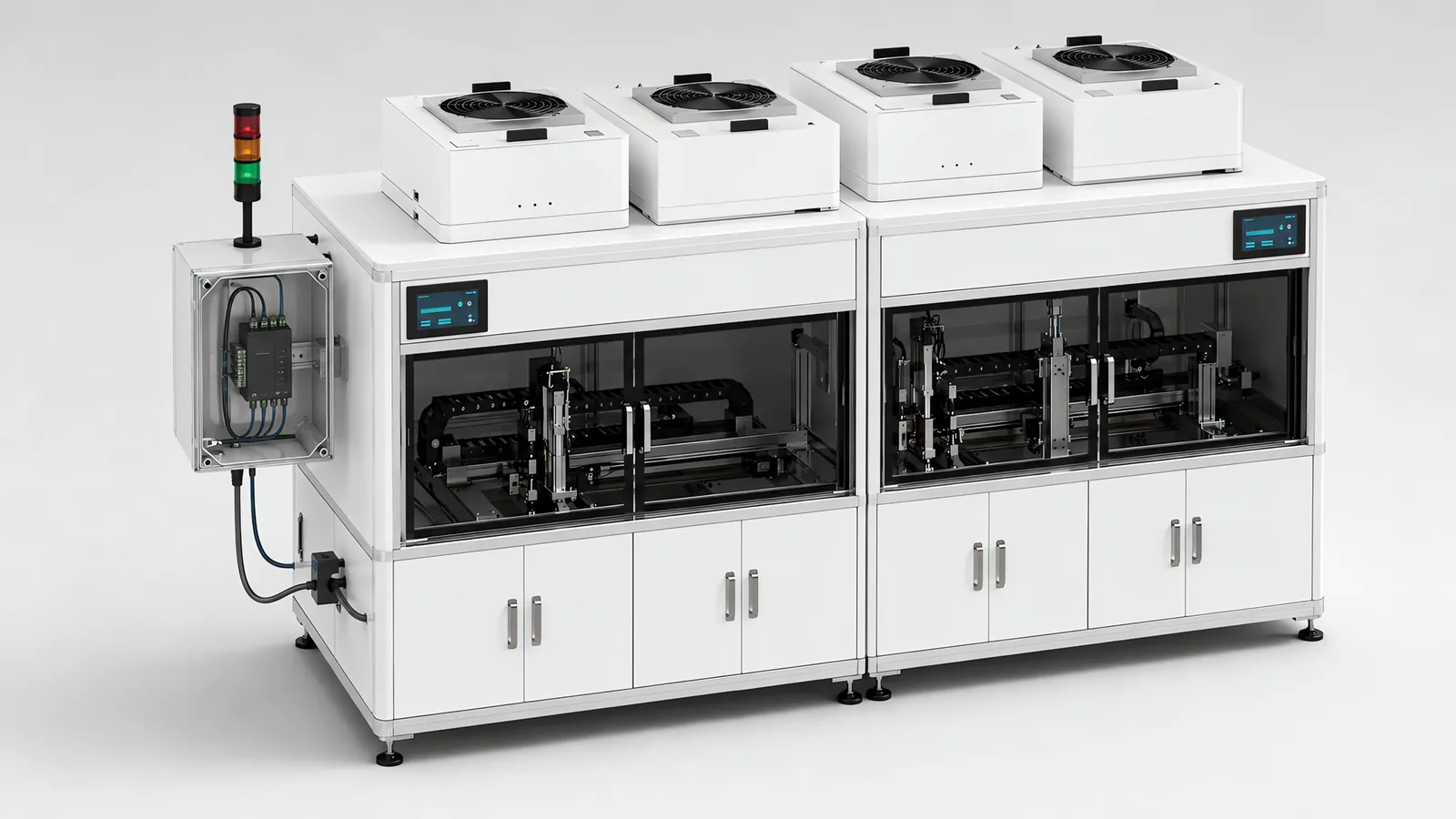
Motionwell Automation does machine data acquisition in Singapore as part of the control system modernisation that is our largest line of work this year, and these projects start with one question: how to get numbers out of a machine that was never designed to give any. What that looks like on delivered equipment: our cleanroom automated test equipment series exports CSV for offline analysis and also serves OPC UA (OPC Unified Architecture) for live charting, which is two outputs, because a file answers a Cp/Cpk study a month later while a subscription answers an SPC chart now, and a scheme carrying only the live path loses the history the first time the link drops. Control limits and alarm thresholds are configurable per test parameter through the HMI, so moving a limit is a configuration change under change control.
On a delivered palletizing cell the cell sequence and the robot motion run on separate controllers over industrial Ethernet, so a robot program edit does not sit in the same execution path as the line handshakes. An automated storage and retrieval crane is sequenced by its own PLC and reports to a fleet management server, the server deciding which pallet moves next and the PLC deciding whether the crane may move at all. On the QA laboratory automation programme, re-ordered in four consecutive years, every sample state transition is timestamped inside the controller at millisecond resolution, because the order of two events happening close together has to stay decidable a month afterwards.
Machines are designed, assembled and tested at our Woodlands Link facility, and the company has delivered more than 150 special purpose machines since 2014 under ISO 9001:2015 and bizSAFE Level 3.
The short version comes first. Read as legacy machine IIoT, this is not a software purchase. It is a ladder of options ordered by how much of the machine you are allowed to touch, running from the tags a modern controller already holds down to a hardwired dry contact off an existing circuit, and every rung is a real answer for some machine. Where you land is decided by the machine, and a signal you can trust completely is worth more than a rich one you cannot, because everything derived from an untrustworthy signal gets thrown away the day somebody proves it wrong.
The work sits at the machine end: deciding which signals exist, wiring the ones that do not, structuring them so they mean the same thing on Tuesday as on Friday, and exporting them in a form your own systems read. Nothing above that line is licensed from us, so the number of tags collected is an engineering decision. The arithmetic those signals eventually feed is in our explainer on what OEE actually measures.
What Does the Machine Already Know Before Anyone Buys a Sensor?
It knows more than the enquiry usually assumes, because a machine cannot sequence itself without knowing where it is.
Every interlocked motion depends on a confirmation. On our delivered electronic test equipment a magnetic reed switch on the cylinder wall tells the PLC the piston has arrived, and the controller issues the next command only once that confirmation is present. On an inspection station, a pass or fail bit plus the measured values already travel to the PLC over EtherNet/IP, PROFINET or digital I/O, because the reject gate needs them. On the delivered palletizing cell the PLC already owns a set of handshakes with the rest of the line: part ready, cell ready, buffer full, fault, reject asserted. None of that was installed for reporting. All of it is state.
So the first question is not which sensor to buy. It is which of the things the controller already computes it has no way to say out loud, and that is answered from the program and the I/O list, without walking the floor with a catalogue. It is the same survey we run on lab instruments, described on our laboratory automation page.
The exception sits at the bottom of the range. A relay-logic machine has no cycle-active tag and no counter anything can read, so there is nothing to expose and the conversation moves straight down the ladder, or onto our machine retrofit and modernisation page.
Reading production data and controlling cyclic machine I/O are different jobs. If the project also changes the field network, the PROFINET vs EtherNet/IP guide helps define supported device functions and what a gateway must preserve.
What Is the Ladder From a PLC Tag Down to a Dry Contact?
Five rungs, ordered by how much of the existing control system the work has to disturb. Fidelity falls as you go down, and cost does not follow it neatly.
| Rung | What it reads | What you get | What it cannot give you | What it disturbs |
|---|---|---|---|---|
| Read the controller’s own tags | State, counts, alarm words and process values the program already holds | The fullest of the five, with reason codes, because the machine knows why it stopped | Anything the program never computed | The program, so on a qualified machine it is a change |
| Protocol gateway | Whatever the old controller speaks, republished as OPC UA, Modbus TCP or tags on an Ethernet protocol the plant runs | Most of the above, without rewriting the program | Values the controller holds but does not expose on that interface | A network port and a panel position, rarely the logic |
| Bolt-on sensing | Motor current, vibration, a stack light tap, an optical count at the discharge | Run and stop state, cycle count, sometimes condition data | Why it stopped, which product it was making, any internal parameter | Nothing in the control system |
| Hardwired dry contact | An existing relay, contactor coil or lamp circuit | Running, stopped, fault, and nothing else | Reasons, counts, parameters, product identity | A terminal and an isolated input |
| Nothing exists yet | The machine has no readable state at all | The decision moves to whether the controller is replaced | Data, until something changes | The whole control system, as a project |
One thing is worth reading out of that table. The third column shrinks much faster than the fifth grows, so the middle rungs are where a good number of legacy machines land, and bolt-on sensing is the rung that leaves the original control system untouched, which makes it the starting answer on a machine carrying qualification evidence.
The rung is a property of the machine. A row of ten machines can easily need three different rungs, and forcing one scheme across all ten is how a programme gets expensive. Where the controller is being replaced anyway, the tag list belongs inside that scope, on our PLC migration and upgrade page, along with the drive-side signals that arrive with it, torque and following error on every move, on our servo and drive retrofit page.
The PROFINET vs Modbus comparison follows a value through its device definition, mapping and timeout behaviour. Once signals are available, a machine monitoring system still needs agreed states and counters. Industrial energy monitoring adds a measurement boundary and verified meter configuration, not merely a current trend.
When adding IO-Link devices, verify the master-to-destination path as well as sensor communication. IO-Link master selection covers ports, power and interpreted data.
How Does OPC UA Work, and Is It Free?
OPC UA stands for OPC Unified Architecture, an open standard for carrying machine data upward, and it is what the gateway rung in that table usually republishes into.
A server on the machine side holds a browsable address space: named nodes with data types, timestamps and quality. A client above it, a SCADA platform, a historian or an MES, opens an authenticated session, browses what is there, then reads on demand or subscribes and is told when a value changes. Security sits in the transport, and the trust between the two ends rests on certificates that expire.
What it is used for on this kind of project is carrying production data, results, alarms and history to something above the machine, and passing data sideways between stations that stay independent. Our delivered cleanroom test equipment offers it for real-time SPC charting into whichever SCADA platform the plant already administers, which is the reason for using a standard here: the machine does not have to know which client will subscribe, and that client can be replaced later without reopening the machine.
Getting it onto an old machine goes one of two ways: enable the server a modern-enough controller already has and expose named tags, or put a gateway in front of a controller that will never speak it. What decides whether the link survives afterwards is on our HMI and SCADA integration page: a namespace agreed in writing and versioned, buffering held at the machine, and somebody owning the certificate renewal.
Whether it is free depends on which half of the question you mean. The specification is open, and no vendor licenses it to you, and that half is free. The implementation is not: the server option on a controller, the gateway, the client on the receiving platform and the engineering to agree a namespace all carry a price. A machine that already holds a server is cheap to connect, and one that does not is a gateway purchase.
Gateway mapping needs identity, units, quality and timestamps defined. OPC UA and MQTT data routes compares information models, messaging and replay behaviour.
Why Is a Dry Contact at the Bottom of the Ladder Not a Failure?
A dry contact can provide a simple, testable state signal. Document what energizes it and compare it with the machine’s observed behaviour across running, stopped and fault conditions. A contactor being on is evidence of that circuit state, which may differ from the machine producing a good part.
Simple signals are easier to verify than an inferred state built from several thresholds, but their meaning still changes if wiring or controller logic changes. Keep the signal map with the machine documentation and recheck affected states after maintenance or modification. For richer data, also review threshold drift and any tooling or recipe changes affecting the baseline.
That is not a theoretical position. Dry contacts to an existing line, versus recipe download from an MES or ERP, is a scope choice we price on capping, labelling and palletizing work, with cost on both sides. The cheap end gets chosen deliberately, for instance where the neighbouring equipment is somebody else’s and the interface has to survive their changes as well as ours.
What the bottom rung cannot do is tell you why. A total with no reason attached is enough to rank machines against each other, and short of enough to fix one, so a dry contact scheme is the right first purchase while you still do not know which machine to work on, and the wrong permanent answer on the machine you have decided is the constraint.
One discipline makes or breaks the cheap route. Write down what the contact means before it is wired, in a sentence maintenance would agree with, and check it against the circuit. A contact off a main contactor says the machine is energised. A contact off the cycle-start latch says something much closer to producing. What that distinction does to every number downstream is the trap covered in our OEE guide.
What Can Bolt-On Sensing Infer, and Where Does It Lie?
Bolt-on sensing sits above a dry contact because it yields a count and sometimes a condition trend, and below a controller tap because everything it produces is an inference. Each method has a characteristic way of being wrong, and knowing that way is the skill.
| Sensing method | What it is used to infer | How it goes wrong |
|---|---|---|
| Current transformer on the drive or motor supply | Running against idle, and coarse load trend | A machine that idles hydraulics, vacuum or heaters draws current while producing nothing; the running threshold moves with product and tooling |
| Accelerometer on the frame | Cycle detection, and bearing or gear condition over time | Vibration from a neighbouring machine couples through the floor and the frame, so a threshold set in a quiet hour fails in a busy one |
| Stack light tap | State as the machine itself declares it | The lamp scheme is a local convention, and a flashing amber can mean three different things on three machines in one bay |
| Optical or proximity counter at the discharge | Total count | Where it is mounted decides what is counted, and a jam can present the same part twice |
| Vision on an operator display | Values that exist only on a screen | Screen layouts change during maintenance, and the reading breaks silently |
An item easily cut from a budget is the one that makes the rest work: a baselining period where somebody stands at the machine, records what it is doing, and compares that against what the inference claimed. A day of that is worth more than a second sensor, and on a high-mix machine it can mean re-establishing a threshold per product family. Two habits keep it trustworthy afterwards: log the raw quantity alongside the inferred state so a disputed month can be re-derived, and record every re-baselining as a dated event, because a step in a trend that coincides with somebody adjusting a threshold is not a process change.
A new sensor adds its own physical measurement and scaling requirements. IO-Link sensor measurements distinguishes exposed process values from unavailable internal waveforms.
Which Data Is Actually Worth Collecting?
The common failure is over-collection, not under-collection: taking everything the gateway offers because it is there, then using none of it, which buys storage cost, a slow database and an argument about which of two disagreeing counters is right. The test we apply is one sentence per signal: when this value does X, a named person does Y. If the sentence cannot be finished, the signal should be left in the machine.
| Signal | The decision it feeds | Who acts on it | What it costs to obtain |
|---|---|---|---|
| Machine state with a reason attached | Which stoppage class to attack first | Production and maintenance, jointly | Reason codes are available at the top two rungs and nowhere below |
| Good count taken after the last operation | Whether a shortfall is rate or scrap | Production planning | Available from a sensor at any rung |
| Per-unit process signature | Whether the process is drifting before it makes rejects | Process engineering | High sample rate, and storage sized for it |
| Alarm bits mapped to loss categories | The repeat-cause list that ranks maintenance work | Maintenance | Cheap during a controller rebuild, expensive afterwards |
| Changeover start and end, with the product on each side | Which product family is actually consuming the week | Planning and industrial engineering | Needs product identity, which a bolt-on scheme rarely has |
The third row is worth seeing in terms of sample rate. The delivered test equipment logs force, displacement, resistance and continuity per serial number, exported by batch for Cp/Cpk study. A curve captured across a few hundred milliseconds and a shift counter are not the same kind of data, and treating them as one stream is how a scheme ends up too slow for the process or too heavy for the network.
One more thing decides whether a per-unit measurement is worth anything. It has to carry the identity of the unit it came from, captured as it was taken, which is the discipline set out on our code reading and traceability page. A measurement with no identity is a statistic. A measurement with one is evidence.
Why Does Clock Discipline Decide Whether Two Machines Can Ever Be Compared?
Almost every number you want is a difference between two timestamps, and a difference between two clocks is not a difference between two events.
The mechanism is duller than it sounds. Real-time clocks in PLCs, HMIs and industrial PCs run independently, and left alone they separate: two devices on the same machine can be minutes apart after a year in service, which is enough to make a merged event log undefendable, and nothing forces two machines on a line to agree at all. Sync everything that produces a timestamp to one source, store in UTC and display local time, and log clock adjustments as events, so no correction silently rewrites a shift. The regulated version of that requirement is on our 21 CFR Part 11 and electronic records page.
Where the stamp is applied matters more than how fine it is. A timestamp written by the collector when the message arrives measures the network and the polling interval, and it looks perfectly plausible while being wrong by whatever the queue was doing. Stamp at the source, then let the message be as late as it likes.
Resolution follows the question. The QA laboratory programme’s millisecond stamps inside the controller are not there because anyone reads milliseconds: the order of two events happening close together has to be decidable afterwards, which is the difference between knowing a machine starved a downstream station and suspecting it. On a shift-level availability question, seconds are plenty. Before anything is installed, ask two machines you expect to compare what time it is. That gap is the floor on any conclusion about which one waited for the other.
Where the decision concerns equipment health, the machine condition monitoring guide separates IO-Link process values, raw signal capture and the upstream collection interface. Collecting production states alone does not cover those observations.
History acquisition needs known timestamp and unavailable-state semantics. industrial historian data records distinguishes measured records from aggregation/interpolation and verifies retained history.
What Belongs at the Edge, and What Belongs Centrally?
Two questions settle it, and neither is about processing power. Does the machine need this answer to keep running, and what does it cost to lose the data while a link is down?
| Function | Where it belongs | Why |
|---|---|---|
| Sequencing, interlocks, safety | On the machine | Nothing in a control loop may depend on a network that can be unplugged |
| State definition and its transition rules | On the machine | The machine is the only thing that knows its own state at the moment it changes |
| Timestamping | On the machine | A stamp applied later measures the transport |
| Buffering during an outage | On the machine | Production does not stop because reporting stopped |
| Comparison between machines and lines | Centrally | It is the only place that sees more than one machine |
| Long retention and query | Centrally | Machines are rebuilt, replaced and re-commissioned; the history has to outlive them |
The pattern already appears in delivered work. On the modular carton unloading station built for a consumer goods distribution centre, each station runs its own PLC for local machine control and exchanges data with neighbouring stations over OPC-UA, so a station keeps working when the one beside it stops. That independence is a design choice with a cost, and it is the right one where the alternative is a stoppage propagating for no physical reason. Applied to reporting, local event storage should be sized against the longest realistic outage, a point made on our code reading and traceability page.
One caution, because the decision cannot be reversed. Summarising at the machine and discarding the raw signal is cheap and often correct, and it also means a question nobody thought of in year one can never be asked of year one’s data. Decide deliberately what gets thrown away, and revisit it when the questions change.
What Changes About a Machine’s Risk the Day It Is Connected?
Its exposure changes and nothing else does, which is why the change gets underestimated. A machine that ran isolated for fifteen years was protected partly by being unreachable. Pull a cable to it and that protection is gone, while the controller, the drives and the safety circuits stay exactly as they were, including whatever cannot be patched.
The control that matters first on a data acquisition project is direction. Collecting production data needs a path that reads, and a path that can only read is a different object from one that is merely supposed to only read. Make the upward route incapable of writing where the hardware allows it, relying on no configuration somebody can change during a support call. Then classify the collector for what it is: a device with one interface on the machine network and another facing the plant is a boundary device whatever the purchase order calls it, and it has to be specified, hardened and owned as one. The zone and conduit reasoning, the security levels worth specifying and the split of responsibility between asset owner, integrator and product supplier are in our guide to IEC 62443 for industrial control systems, which also explains why a safety function must not depend on anything reachable from a general-purpose network.
There is a documentation consequence arriving on a date. Regulation (EU) 2023/1230 replaces the Machinery Directive for machines placed on the EU market from 20 January 2027, and it puts software integrity, updates and connected functions alongside mechanical safety, which changes what a builder has to document for a networked line. Before that date a manufacturer may declare conformity voluntarily, so a machine being modernised now can be documented against it early; the European Commission machinery page carries the current position. Whether a modernisation crosses into being new machinery is a separate judgement made per project, covered on our machine retrofit page.
Our scope is the machine end: the network layout on equipment we build or modify, the interface split, the account and role configuration on controller and HMI, and a handover pack recording what was left enabled. Assessment and certification belong with an accredited body.
What Does the Data Have to Feed to Be Worth the Money?
A dashboard is a display format, and a project justified on having one gets measured by whether the screen is up.
The destination that earns the wiring is a decomposed view of availability, performance and quality, and the emphasis belongs on decomposed. The arithmetic is in our OEE explainer, so what belongs here is the collection consequence. Availability losses filed into one setup bucket hide the thing you are trying to fix, because waiting for a fitter, waiting for material and cleaning have different owners and different fixes. Splitting them is a collection requirement, because the machine knows which condition it is in at the moment it is in it, and nothing downstream can reconstruct that afterwards.
Two other destinations justify the wiring on their own terms. Where the values are process measurements, the point is a trend with limits on it, set per test parameter through the HMI on our automated test equipment page, which turns a pass or fail into a warning arriving before the rejects do. And where a predicate rule requires the record, the scheme stops being a management tool and acquires an audit trail, a retention period and an account model, which is the build described on our electronic device history record page.
Connectivity supplies values, but an AI pilot also needs context and verified labels. AI-ready manufacturing data scopes the task and tests data alignment.
When Is Connecting an Old Machine the Wrong Project?
Six situations make this the wrong purchase, and each one is cheaper to find now than after the order.
The machine is not the constraint. Instrumenting a station that is not limiting output produces a number and no shipments. Which machine to measure first is a question about the line, and it is worth settling before any hardware is quoted.
A week of manual logging would answer the question. Where the question is narrow and current, a paper log and a stopwatch for a week are faster and cheaper than a collection scheme, and they often show the answer was already known on the floor.
The controller is being replaced within the year. A parallel arrangement bolted onto an obsolete controller buys a few months of data at full price and is then discarded. If a migration or retrofit is already on the plan, the collection design belongs inside it.
Nobody owns the output. A data path with no named owner and no standing meeting produces a database. It is a common reason these systems go quiet in the second year.
The machine is qualified and the change is not scoped. Touching a validated control system to obtain data is a change control project with re-testing attached, which is a legitimate cost and a surprising one after the purchase order. Where that route has to be taken, it runs from user requirements through IQ, OQ and PQ, as set out on our computer system validation page.
The quantity you want was never measured. No gateway invents a value that no device produces. If the process variable was never sensed, this becomes a sensor selection and installation problem, and on some machines there is nowhere to mount one without disturbing the process.
One boundary is worth stating directly. Where your plant has already standardised on a reporting platform, the deliverable ends at signals that platform can read, in the form it reads them.
Which Route Fits the Machine in Front of You?
Run this per machine. The controller and its vintage, and whether program source and passwords exist, settle the rung on a good number of machines before anything else is considered.
| Your situation | Start from | Why |
|---|---|---|
| Modern controller, spare capacity, supported platform | Read its own tags | Reason codes and process values are already computed; nothing else gives you those |
| Capable controller, closed or unsupported programming environment | Protocol gateway | Keeps much of the fidelity without opening a program nobody can safely edit |
| Qualified machine, change control is the binding cost | Bolt-on sensing | Nothing in the qualified system changes, so nothing has to be re-tested |
| You do not yet know which machine is the problem | Dry contacts across several machines | Cheap, verifiable, and enough to rank machines against each other |
| Per-unit process evidence is the requirement | Design the signal into the machine | Sample rate, identity binding and retention are build decisions |
Where two rows disagree, you are usually looking at a line, and the answer is a mixed scheme sharing one clock, one state vocabulary and one definition of a good part. That consistency matters more than fidelity, because a line measured three ways cannot be added up.
Standards Used in Machine Design and Validation
These references inform the design, testing and documentation described on this page. Each row links to its primary source and records the edition checked.
| Standard | Current edition | What it means for your machine |
|---|---|---|
| Regulation (EU) 2023/1230: the EU Machinery Regulation | (EU) 2023/1230 (changeover pending) | Applies on a mandatory basis from 20 January 2027, replacing Machinery Directive 2006/42/EC. Project planning should align the intended EU market date with the conformity assessment and technical documentation, including relevant software integrity and connected-function requirements. The European Commission permits voluntary declarations against the Regulation before that date, while the Directive remains applicable.Checked 1 Sep 2026 against European Commission, Machinery page (single-market-economy.ec.europa.eu/sectors/mechanical-engineering/machinery_en); EU-OSHA legislation register |
Frequently Asked Questions
Can you get production data off a machine that has no network port?
Yes, and the fidelity you get depends on how much of the machine you are allowed to touch. If there is a modern-enough controller with spare capacity, the state and counts it already holds can be read directly. If the controller is closed or obsolete, a gateway can terminate what it does speak and present it upward. Below that, bolt-on sensing infers state from motor current, vibration or the stack light without altering the control system at all. At the bottom, a hardwired dry contact from an existing circuit gives running, stopped and fault. That is a smaller dataset and a fully trustworthy one.
Do we have to replace the PLC to collect production data?
Data collection can often use the existing PLC through its supported interface or an added gateway. If a controller migration is already needed for support, diagnostics or capacity, include the required tag list and state definitions in that project. That gives the new controller a durable data interface and avoids building a temporary parallel collector that will be removed during the migration.
What changes about a machine's risk when we connect it to the plant network?
Its exposure, and nothing else about the machine. A machine that ran isolated for fifteen years got part of its security from being unreachable, and that protection disappears the day a cable goes in, while the controller, the drives and the safety circuits stay exactly as they were. The useful controls are direction and boundary: make the upward path incapable of writing, keep device-level traffic on its own segment, and treat the collector as the boundary device it now is. Zones, conduits and who owns which requirement are covered in our IEC 62443 article.