
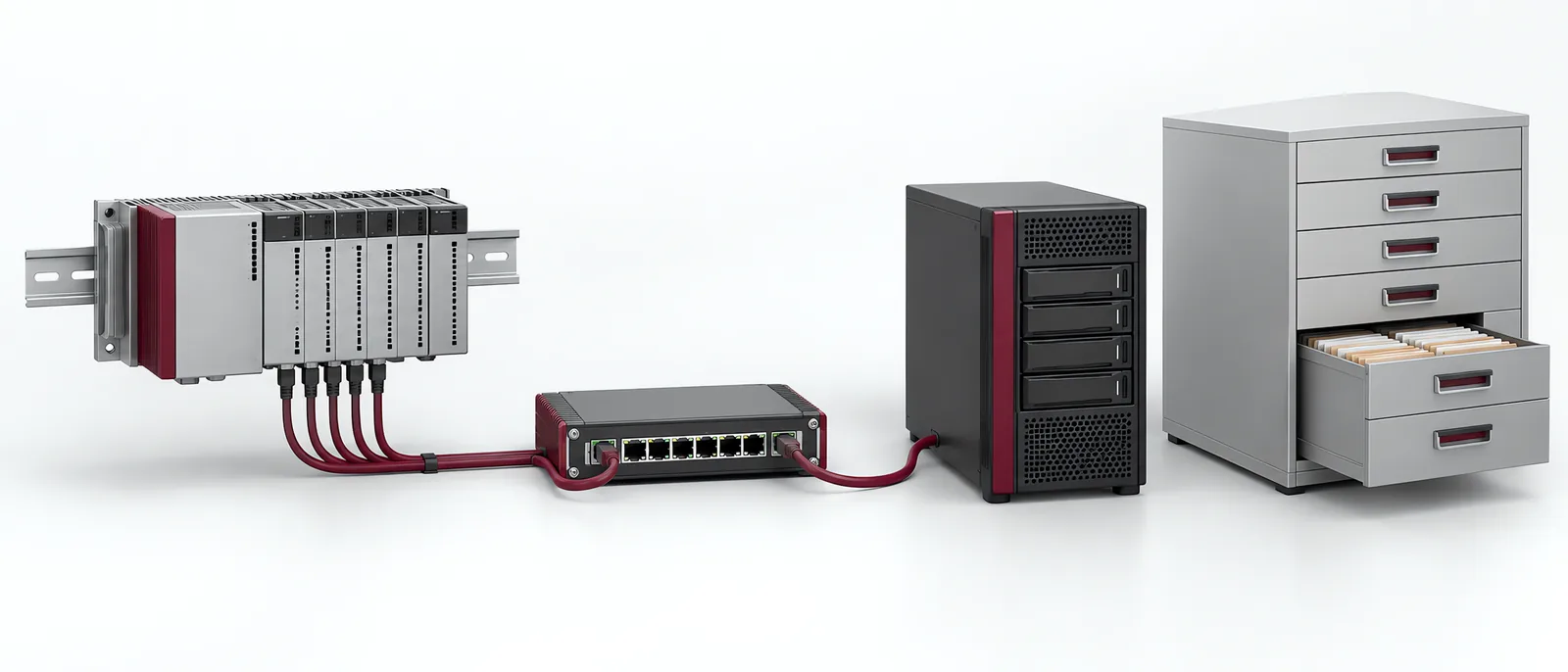
Conceptual equipment illustration.
An industrial data historian stores time-associated process values so that later analysis can reconstruct what happened. Specify the value, timestamp, quality and machine context together. A database containing many numbers is not automatically a usable history of production conditions.
For machine retrofit and modernization, the historian is a separate delivery stage after acquiring data from the equipment.
Preserve Time and Quality
Distinguish the time a measurement originates from the time a gateway receives it and the time it is stored. If a system uses receipt time because the source has no reliable clock, record that decision. Replayed buffered data should not silently become “new” measurements at the replay time.
Ignition’s Tag Historian documentation describes records containing value, quality and timestamp, with sampling/deadband configuration affecting storage. That example highlights fields to specify, not a promise that every historian stores every input sample.
Keep invalid or unavailable measurements distinguishable from measured zero. For equipment acquired through legacy-machine connectivity, preserve that status through the mapping layer.
Specify What Is Stored and What Is Calculated
A deadband can reduce stored changes; a fixed interval can omit fast events. Query interpolation or aggregation can also produce values that were not directly measured at the displayed time.
Define the intended use before choosing those settings. A production total, a temperature trend and a short alarm event can need different record types. Store recipe, operating state or part/batch identity where it is needed to interpret the value.
The machine-monitoring guide establishes production-state semantics. Carry the agreed state definitions into the historian’s tag mapping and query documentation.
Test Disconnection and Replay
Confirm the actual storage architecture, buffering capacity and behaviour when the destination becomes unavailable. Different historian implementations use different write and recovery mechanisms; do not assume every product feature applies to every storage engine.
Exercise a controlled disconnect with known values/events, then reconnect and query the interval. Check:
- Which records are present, missing or duplicated.
- Whether source timestamps and quality survived replay.
- How the system reports a full buffer or unavailable storage.
- Whether an ordinary user can retrieve the retained interval.
Retention and backup are separate decisions. Specify how long data remains available and how it can be restored if the storage system fails.
Hand Over the Query Contract
Name the tags, units, timestamp basis and query modes. A chart with an attractive continuous line should still reveal whether gaps were interpolated.
Coordinate dashboards and alarms with HMI/SCADA integration. Contact Motionwell about industrial history to define the acquisition, storage and retrieval tests together.