
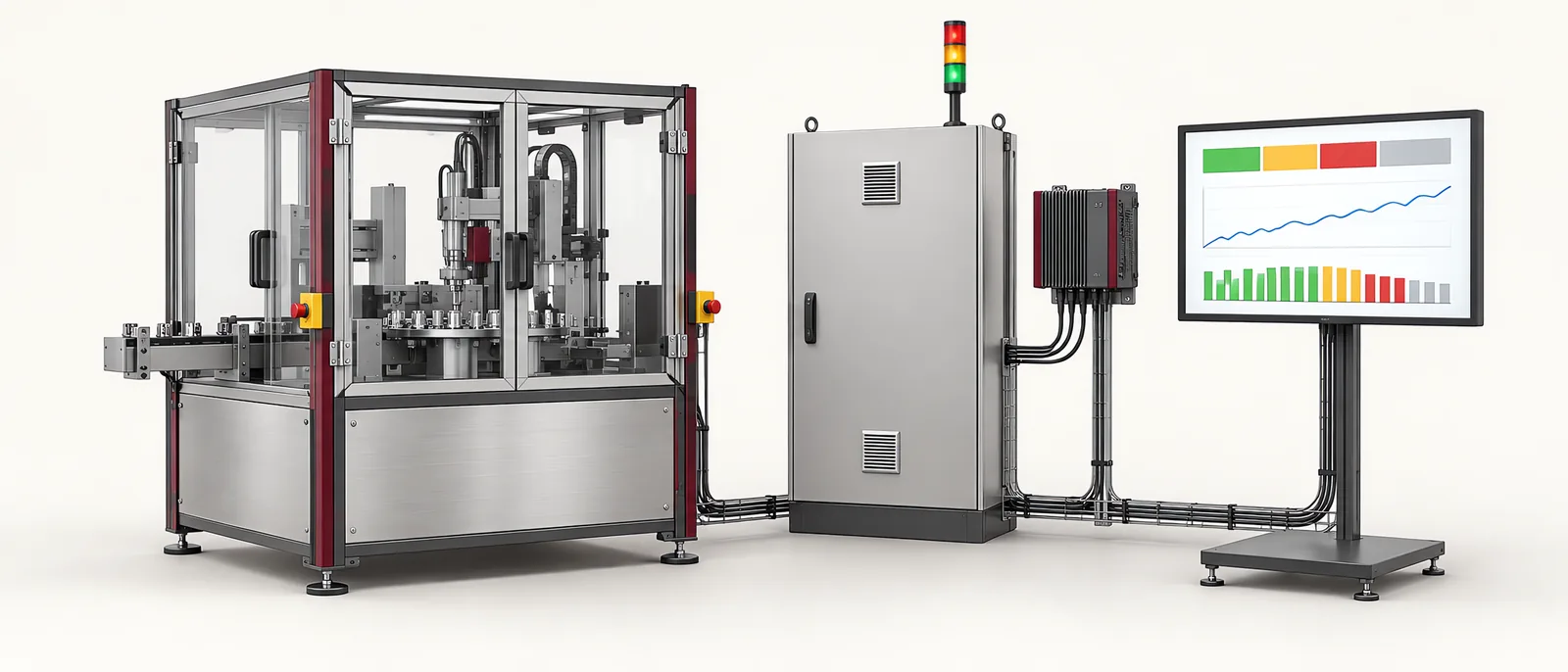
Conceptual equipment illustration.
A machine monitoring system turns equipment signals into a trustworthy account of production. Its value depends on whether states, counts and timestamps mean what the production team thinks they mean. Connecting a PLC and drawing a dashboard does not resolve those definitions.
Start with a decision the data should support: identify repeated stops, compare cycle variation or understand waiting time. Then define the observations needed to make that decision.
Write the State Dictionary First
Keep the machine’s operating condition separate from the monitoring connection. A disconnected data source is not evidence that the machine stopped. A running programme is not always evidence of accepted production.
MTConnect’s observation model explicitly represents unavailable observations. The same distinction is useful in a monitoring design even when it uses another interface.
A project-specific dictionary might include:
| State | Definition to agree | Evidence to retain |
|---|---|---|
| Producing | The agreed production cycle is active | Source signal and transition time |
| Waiting for material | Production is enabled but supply is absent | Demand and material-availability conditions |
| Blocked downstream | Output cannot be released | Receiving-machine permission or buffer status |
| Faulted | A defined machine fault prevents operation | Fault identity and acknowledgement history |
| Planned stop | Production is intentionally unavailable in the schedule | Schedule or operator classification |
| Unknown | The required observations are missing or invalid | Data-quality and connection information |
Adapt the dictionary to the process and define which state takes precedence when several conditions occur together.
Count at a Named Point
Specify whether a counter records starts, completed cycles, produced units or accepted units. Multi-cavity tooling and rework can make those numbers different.
Record resets and rollovers. If a PLC counter restarts after a power cycle, the historian must not turn that reset into negative production or count the same units twice. Test the behaviour using a known sequence.
The OEE guide explains the production inputs behind the metric. The monitoring system must supply those inputs consistently before an OEE percentage is useful.
Preserve Time and Data Quality
State how timestamps are assigned, how clocks are aligned and what happens when records arrive late. Decide whether the source records events or the collector samples values periodically. A short stop can be missed if the observation method is too coarse for the question being asked.
If communication is interrupted, show the gap explicitly. Where local buffering is provided, verify ordering and duplicate handling after reconnection. A continuous-looking chart made from repeated last values can conceal a real data outage.
The legacy-machine connectivity scope addresses how signals become available. This monitoring layer addresses their interpretation and acceptance.
Reconcile a Shift Before Scaling
Choose a representative trial period and compare the system with an independently recorded event sequence. Include production, material starvation, downstream blocking, a fault, a counter reset and a communications interruption.
Check whether the state durations account for the whole observation period without overlaps or unexplained omissions. Investigate discrepancies at the event level before changing a headline metric.
For reducing unplanned downtime, retain enough fault and sequence context to distinguish recurring causes. A list of stop durations without cause or machine context can be difficult to act on.
Keep Monitoring Separate From Machine Authority
Document which system observes and which system controls. A dashboard outage should have a defined effect on data collection; it should not unexpectedly alter the machine sequence. Any write-back function needs its own command and permission design.
Motionwell’s machine retrofit and modernization work can include the signals and controls around a monitoring project. Discuss the production question you want to answer.