
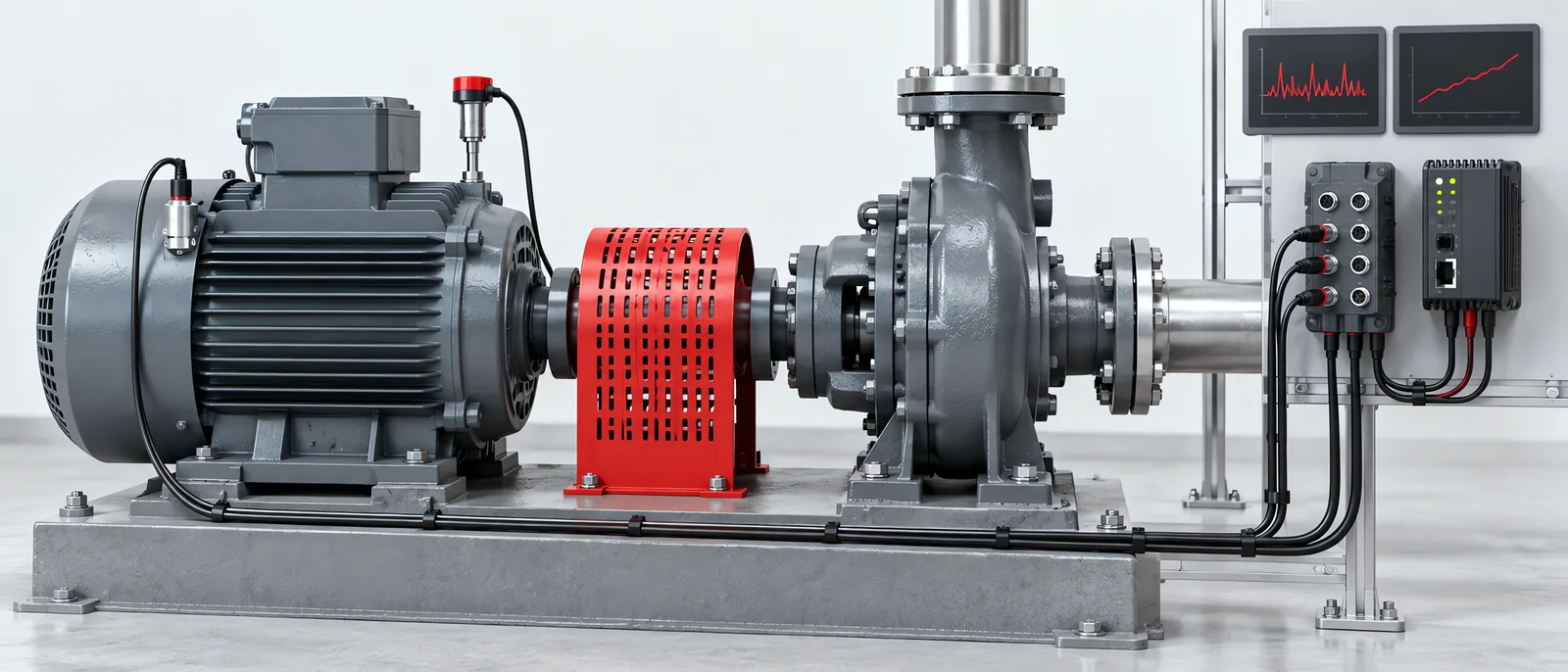
Conceptual equipment illustration.
A machine condition monitoring system observes changes in equipment health so maintenance can investigate before those changes become a production problem. Start with a named asset and a plausible fault mechanism, then select the signals, collection method and response. A dashboard becomes useful when an alert leads to a specific inspection or maintenance decision.
Condition monitoring is different from recording whether a machine is running, waiting or faulted. Our machine monitoring system guide covers those production states and counters. A health-monitoring project needs additional evidence about the physical asset.
Choose the Asset and the Decision First
For a motor-driven pump, the question might concern bearing condition, unusual vibration or rising temperature under comparable duty. For another machine, leakage, current or pressure behaviour may be more relevant. Choose sensors against the question, not a fixed list applied to every asset.
ifm’s drive-motor monitoring example combines several observations and describes routes for data integration. Use this manufacturer example to compare the observations and interfaces available for the asset you want to monitor.
Define the action alongside the signal. A sustained change might trigger an inspection at the next planned stop; another condition may need prompt escalation. The responsible maintenance team should agree the response, supporting observations and escalation route before alerts are enabled.
Know What the Sensor Actually Sends
An overall vibration value, a calculated condition indicator and a raw waveform are different data products. They need different storage and analysis. A trend that changes once per second cannot be treated as a high-frequency vibration recording.
ifm’s IO-Link vibration monitoring documentation lists process values for its VV family and describes a separate raw-signal BLOB collection option. Check the selected model, operating mode and interface: raw-data availability is not an automatic property of every IO-Link sensor.
For each required observation, specify:
- The quantity, unit and source device, including any scale conversion.
- Whether it is a sampled process value, calculated indicator or raw recording.
- The collection interval or capture method and its time reference.
- How invalid, stale or missing measurements are represented.
The legacy machine connectivity page covers the existing controller and interface survey. Reuse trustworthy observations already available, then add sensors where the maintenance question needs more evidence.
Put IO-Link in the Right Place in the Architecture
The sensor connects to an IO-Link master. The master and the chosen controller or gateway determine how measurements reach the collection software. Specify that upstream interface explicitly, including access permissions and the treatment of interruptions.
In ifm’s documented motor example, the software can expose processed data through MQTT or OPC UA. Those are integration options in that solution; an IO-Link connection alone does not establish an MQTT service or historian.
For a machine retrofit and modernisation project, separate observation from machine control. Decide whether the new system only records and alerts, or also requests a production action. Any action affecting operation needs its own control and safety review.
Compare Like Operating Conditions
A useful baseline records the asset’s operating context. Compare measurements at relevant speeds, loads and process states, and retain those observations beside the condition values. A change during startup may have a different meaning from the same change during steady production.
Set alert behaviour around that context. Decide how long a condition must persist, how repeated notifications are grouped and what ends the alert. Record maintenance interventions so a later review can distinguish a physical improvement from a changed sensor position or configuration.
This is the practical link to reducing unplanned downtime: the record should show what was detected, what was inspected and whether the resulting action addressed the problem.
Build a Data Foundation Before an AI Model
AI analysis needs identifiable assets, consistent units, operating context and usable maintenance labels. Collect those deliberately. A history of alerts with no confirmed inspection findings is weak training evidence for a model expected to name faults.
Begin with a bounded pilot: a small asset group, agreed observations and a maintenance workflow. Evaluate missed events, nuisance alerts and data gaps. Keep threshold-based monitoring as a usable baseline while testing whether a model adds information that changes a decision. A rising trend alone does not establish remaining useful life.
At acceptance, test a disconnected sensor, interrupted collection and restoration of stored data. Verify that an alert reaches its owner and can be traced to the underlying measurement and operating state.
Planning an IO-Link data collection or equipment-health pilot? Talk to Motionwell about the assets, interfaces and maintenance workflow.