
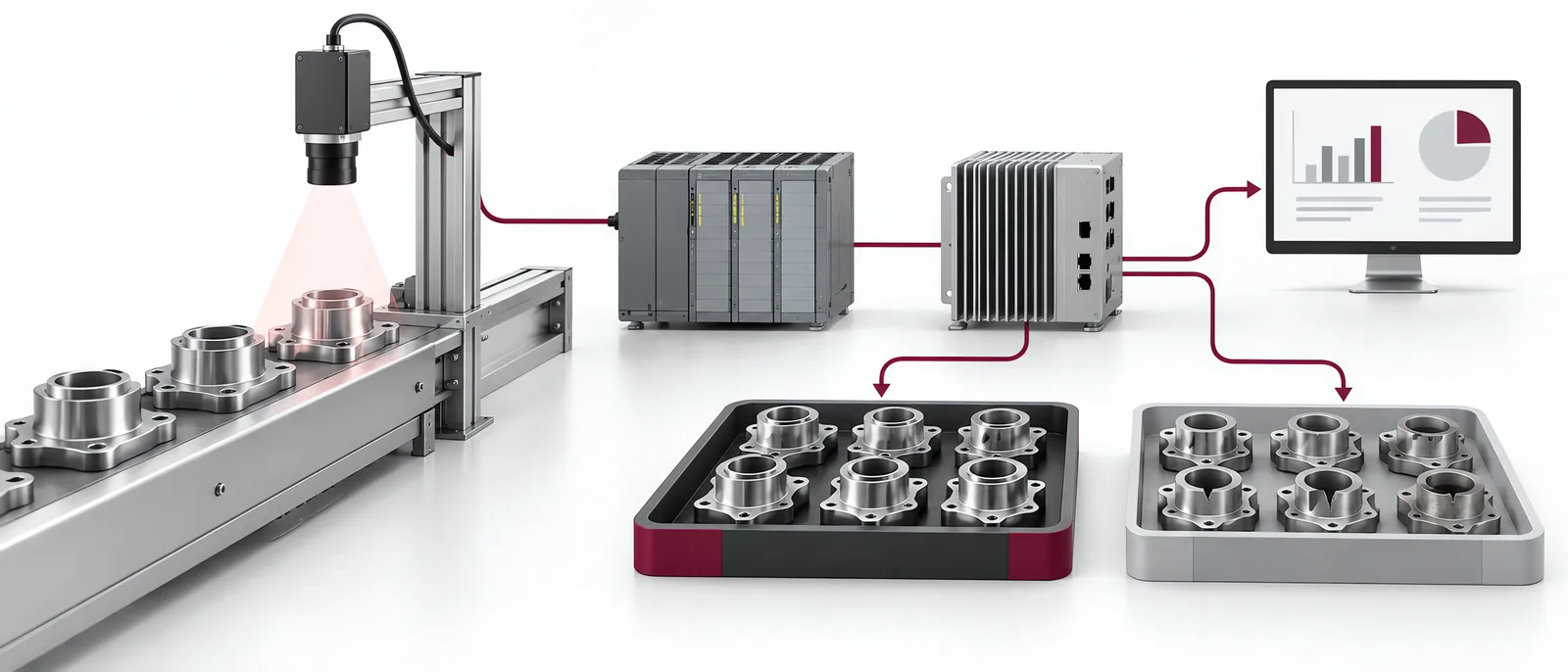
Conceptual equipment illustration.
Manufacturing AI data readiness means having evidence that the collected data can support a specific operating decision. Start with the task: detect a defined defect, identify a maintenance condition or explain a process deviation. Collecting every accessible tag is not a substitute for naming the action the analysis should improve.
Motionwell’s development direction connects industrial data collection with AI applications. The practical starting point is machine retrofit and modernization: establish the data route, then test a bounded application.
Define an Observable Outcome
Write the event or result the system is meant to identify. For maintenance, separate a machine fault, planned stop and product change. For quality, identify the relevant defect and when its label becomes available.
NIST’s industrial-AI data guidance emphasizes relevance and representative operating conditions, including rare events. More records are not automatically more useful evidence.
A starting inventory can be small if each field has a purpose:
| Field | What it lets the pilot distinguish |
|---|---|
| Machine and operating state | Production, idle, stopped or maintenance conditions |
| Recipe/product identifier | Different legitimate process settings |
| Timestamp and quality | Ordering, alignment and unavailable measurements |
| Measured variables | The physical conditions relevant to the task |
| Outcome label | What actually happened and how it was confirmed |
The legacy-machine connectivity scope covers obtaining available machine signals. IO-Link and other interfaces expose device-dependent data; the readiness review must identify what actually reaches storage.
Audit Labels before Training
Maintenance notes and inspection labels can be incomplete or recorded later than the event. Check the relationship between their timestamps and the sensor history. A repair date is not automatically the moment a fault began.
Keep operating context with the data. A value during one product recipe may be normal while the same value under another is unusual. The OEE guide explains production-state distinctions that also matter when constructing an AI dataset.
Review missing intervals and changes in sensor settings. Do not smooth away a transient merely because it makes a chart look less tidy; determine whether it is relevant to the task.
Hold Back New Production Conditions
Test the application on parts, batches or time periods not used to develop it. Avoid placing repeated samples from the same event on both sides of the split.
Compare the result with a stated baseline, such as the existing rule or operating check. Record missed relevant events, unnecessary alerts and uncertain cases. If rare failures are absent from the evidence, keep that limitation visible in the pilot test record without inventing predictive performance.
Connect the Result to an Action
For a maintenance task, define who reviews an alert, what evidence they see and what confirms its outcome. A model output that creates no usable action has not completed the workflow described in the downtime-reduction guide.
Discuss an industrial-data and AI pilot with Motionwell. Start with one decision and the data needed to test it, then expand from the result.