
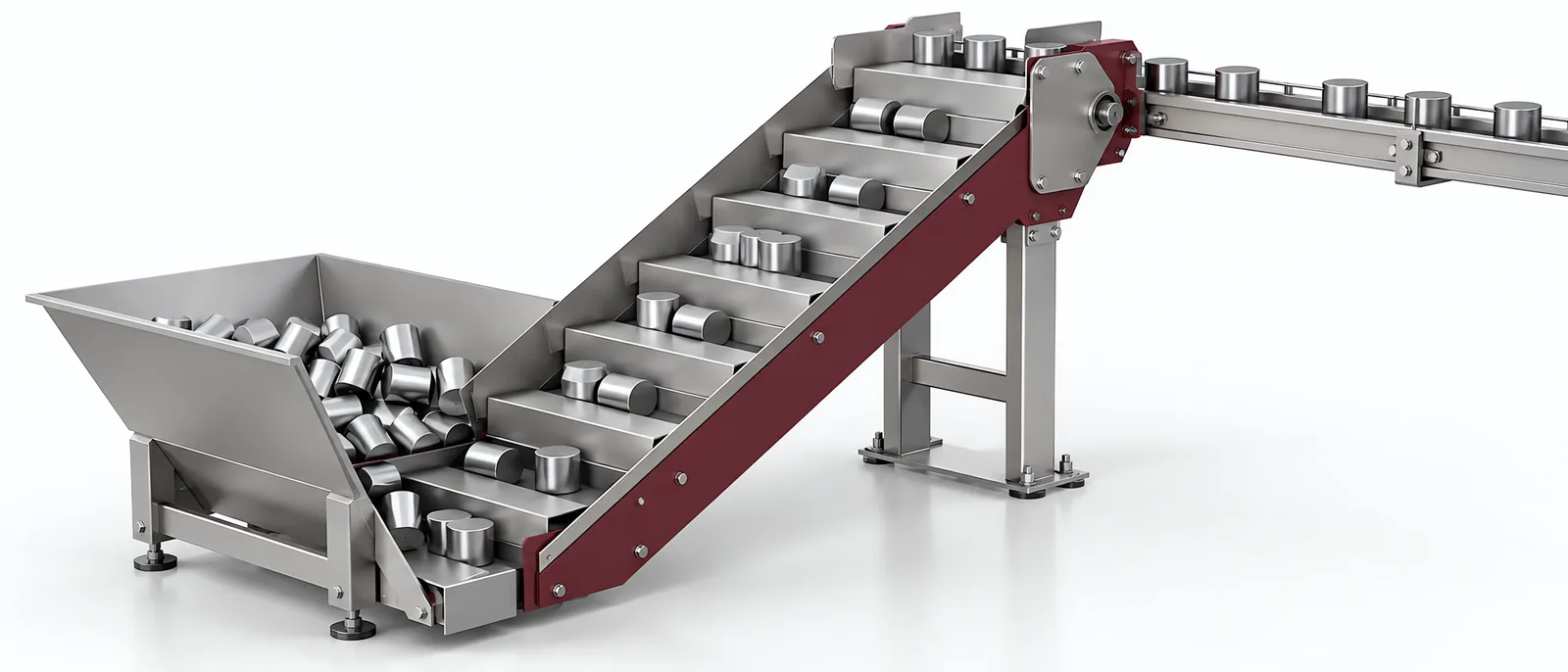
Conceptual equipment illustration.
A step feeder lifts bulk parts through reciprocating steps and transfers them to downstream equipment. That lift does not automatically orient every part or deliver it one at a time. Specify the orientation tooling, track and escapement needed after the lifting section.
Within custom assembly automation, the required output is a usable presented part, not simply movement out of a hopper.
Follow the Part Beyond the Last Step
RNA’s step-feeder operating instructions describe alternating step frames transferring parts upwards and a chute supplying downstream equipment. The next equipment determines the presentation delivered to the process.
Separate these functions in the quotation:
| Function | Required output |
|---|---|
| Bulk lifting | Parts reach the downstream transfer without damage |
| Orientation | Parts leave in the agreed orientation |
| Buffering | Enough correctly presented parts are available |
| Escapement | One part is released for the next operation |
The part-feeding and presentation scope explains how these functions fit together. Calling all of them “the feeder” can hide a missing track or release mechanism.
Trial Part Variation at Several Hopper Levels
Use the actual component family, including allowed dimensional and finish variation. Observe whether parts interlock, bridge or collect at the transfer. Compare operation near the agreed minimum and maximum bulk fill levels.
Measure the supply of usable parts at the escapement. A high lifting rate is not enough if orientation tooling rejects most parts or the track remains starved.
If delicate surfaces matter, inspect after feeding. The absence of visible marks on a few hand-selected parts is not a complete handling trial across the intended bulk condition.
Define Track Demand and Back-Pressure
The step feeder should respond to the downstream buffer. Test a full track, stopped escapement and blocked transfer. Repeatedly pushing parts into an occupied path can change how they sit or damage them.
Keep shortage and jam states distinct. A station waiting for parts and a mechanism requiring recovery need different responses. Record how each is detected and how it returns to normal supply.
A centrifugal feeder uses a different bulk-delivery mechanism; compare it using the same presented-part requirement. Do not choose between them using the movement mechanism alone.
For a rotary indexing assembly machine, verify that the escapement releases exactly one part in the available transfer interval. The final trial should cover the feeder and receiving nest together.
Contact Motionwell about the component flow to plan bulk supply, orientation and handover as a complete feeding task.