
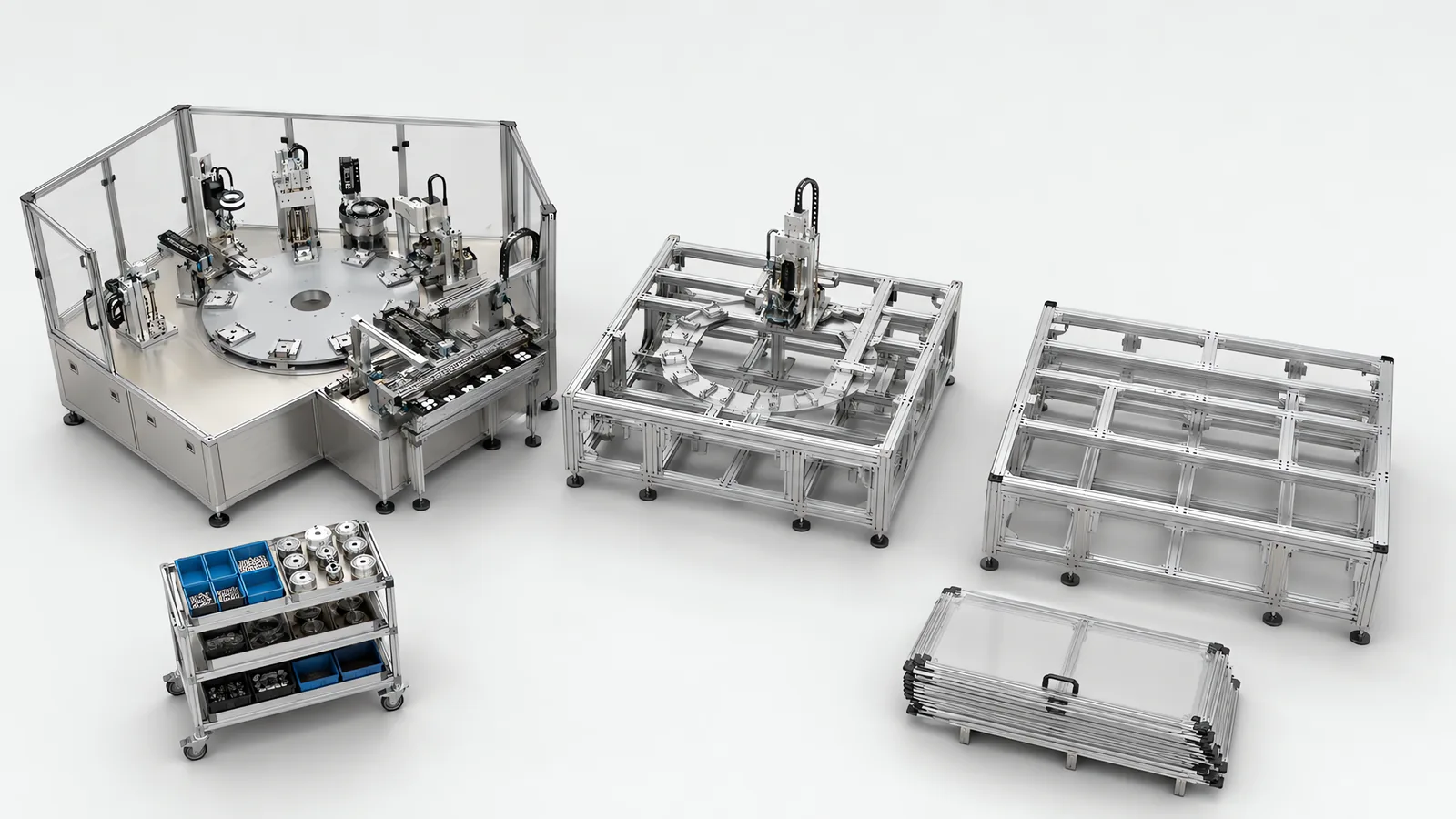
Motionwell Automation is a Singapore automation company providing custom machine design, system integration and control-system modernisation. We build around your parts, sustained production rate and site conditions, then deliver the machine with acceptance tests, drawings, schematics and program documentation. Design, assembly and testing take place at Woodlands Link.
Delivered work includes a vision-guided SCARA sensor panel assembly cell, a five-axis CNC shot peening machine, a three-head filling and sealing platform, and a low-profile robot seventh axis. These illustrate the difference between buying a component and commissioning a complete machine: tooling, controls, guarding and recovery behaviour are engineered together.
Each section below points at the page that owns the subject, and the full index of equipment classes is the capabilities hub.
What Kind of Automation Company Is Motionwell, Precisely?
It is a machine builder that also integrates, which is narrower than the search phrase suggests. Four kinds of supplier turn up on a shortlist assembled from a search for automation companies in Singapore, and they are not really competitors, because they sell different objects.
| The supplier | What you are actually buying | What they will not do | When that shape is right |
|---|---|---|---|
| Custom machine builder and integrator | A machine drawn against your part, rate and site, built and tested here, handed over with its documentation | Sell from a shelf, certify the machine for you, or run your production | The sequence exists in your process sheet and in nobody’s brochure |
| Equipment distributor | A catalogue model with a published price, an installed base and spares under an order code | Redraw the machine around your container, your tolerance or your line | A proven standard machine already covers your part at your rate |
| Engineering consultancy | A specification, a layout and a tender package, independent of whoever builds it | Own the mechanism, the cycle time or the acceptance evidence | You are going to tender and want a vendor-neutral requirement first |
| Contract manufacturer | Your product, made on somebody else’s equipment | Give you a machine or an asset on your books | You want output |
The first row is two businesses on one line, and that is where the confusion sits. The phrase system integrator covers a company that assembles bought equipment into a working line, and a company that also designs equipment nobody sells. We do both, and the second is what changes what you are allowed to ask for: when a fixture, a feeder or an end effector has to be drawn from scratch to make the cell work, that is an engineering task inside our scope, and no reason to change the specification.
The consultancy row is worth taking seriously. If you have four suppliers to compare and no document they can all quote against, the missing item is a requirement, and our page on writing an automation URS turns differently shaped proposals into one comparable table. The questions worth putting to any builder on that shortlist, including us, are in our guide to choosing an automation system integrator. If what you have is a problem, start instead from custom automation solutions.
What Do We Actually Build?
Six groups, sorted by what the machine has to do and never by the industry it goes into: a filler for a pharmaceutical vial and a filler for a paint pail are different machines, while a filler and a capper on the same bottle are one project.
| What the machine has to do | Delivered work behind it | Start here |
|---|---|---|
| Fill, close, code and pack | GMP filling and sealing on a tray platform dosing through three heads in parallel, with the accuracy band and the rate set by your product and closure; net-weight dosing at the drum and pail end | Filling machines, drum and pail filling, capping and sealing, labelling and coding, case packing and wrapping |
| Move it | A 4-axis column palletizer stacking cartons from a purely vertical lift column on a heavy-duty linear track; a welded steel single-beam gantry serving more than ten CNC machines from one long X axis; eight laser-guided AGVs at 1,500 kg each | Palletizing systems, machine tending automation, robot integration services, AMR and AGV integration |
| Join it | SCARA sensor panel assembly at plus or minus 0.01 mm repeat positioning with vision guidance and an electric screwdriver station | Medical device assembly machines, rotary indexing versus inline assembly, how we design rotary indexing assembly machines, screwdriving and fastening |
| Prove it | Cleanroom automated test equipment running 4 to 6 stations under fan filter units holding ISO Class 7/8, with SPC-ready data export; a QA laboratory landing samples to plus or minus 0.5 mm | Machine vision inspection, automated test equipment, inline dimensional measurement, laboratory automation |
| Modernise it | Obsolete PLCs, servo drives and VFDs replaced on machines whose mechanics are still sound, onto a platform still in current production and preferably the one your plant already runs | Machine retrofit and modernisation, PLC migration and upgrade |
| Make it provable | Torque curves, force-displacement curves and process parameters logged against a serial number | Machine safety and CE marking, computer system validation, electronic batch records |
One thing sits behind several of those rows and is worth saying explicitly. Robot arms, controllers, cameras and drives are bought; what has to be drawn against your product is the tooling, the part presentation and the fixture, which is a common reason a cell misses rate, and it is the work described on our end of arm tooling page.
The last row is a documentation project running alongside the build, and never a feature added to it afterwards. Safety functions are rated for a performance level under ISO 13849-1 and validated, and once a machine’s log is the evidence that a step was performed correctly it falls under rules such as 21 CFR Part 11, which decide where the record is stored, who may alter it and what audit trail follows. Where the whole scope sits under one contract, that shape is on the turnkey automation systems page.
Which Industries Have We Delivered Into?
Our delivered work covers the sectors below, with EV battery dismantling described in the linked case study. The mechanism may transfer between sectors; defect consequences, record requirements and qualification work change the engineering scope.
| Sector | What it changes about the engineering | The page |
|---|---|---|
| Medical devices | Cleanroom compatibility, serialised records per unit, and validation running beside the build | Medical device automation |
| Pharmaceutical packaging | GMP construction, dosing accuracy proven, and serialisation on top of the line | Pharmaceutical packaging |
| Electronics and semiconductor | ESD control, particle control under motion, and fixtures for connectors | Electronics and semiconductor |
| Aerospace and precision | A process specification owned by somebody else’s approval authority, and a machine that records it held | Aerospace and precision |
| Warehouse and intralogistics | Traffic, handover points and the interface to a warehouse system | Warehouse and intralogistics |
| QA laboratories | Instruments as the process, scheduling as the design problem, and technicians working in the same room | QA laboratory automation |
| Consumer products | Mixed SKUs, quick-change tooling and pack formats that move faster than machines do | FMCG and consumer products |
The delivered builds, with what each one gave up, are in the case studies: among them a QA laboratory programme re-ordered in four consecutive years and an EV battery dismantlement line where the workpiece cannot be switched off. Read one of those before a capability page if you want to know how we work; for the reasoning behind a machine class, see how we design multi-station rotary assembly machines.
How Big Are We, and What Does That Buy You?
We are small enough that the answer is worth stating. Motionwell operates five units at 20 Woodlands Link: a design centre for mechanical and electrical engineering, an assembly and integration centre where machines are built and acceptance tested, and a manufacturing shop for CNC machining, sheet metal fabrication and precision grinding. The year-by-year story and the full certification list are on our about page.
What that scale is genuinely good for is a short list, and all of it comes from everything being in one building on one island.
- The engineer who drew your fixture is in the same building as the machine, so an adjustment found at assembly is a morning.
- You attend the factory acceptance test in an afternoon instead of flying to it, and more than once, which changes how many iterations the test gets and never how rigorous each one is.
- Concept, detail design, build and commissioning are done by the same people, so the reason behind a decision taken in week two is still in the room in week twenty.
The same scale sets the shape of work it suits. One facility and a design team of eight build machines one or a few at a time, drawn against a specific part, so a programme needing twenty identical machines commissioned across four countries in one quarter is a volume problem answered by a different kind of supplier.
What Does Buying a Machine From Us Actually Take?
It takes five stages from concept approval, with a decision from you at the end of each one.
Lead time runs 16 to 24 weeks from concept approval to factory acceptance testing on a standard build, and 24 to 32 weeks where cleanroom compatibility or full GMP validation applies, with a regulated build adding four to eight weeks of qualification work on top. The clock starts at concept approval, which puts everything before that outside the numbers quoted here.
Before any of that, a quotation needs a requirement to answer. A budget range comes out of concept design review and the detailed quotation follows it. To get that far we need the part, the sustained rate, the space and the interface to whatever the machine has to talk to, which is the list at the end of this page. What happens between the enquiry and a working machine, stage by stage, is on our automation project process page, and the engineering inside those phases is in the special purpose machine design guide.
Two things are worth insisting on from any builder here. Bring your awkward parts to the acceptance test: the underweight one, the one from the end of the tool life, the batch that came back out of specification and got used anyway. A machine that handles the nominal part is not the same machine as one that handles your distribution. And agree what the handover pack contains before the machine is built.
How Do We Compare With a Distributor, an Import or Your Own Engineers?
Four routes, compared on the things that actually differ. The bottom row is the one to read first.
| Custom builder here | Equipment distributor | Overseas machine builder | Your own engineering team | |
|---|---|---|---|---|
| What you can change about the machine | Anything, until design freeze | Whatever the model offers as options and change parts | The same, negotiated across a time zone | Anything, subject to your own drawing office capacity |
| Price discovery | A quotation after concept review | A list price against a model number | A quotation, plus freight, insurance, clearance, rigging and commissioning travel | Internal cost, with no margin and no fixed price |
| What the lead time is measured from | Concept approval, 16 to 24 weeks to acceptance testing | A delivery date, then your own integration work | Concept approval, plus a sea freight leg and a crate | Whatever capacity is left after the plant’s day job |
| Where acceptance testing happens | Woodlands Link, attended in an afternoon, more than once | On your floor, after delivery | At their works, once, after a flight | On your floor, by the people who built it |
| Spares and service | Components listed in the handover pack, local support | An assembly under an order code, plus a service network | An order code with a shipping leg attached | Whatever your stores already hold |
| Who owns the rate if it misses | Us, against the agreed acceptance criteria | Nobody, unless integration was in the scope | The builder, at a distance, under whichever law the contract names | Your own team, alongside production |
| Where this route wins | The part sets the machine and no catalogue reaches it | A proven machine already covers your part at your rate | A mature standard product bought at volume, or a specialist process built elsewhere | The fix is a fixture, a program change or a process decision, and nobody knows the process better |
The internal engineering column deserves more than a row. Where your own team has drawing office capacity, shop time and somebody who can own the safety file, they are frequently the right answer, and there is no margin in their number. The condition is capacity: an internal build competes with the plant’s daily firefighting, so the question to settle first is who protects the drawing time and the documentation when production calls. Whether the purchase is worth making at all, by either route, is arithmetic set out on the automation ROI page, which contains the cases where the numbers say do not automate.
Two of those columns have their own pages, because a row in a table is not enough to decide on. The thresholds that close and open the catalogue option are on custom machine versus standard equipment. Landed cost, acceptance testing, spares and modification response against an import are on local versus overseas machine builder. And if the machine already exists on your floor and the question is whether to fix it or replace it, that is the retrofit versus replace decision.
What Makes a Project a Good Fit for Us?
The work suits us when the part is yours, the process has no catalogue answer, and somebody has to be accountable for the rate at the end of it.
Your part sets the machine. The strongest fit is a process where the tooling has to be dimensioned against your component: a nest cut to your container, a gripper shaped to your panel, a station sequenced around how your product actually behaves. That is the work a catalogue cannot reach, and it is what a custom build is for.
Settled equipment gets integrated into the line. A whole family of end-of-line equipment is made in quantity and works well: carton erectors, case sealers, shrink tunnels, stretch wrappers, can seamers, induction sealing heads and high-speed rotary roll-fed labellers. We buy those and design the line around them. On an induction seal the result is decided by the cap, the liner and the application torque, so the value sits in specifying and proving those settings. Which parts of an end-of-line we build and which we buy is on the case packing and wrapping page.
Mobile robot fleets come with a supply position behind them. We have held an authorised AGV distributorship for Southeast Asia since 2017, so fleet work carries a supply route and a support line as well as the integration, described on the AMR and AGV integration page.
Conformity work is part of the build. The machine is designed to a specification and the evidence package is assembled with it: the risk assessment, the safety architecture, the validation and the technical file, with accredited LVD and EMC testing arranged at an external laboratory and Ministry of Manpower lifting certification where the machine includes lifting equipment. How that package fits together is on the machine safety and CE marking page.
Software ships with the machine. The control and recipe software is part of the delivery, and the vision work is specified end to end: camera, lens and lighting chosen for the feature you have to judge, then proved on your parts before the station is built.
A realistic date buys a machine debugged at our facility. Sixteen weeks is the short end of a custom build, and a schedule with room in it produces a machine that finishes its debugging on our floor instead of in your production. Where the process is genuinely new, a proving trial goes into the schedule first, which turns an opinion into a number before anyone commits to a design.
The same fit question, applied to the choice of arm inside a cell, is worked through on our cobot versus industrial robot page.
Frequently Asked Questions
Can you take on a machine another company built?
Yes, and it is the largest line of work we run in 2026. Control system modernisation keeps the mechanics and rebuilds everything that decides them: the PLC, the servo drives, the VFDs, the HMI, the safety circuits and the wiring between them, normally onto a controller and drive family still in current production, and by preference the platform your plant already stocks and trains on, because an unfamiliar platform trades an obsolescence problem for a training problem. Two things decide whether we can quote it: whether drawings and a program archive exist, and how far the change goes, because for machinery placed on the EU market a modification extensive enough to make it de facto new machinery puts whoever did it in the manufacturer's position.
Who owns the drawings and the PLC program after handover?
You do, and the pack is a deliverable. Every delivery includes mechanical drawings, electrical schematics, PLC program documentation, operator training materials, maintenance schedules and spare parts lists, and on modernisation work the pack also carries as-built drawings, the I/O list, calibration records and an alarm list with each alarm mapped to a stop reason. Ask for one item explicitly at quotation stage: a program archive with a named owner, plus the parameter files for every drive. That is the difference between recovering a machine after a corrupted controller and rebuilding it.
What support do we get once the machine is running?
The support plan names the response window, escalation contact, critical spares and consumables for your machine. We identify long-lead components during quotation so your maintenance team can decide what to hold in Singapore. The handover pack includes replacement intervals and the checks an operator or technician performs on shift.