Motionwell Automation builds turnkey automation systems in Singapore: one coordinated scope for concept development, mechanical and electrical design, software, build, acceptance testing, installation and documentation. The line is designed around your process, sustained output target and existing equipment. Delivery can cover a complete new line or proceed station by station around the shutdown windows your plant can release.
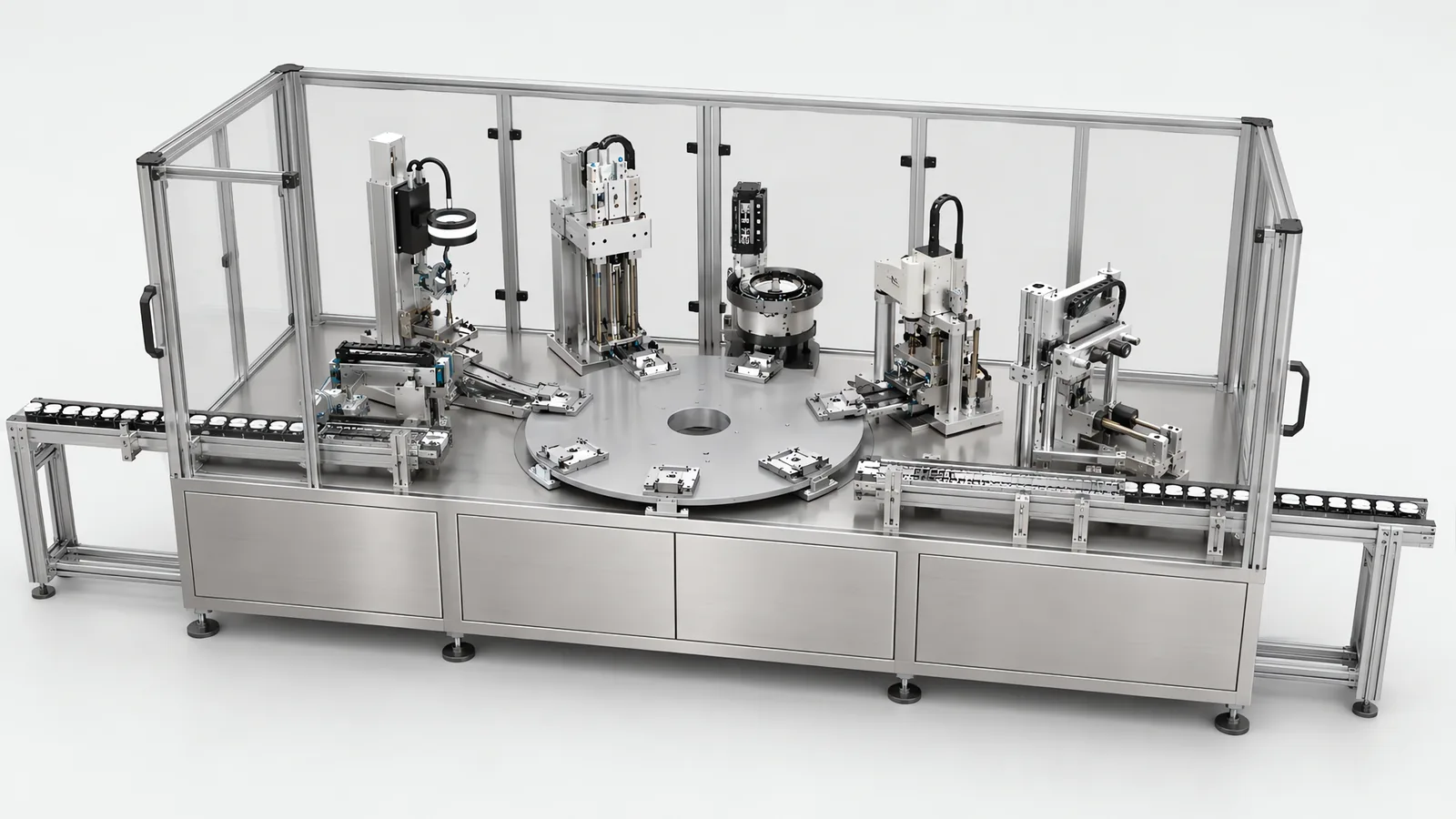
Delivered integration work includes a battery pack dismantling line combining robot handling, tooling, fixtures and controls, and a warehouse AGV programme linking pallet transport with storage and enterprise warehouse records. For a new multi-station assembly process, our rotary indexing assembly machine page shows how station layout, pressing, inspection and part records are planned together.
Machines are designed, assembled and tested at our Woodlands Link facility, and the company has delivered more than 150 special purpose machines since 2014 under ISO 9001:2015 and bizSAFE Level 3.
Single-source delivery gives the integrated line one accountable engineering team. The practical work is to define the interfaces, prove the stations together and hand over a line your team can operate and maintain. Our guide to what turnkey automation includes follows the delivery phases; this page explains how to scope and accept the system.
What Does a Turnkey Contract Actually Transfer?
One thing, and it is worth naming precisely, because a buyer and a supplier who believe different things were bought will find out at the worst possible moment.
Each piece of a line can be procured separately. Arms, conveyors, cameras, drives, panels and standard packaging machines are all catalogue items with datasheets. What has no catalogue entry is the assurance that those pieces will hold a sustained rate on your parts, in your building, with your operators, and recover sensibly when one of them faults. That assurance is integration risk, and a turnkey contract is the instrument that moves it from your side of the table to ours.
Four risks move with it. The cycle time measured on your actual parts, and not gate to gate with a dummy load. The handshake between every pair of stations, including what each does when the other stops. The safety functions that span more than one piece of equipment, since a stop category means nothing unless somebody owns both ends of it. And the record the line produces, which is a design decision taken at concept and an expensive retrofit at any point afterwards.
Transferring risk is not free, and the price is not mainly a line on the quotation. It shows up in three places.
The scope has to be complete before the price can be firm. Whoever carries a risk prices what they do not yet know about it, so a requirement written loosely is priced as a wide one. The work that shortens that is yours and it happens before the quotation, which is what our guide to writing an automation URS is for.
Change stops being a conversation and becomes a change order. Under a split scope you can re-brief one vendor quietly. Under a single scope, a change to one station is a change to the contract, because the party that guaranteed the whole has to re-check the whole.
You give up shopping subsystem by subsystem. The party accountable for the result chooses the components that produce it. You can still name a platform standard, and you should, because the right controller is frequently the one your technicians already know.
How Are Bought-In Equipment and Plant Interfaces Integrated?
A turnkey line brings standard components, custom stations and existing plant equipment into one operating sequence. The scope identifies who supplies each item, the connection it needs and the acceptance test for that connection.
Start with what we buy. Robot arms, cameras, drives, load cells, flow meters and piston pumps are bought in, and so is a family of settled packaging machines: carton erectors, case sealers, shrink tunnels, stretch wrappers, can seamers, high-speed rotary roll-fed labellers and induction sealing heads. Those are mature designs made in quantity, and specifying one is the right answer. Turnkey describes who is accountable for the result.
Then the equipment you already own, which is where the boundary becomes real. On the QA laboratory programme, re-ordered in four consecutive years by a global medical device manufacturer, the automation drives the customer’s own universal testing machines directly for zero-reset, speed setting and test start; the instruments were theirs and the bidirectional link across that boundary was ours. We have also integrated tooling onto customer-supplied collaborative robot cells. Each of those is a boundary with a signature on it.
Then another vendor inside the same project. On the warehouse programme our scope was the vehicle fleet, the conveyor interfaces, the fleet software and the warehouse management integration, while the racking and the stacker cranes came from the storage vendor. The crane side ran on the storage vendor’s own controls, talking to the fleet management server over industrial Ethernet, and pallets were handed conveyor to conveyor. That last choice is the one worth copying. A fork exchange makes two machines from two suppliers agree on pallet position to a few millimetres, and every tolerance in the rack, the vehicle and the pallet itself lands on that agreement, while a conveyor-to-conveyor handover only asks them to agree on a signal and a dead stop. Two suppliers, one line, and one link between them that had to be agreed.
| Element of a complete line | Machine and integration work | Details to agree during scoping |
|---|---|---|
| Process stations and their tooling | Designed, built, tooled and proved on your parts | Part numbers, variants, samples and acceptance tolerances |
| Transport between stations | Conveyors, transfers, robots, buffers and sequencing logic | Product presentation and manual or automated transfer at each end |
| Standard machines in the line | Specified, procured, installed and integrated | Which brand and model, where the spares come from |
| Existing equipment the line must drive | The interface, the signals and the sequence across it | Whether that machine may be modified at all, and by whom |
| Guarding and safety functions | Risk assessment input, safeguarding, safety circuit, validation | Your plant safety standard, and who accepts residual risk |
| Control system and records | Cell and line controllers, HMI, recipes, data the line produces | The receiving IT system, and who inside your company owns it |
| Utilities to the machine | Machine connection points and demand schedule | Plant-side supply capacity and installation owner |
| Building services | Layout and service requirements coordinated with the site team | Power capacity, drainage, extraction routing, floor loading, access |
One legal boundary belongs in this list because it is settled by scope. Where a turnkey line reaches into a machine you already run, the work can cross the line the European Commission describes as existing machinery modified to such an extent that it becomes de facto new machinery, set out on its machinery page. Below that line you keep an existing machine with a change on it. Above it, somebody is placing new machinery on the market and carries the conformity work that follows. Where the line sits is a judgement made per project, and it has to be settled before the scope is fixed. The full version of that decision is on our retrofit and modernisation page.
What Is on the Interface List, and Who Signs It?
The interface list is the document that decides whether a turnkey project works, and it is not the specification, the layout or the schedule. It is a numbered register of every place two things meet, each row carrying one named owner and one test that proves the row is finished.
A single-supplier contract puts station-to-station coordination inside one engineering team. The same register also covers plant utilities, customer-supplied machines and IT systems, with an owner and a test for every connection needed at commissioning.
| Interface class | What the row has to state | How the row gets closed |
|---|---|---|
| Mechanical | Transfer height, pitch, product orientation, and which side hands over | Measured on the existing line before design |
| Electrical supply | Voltage, phases, available capacity and the point of connection | Confirmed against the switchboard, in writing |
| Control signals | Part ready, cell ready, buffer full, fault and reject asserted, each with one owner | Proved point by point at commissioning, both directions |
| Safety | Whose emergency stop removes whose power, which stop category applies, and what state the line comes back in | Validated on the built line, with the evidence retained |
| Data | Which values leave the line, in what format, to which system, and who approves the path | Demonstrated end to end with a real record |
| Product and consumables | Who supplies the closures, liners, media, adhesives and trays, and to what specification | The consumable supplier’s own document |
| People | Who clears a jam, who changes format, who holds the keys to a bypass | Written into the operating procedure before handover |
Two habits make the list work. Give every row a person’s name, because a company cannot be asked a question on a Tuesday afternoon. And date each row when it is agreed, so a change to an interface is visible as a change. How to make each of those rows testable in the first place is on the URS page.
What Does Single Point of Accountability Actually Buy?
It buys one owner for the number, which is the thing being purchased and the thing most easily given away by accident.
The number is sustained rate on your parts, measured at acceptance against a stated counting rule. Under a split scope that number belongs to nobody: each supplier can demonstrate their own equipment working correctly and still leave you with a line that does not make rate, because rate is a property of the whole and every party owns a part. Under a turnkey scope one party has to stand behind it, and cannot resolve a shortfall by pointing at somebody else’s equipment.
Three things dissolve that, and all three are done with good intentions. Free-issuing equipment into the scope without a performance statement attached to it. Keeping one station outside the contract because you already have a good supplier for it. And keeping a signal, usually a legacy one, because your own team wrote that logic years ago and understands it.
None of the three is forbidden, and a split scope is a normal thing to buy. Each just has to be recorded as a change of owner on the interface list at the time it is agreed, so nobody discovers it at acceptance when the rate is short and the argument is expensive.
How Is a Multi-Station Line Staged, Tested and Installed?
It is staged in an order chosen so that as little as possible happens on your floor, because floor time is time your line is not producing, and that hour is yours.
Stations are built and proved individually before they are linked. A station running against simulated inputs gives an unambiguous fault: the mechanism, the tooling or the sequence is wrong, and there is nowhere else for the problem to hide. Once four stations are coupled, a dropped part at station three can be a gripper, a fixture, a timing assumption at station two or a conveyor that stopped somewhere else, and every hour of that ambiguity is paid for at four stations.
The stations are linked and run as one line at Woodlands Link for factory acceptance testing. Our in-house team handles design, assembly, integration and testing; machined and fabricated parts from Singapore subcontractors are inspected before assembly. Bring the operators and maintenance staff to FAT so they can review access, recovery and changeover while the line is on our floor.
Shipping splits the machine again. A line arrives through your doors and around your corners in the sections it was designed to ship in, which is a design constraint, and section joints have to land where re-alignment is quick.
Installation is then scheduled into the windows the plant actually has. Rigging, power, network connection and safeguarding do not happen mid-shift, so they go into shutdowns and weekends, and on our laboratory automation work the delivered system ran in parallel with the manual workflow until each station was accepted. Whether that parallel route is available at all is a site question: floor space beside the running line, a feed that can be diverted, utilities reaching the new position, and enough people to run two configurations at once. The version of that trade for an existing machine is on our retrofit versus replace page.
Lead time runs 16 to 24 weeks from concept approval to factory acceptance testing on a standard build, and 24 to 32 weeks where GMP or cleanroom validation applies. Read those as calendar time: almost all of it happens in our building while yours keeps producing.
What Does the Site Team Prepare for Installation and Handover?
Site preparation runs alongside machine construction. Four workstreams keep the installation and production release aligned with the build.
Utilities and access. We prepare the machine’s demand schedule and connection layout with the site team. It covers electrical supply, air pressure and consumption, extraction, drainage, floor loading and access. On the cleanroom test equipment, valve-bank pressure follows each station’s test force; the shot peening machine adds dust-collection connections. A battery project also needs its extraction and containment arrangements defined from the process and facility assessment. These requirements enter the plant installation plan before the machine arrives.
Product and consumables. Acceptance samples represent the production range, including tolerance extremes and known defects. Closures, liners, media and adhesives are specified with their operating windows so the tooling and tests reflect the material your line will use.
Operating and maintenance readiness. Mechanical drawings, electrical schematics, PLC documentation, manuals, maintenance schedules and spare parts lists support the team taking over the line. We agree training, access levels, critical spares and the support route as part of handover planning.
Shutdown and production release. The installation plan names who releases each work area, coordinates isolations, witnesses acceptance and authorizes production. Safeguarding verification, operator training and any open actions are reviewed together before the line enters service.
| Site workstream | What to agree | Completion evidence |
|---|---|---|
| Plant utilities | Capacity, connection points and installation responsibilities | Services checked against the machine demand schedule |
| Access and shutdown hours | Rigging route, work areas and tie-in windows | Agreed installation and isolation plan |
| Product and consumables | Production range and test quantities | Samples and material specifications ready for acceptance |
| Maintenance and spares | Training, access, stock and support | Handover pack and training records |
| Production release | Acceptance witnesses, safeguarding checks and operating authorization | Test evidence and recorded closure of open actions |
Why Does Acceptance Belong in Stages Instead of One Event?
Staged acceptance builds evidence from the individual mechanism through to sustained production. Factory tests establish the machine sequence; site tests add the plant’s materials, services and operating routines.
| Stage | Evidence collected | How it supports the next stage |
|---|---|---|
| Station test at our facility | Mechanism, tooling and sequence checks on your samples | Establishes each station’s operation before linking |
| Linked factory acceptance test | Sustained rate, fault recovery and safety-function tests | Provides the baseline for installation and site comparison |
| Installation and services check | Position, alignment, connections and safeguarding | Prepares the installed line for production trials |
| Site acceptance on production material | Rate and quality with site materials, utilities and operators | Confirms the agreed production conditions |
| Initial production support | Changeovers, shift routines and faults seen at volume | Feeds adjustments and maintenance tasks into the handover pack |
| Qualification, where required | Approved installation, operational and performance protocols with results | Supports the quality team’s process-release decision |
Two consequences follow. The first production week is a stage whether or not anybody named it, and having an engineer still on the floor through it is the difference between a fix and a support ticket. And in regulated production the qualification protocols are written against that same evidence, which is why engineering commissioning runs first and generates the data that qualification then uses, a sequence set out on our computer system validation page.
Which Delivery Scope Fits Your Line?
The integration work can be packaged around your engineering team, existing machines and available installation windows.
Full turnkey delivery. For a new line with a defined process, we coordinate the stations, transport, controls and acceptance under one scope. Your plant standards and operating requirements guide the design.
Stations and engineering support. A plant with its own controls team may keep line-level integration while buying station design, tooling, build and testing. The interface list makes that division testable.
A single bottleneck station. Where one operation constrains an established line, focus the project on that station and its connections. Our custom automation solutions page explains how to frame that enquiry.
Standard equipment integrated into the line. A catalogue packaging or process machine can sit alongside custom handling and controls. Compare cycle, product range and interface requirements using our custom machine versus standard equipment page.
Concept trials before design freeze. For a changing product or a new process, prove the critical operation on samples first. The trial results establish the tooling and acceptance criteria for the production build.
Phased delivery or integration of existing equipment. Buffers and manual transfer points can create station-level installation windows. Where machines are already owned or ordered, the project can centre on transport, signals, safety functions and data integration between them.
On conformity, whatever the scope, we deliver the guarding, the safety functions and the evidence trail that support it, as described on our machine safety and CE marking page.
What Should You Settle Before Signing?
Seven questions, in the order they actually bite. The first that gives a hard answer usually decides how the scope should be drawn.
- What is the sustained rate, and how will it be counted? A rate with no counting rule and no run length is not a requirement, it is an aspiration that will be argued about while the line stands there.
- Which equipment in this line already exists or is already ordered? Every item on that list is an interface, and each one changes the design as well as the price.
- Can the process be broken at a buffer? If it can, phased delivery and station-by-station acceptance are available. If it cannot, the whole line arrives at once and the window has to carry it.
- What does the building actually provide? Power capacity, air, extraction, drainage, floor loading, clear height and the access route the sections arrive through.
- How many hours can the line stop, and when? Shutdowns and weekends, stated as hours, because the installation programme is built from them.
- Who on your side owns each interface row? Named people, particularly for the safety boundary and the data path, since the data path usually belongs to a department that is not in the room.
- Who runs and maintains it in year two? If the answer is nobody yet, that changes the platform choice, the documentation depth and the training scope.
| Your situation | Start from | Why |
|---|---|---|
| New line, one accountable supplier wanted | Full turnkey scope | One team coordinates the stations and integrated-line acceptance |
| Strong controls team, own platform standard | Stations and design, interfaces kept in-house | The integration is the capability worth keeping |
| One bottleneck inside a working line | A single station | The cheapest intervention that solves the stated problem |
| Most of the equipment already bought | Interface and integration scope | Concentrates engineering on the connections and combined sequence |
| Regulated production with a documentation package | Turnkey scope including qualification support | The evidence trail is designed in |
| Line replacement with no long shutdown available | Phased line with station-level acceptance | Acceptance in stages is what makes a short window survivable |
| Product or process still developing | Concept and feasibility work | Sample trials establish the requirements for the production build |
Where two rows apply, the enquiry usually contains two projects, and separating them is cheaper than writing one contract that covers both. The framework for scoring builders against each other, including us, is in our guide to choosing a system integrator.
Standards Used in Machine Design and Validation
These references inform the design, testing and documentation described on this page. Each row links to its primary source and records the edition checked.
| Standard | Current edition | What it means for your machine |
|---|---|---|
| Modified machinery as new machinery: Machinery Directive 2006/42/EC scope rule | Directive 2006/42/EC (applies until 19 January 2027) | For EU-market retrofits, review the proposed changes to function, performance and safety to establish whether the modified equipment is treated as new machinery. Record that assessment during scope definition and assign responsibility for the risk assessment, technical file and conformity documentation.Checked 1 Sep 2026 against European Commission, Machinery page (single-market-economy.ec.europa.eu/sectors/mechanical-engineering/machinery_en) |
Frequently Asked Questions
Can a turnkey line be delivered and paid for one station at a time?
Often, and it is worth asking for where the process allows it. The condition is that the stations have a natural break in them: a buffer, a rack or a tray where product can wait, so an accepted station can run into a manual step while the next one is still being built. Where the line is continuously coupled and every station depends on the one before it, phasing buys you a longer project. Tell us at enquiry which part of the process hurts most today, because that usually decides which station is worth building first.
What happens if our product changes after the design is frozen?
It becomes a change order, and how expensive it is depends entirely on when it lands. Acceptance criteria are written against named part numbers with stated dimensions and tolerances, so a geometry change moves the tooling, the nests and sometimes the station count with it. Concept approval is the cheapest place to change your mind; once detail engineering has started, the same change costs weeks, and after fabrication it costs parts. A product still moving is a reason to delay a design freeze, because the machine will be built to whatever was on the drawing.
Does the turnkey scope include connecting the line to our IT systems?
It can, and it is the interface with a second owner inside your own company. Delivered examples: pallet movements tracked from pickup to delivery into a logistics operator's own enterprise warehouse system without manual scanning, a lightweight warehouse management system written natively in PLC logic managing 70 sample positions across 7 racks, and test results named under a controlled convention and uploaded to network storage. What has to be settled early is which values leave the line, in what format, to which system, and who on your side approves the network path, because that person is rarely in the room at concept review.