
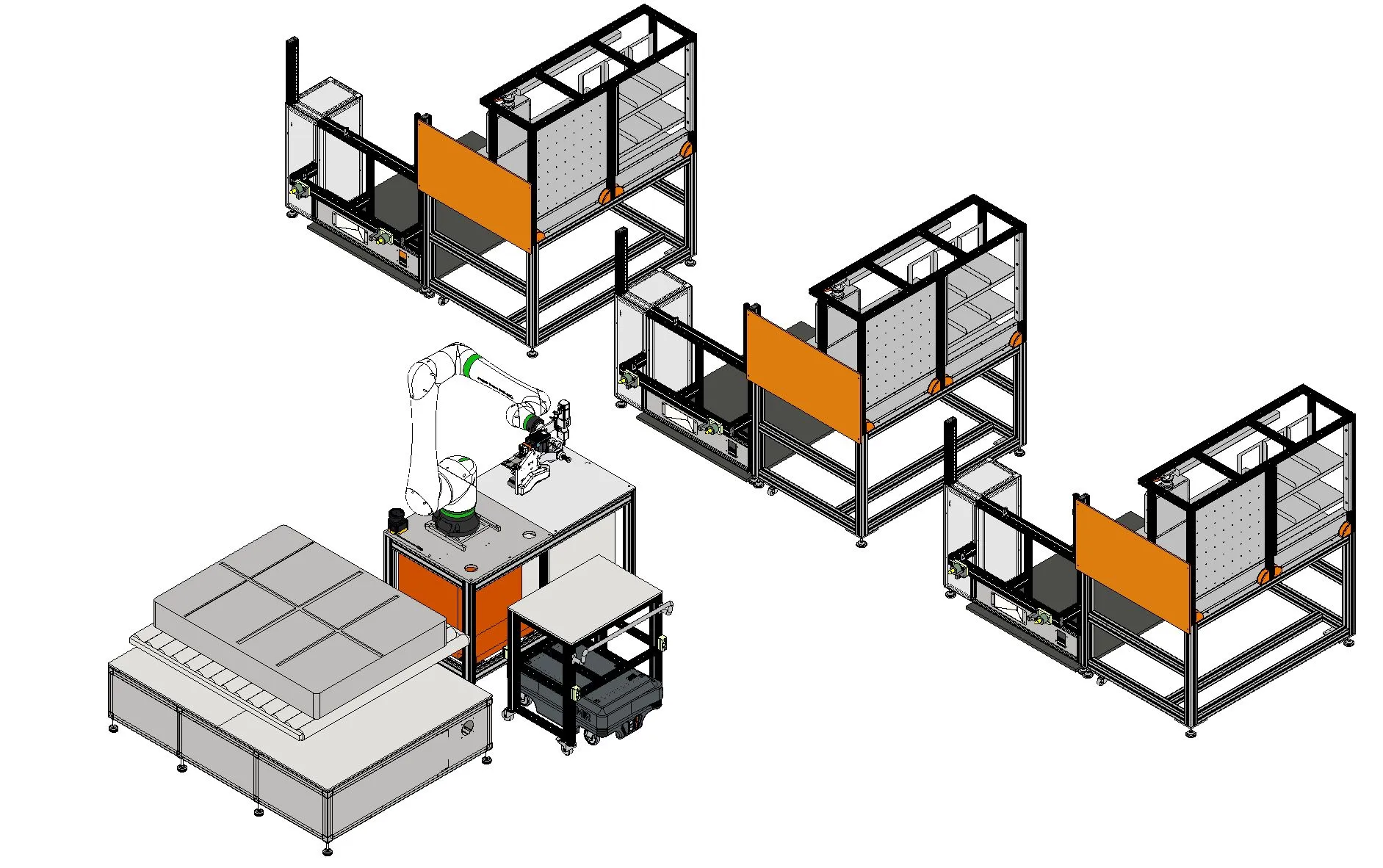
Motionwell builds EV battery automation in Singapore, including robotic pack dismantling, fastener removal and module handling. The dismantling line combines six-axis robot tooling with a heavy-duty pallet conveyor rated for 500 kg per position. Zero-pressure accumulation holds waiting packs clear of the next station, while the unbolting tool uses servo control and EtherCAT communication for the fastening sequence.
Machines are designed, assembled and tested at our Woodlands Link facility, and the company has delivered more than 150 special purpose machines since 2014 under ISO 9001:2015 and bizSAFE Level 3.
The engineering behind a teardown cell is on the battery and energy storage automation page, and the delivered line is written up as a case study. This industry guide connects regional production needs with the automation tasks, output handling and process interfaces to specify in an enquiry.
Who Buys EV Battery Automation in Singapore?
Three groups, and they want different machines.
| Buyer | What they are trying to do | What the equipment has to be good at |
|---|---|---|
| Recyclers and material recovery operators | Recover cells, modules, copper, aluminium and casing for downstream processing | Throughput on a varied input stream, and separation quality at the point of teardown |
| Second-life integrators | Recover modules healthy enough to be re-certified into stationary storage | Not damaging what is being recovered, and recording enough per module to support a grading decision |
| OEM and service operations | Take a pack apart for warranty analysis, repair or field return | Traceability per fastener and per module, because the teardown is evidence |
The distinction matters at the specification stage. A recycler can accept a destructive step if it is faster; a second-life integrator cannot, because the thing being damaged is the product. Two lines that look similar on a layout drawing behave differently at every station where that choice was made.
What Does a Battery Teardown Line Actually Contain?
The delivered line breaks into five blocks, and the interfaces between them are where the schedule goes.
| Block | What it does | What is delivered |
|---|---|---|
| Infeed and buffering | Presents packs at a repeatable position and holds work between stations | Heavy-duty belt conveyor at 500 kg per pallet position, zero-pressure accumulation zones so a stopped station does not push into the one behind it |
| Fixturing | Holds a pack that varies against a datum the robot can trust | Locating on features common to the declared pack family |
| Unbolting | Removes fasteners under torque control and knows when one has not moved | Servo-driven unbolting head with EtherCAT drive and inline torque sensing, plus a vacuum ejector and vacuum switch to confirm the fastener left with the tool |
| Module handling | Lifts and moves modules without loading them where they must not be loaded | Robot tool change through a servo-capable coupler so the same arm carries different tools |
| Records | Leaves evidence a downstream decision can rest on | Per-fastener and per-module state written at the controller |
The purpose-built unbolting head carries a servo motor, EtherCAT drive and planetary reducer. The controller coordinates the tool with the robot and records the configured process feedback. Verification checks whether the fastener was removed and identifies an incomplete operation for recovery. Tool sensing and acceptance thresholds are selected for the bolt and joint; a three-in-one tool variant supports several operations within the cell.
Why Is a Teardown Line Harder to Specify than an Assembly Line?
The input is not controlled, and that one difference reaches every station.
An assembly machine starts from known parts moving toward a known product. Its fixtures locate features guaranteed to be there and its sequence never branches. A dismantling line receives a product that has been in service, and everything about that is uncertain: the bolt pattern may have changed between model years, the case may be deformed, a fastener may be corroded into its thread, and the pack may have been opened before by somebody who did not put it back the way it left the factory.
Three consequences follow, and all three belong in the specification.
The declared range is a commercial boundary. The machine can be built to handle a family of packs. It cannot be built to handle whatever arrives. Where that line sits determines the fixture, the tool, and the fraction of throughput that goes to a manual station, and it is cheaper to argue about it before the fixture is drawn.
Every station needs a defined failure route. A fastener that will not move is a normal event. If the only response is to stop the line and call somebody, the line will spend its shift stopped. The delivered answer is a route to a manual station, and a record saying why the pack went there.
Recovery has to be designed for a person who cannot simply reach in. On an ordinary cell, an operator clears a jam and restarts. On a battery cell, approaching the work means the electrical state of the pack has to be known first. That single difference reshapes the guarding, the interlock logic and the restart sequence, and it is covered on our machine safety and compliance page.
What Has to Be Recorded, and Who Reads It?
The record is not a nice-to-have on this equipment. It is frequently the reason the automation was bought.
| Level | What is captured | Who uses it |
|---|---|---|
| Per fastener | Torque curve, whether it released, whether the tool retained it | Process engineering, and any downstream investigation of a pack that behaved oddly |
| Per module | Position in the pack, condition at removal, destination | Second-life grading, and material accounting for recovery |
| Per pack | Serial identity, route taken through the line, exceptions raised | Warranty analysis, and regulatory reporting where it applies |
A useful test at the specification stage is to ask who will read each level and what decision it supports. A level with no reader is a level nobody will maintain, and it will quietly stop being accurate in month nine. The general version of this argument is on our machine data acquisition page.
How Are the Battery Process and Equipment Interfaces Defined?
The equipment design combines mechanical handling, tooling, robot controls and process records with the incoming pack specification. Battery-condition checks, state-of-charge requirements and downstream test results enter the sequence as defined process conditions. We agree the signals, permitted states and recovery actions with the teams responsible for each operation, so the line can act on those results consistently.
What Should You Send to Get a Straight Answer?
Five things, and with them a conversation about scope becomes a conversation about engineering.
One: the pack family, by model and year, and how much variation exists inside it. Two: the state the pack arrives in, meaning discharged or not, and who certifies that. Three: the target, in packs per shift, and whether that is an average or a peak. Four: what happens to what comes out, because recovery and second life pull the design in different directions. Five: what has to be recorded and who reads it.
If you have a teardown volume you are trying to hit and a pack family to hit it on, send those five things to an engineer and we will tell you which of the five blocks above you actually need, and which part of it belongs at a manual station.