
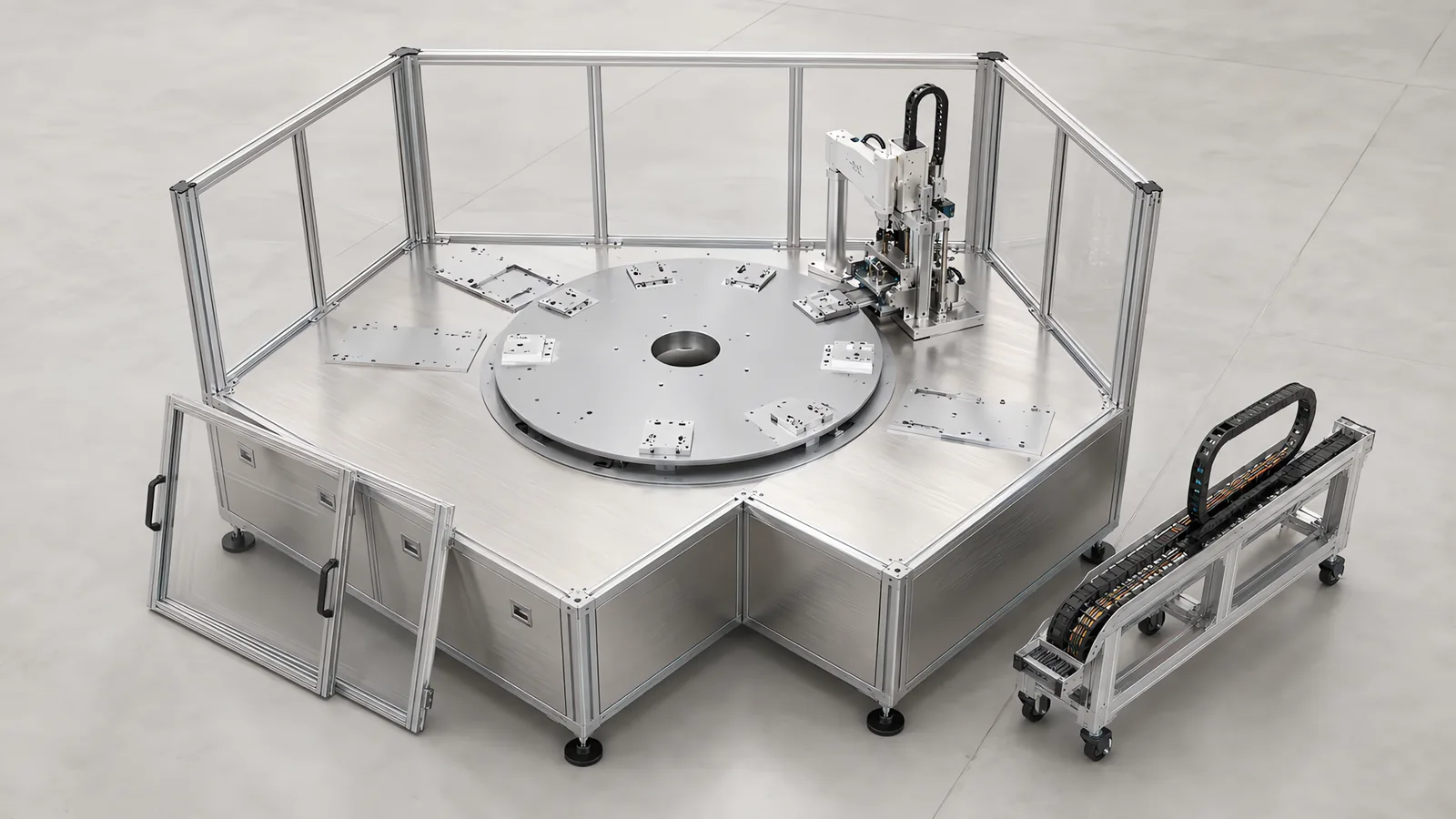
The automation project process runs from enquiry and concept design through detail engineering, build, factory acceptance testing (FAT), site acceptance testing (SAT) and handover. Five customer decisions anchor the schedule: concept approval, design freeze, FAT sign-off, SAT sign-off and acceptance of the handover pack. Engineering work continues between those gates.
At Motionwell, a standard custom build is typically planned at 16 to 24 weeks from concept approval to FAT. A complex or regulated build may need 24 to 32 weeks to the same gate. Enquiry, concept development, transport, site installation and any site qualification have their own activities on the project schedule, so a FAT date is not a production-start date.
The split of responsibility is worth stating before the timeline. We hold the mechanism, the build and the acceptance evidence. You hold the product, the process, the site, the rate and the decisions. Every date below depends on both halves moving.
This page is the commercial and decision side of a build. The engineering phases themselves, meaning kinematics, control architecture, materials and fabrication methods, are set out in our special purpose machine design guide.
What Happens Between Your Enquiry and a Working Machine?
A simple one to three station cell may reach FAT in 12 to 16 weeks after concept approval. The standard 16 to 24 week build and more complex 24 to 32 week build use that same start and finish. Procurement lead times, parallel tasks and qualification scope are mapped into the schedule for the selected design.
| Stage | Roughly how long | What ends it | What you are doing meanwhile |
|---|---|---|---|
| Enquiry and feasibility | Days to weeks, and it is yours to compress | A concept study is commissioned, or the enquiry stops here | Collecting drawings, samples, rates and site facts |
| Concept design | 2 to 4 weeks | You approve a process flow, station layout, cycle time analysis, preliminary component list, risk register and budget range | Assembling the full variant list, including the one arriving next year |
| Detail engineering | 4 to 6 weeks | The bill of materials is released for procurement | Holding the product revision still, and answering interface questions |
| Fabrication and assembly | 6 to 8 weeks | The machine runs at Woodlands Link and a test date is set | Preparing the site, the shutdown window and the people |
| Factory testing | 2 to 4 weeks of the build programme | FAT and agreement on any remaining actions before shipment | Supplying test parts and the acceptance team |
| Installation, SAT and handover | Scheduled separately for the site and shutdown window | Site acceptance, training and the documentation pack | Preparing utilities, releasing staff and supplying production material |
The table shows the complete route, including work outside the concept-approval-to-FAT window. Its activity durations are not a sum for the project: procurement can run alongside engineering, and testing can reveal work that must be completed before FAT. Site preparation should proceed during the build so utilities, access and staff are ready for installation. On regulated lines, identify which qualification activities run with factory testing and which require the installed machine.
What stops being free at each gate is an engineering question, and it is answered gate by gate on our machine design and simulation page.
What Do You Have to Supply, and When?
More than a first-time buyer expects, and earlier than they expect it. Every gate above waits on something only you can produce, and a gate waiting on a decision does not move because engineers work harder. The largest schedule risk in a custom build is not an engineering one at all: it is late finalisation of the product design.
| Stage | What we need from you | What it looks like when it is missing |
|---|---|---|
| Enquiry | The process as performed today including manual steps, part drawings and physical samples, sustained rate and shift pattern, a photograph or layout of the space, and the regulatory scope | A quotation built on assumptions, which is a number neither party can defend |
| Concept design | Review of the concept against the process as it is really performed, and a decision on it | Approval circulates for three weeks and every date behind it moves |
| Detail engineering | A frozen product revision, the interface signals with an owner named for each, and your plant standards for controller and robot brand | Drawings get redrawn at your cost, or an unowned handshake appears on your floor |
| Fabrication and assembly | Site preparation: power, air, extraction, network, access route, floor and clear height | The machine is right and the building is not, discovered on delivery day |
| Factory acceptance | The parts the test will run on, and people with the authority to accept | The test becomes a demonstration of the machine, and no test of your process |
| Site acceptance and handover | Real production material, and operators and technicians actually released from the line for training | Training is delivered to whoever was available, and repeated at your expense later |
The right-hand column is the reason we ask for so much at enquiry stage. Each item is a place where a project stops, and stopping late costs more than the item was ever worth. How to turn the same list into a document a builder can quote against line by line is set out on our guide to writing an automation URS, and what we need before a price can exist at all is on the custom automation enquiry page.
Why Is Design Freeze the Date Worth Defending?
Because it is where the cost of a change changes shape. Before it, a change is a conversation and a redrawn layout. After it, a change to your product geometry means the nests, the fixtures and the press tooling were cut around a shape that no longer exists, and that is scrapped work.
Design freeze means one specific thing, and it is worth writing into the contract in that form: the machine is built to product revision X, dated Y, and the drawing pack is attached. A freeze against “the current version” is not a freeze, because two people will hold different versions before the month is out.
A freeze is also narrower than it sounds, and knowing its edges is what makes it possible to agree to.
| Frozen at that gate | Still open afterwards | Why the difference exists |
|---|---|---|
| Product geometry the tooling is cut around | Program structure and sequence tuning | Software is written against the mechanism |
| Anything that changes a machined part or a fabricated section | HMI screen design and screen flow | Screens are configured |
| The frame envelope, kinematics and safeguarding strategy | Recipes, thresholds and operator procedures | These are set against real parts at acceptance |
| Station count and the cycle time budget | The spares list | It follows the final bill of materials |
So the freeze is not a demand that you stop thinking. It is a demand that you stop changing the one thing metal gets cut around.
When something genuinely has to change after that date, the mechanism is a change order, and three questions decide whether it is worth raising: what it costs, what it does to the acceptance date, and what test scope it invalidates. On a regulated build the third question is the expensive one, because a requirement arriving after detail engineering has begun is a redesign that moves the acceptance date, as set out on our equipment qualification and validation page.
What Should You Insist on Seeing at the Factory Acceptance Test?
A factory acceptance test is a defined protocol with acceptance criteria, run before shipment, and witnessed by you. Ours happen at Woodlands Link, which is why a Singapore buyer attends in an afternoon. Insist on six things, and agree all six in writing before the machine is on test.
Your parts. A machine proving itself on convenient samples has proved very little. Bring the variant at the edge of tolerance and the one operators complain about.
The rate you are buying, sustained. Not a gate-to-gate cycle with a dummy load. A run long enough that vision acquisition, gripper actuation, settling and the handshakes are all inside the number.
Accuracy measured where the machine is worst. Placement at the worst position in the envelope with the tool loaded is a figure you can verify with an indicator, which no amount of structural description is.
Faults created on purpose. Jam a part, remove one, pull the power mid-cycle. What you are watching is the recovery: what state the machine returns to, what the operator has to do, and whether a part-built assembly can be finished or is scrap.
A changeover run by your own people. If the machine takes formats, somebody from your line should perform the change, with the tools that will actually be in the drawer.
The mechanism first. The watching that matters is done at the fixture: whether the motion is clean, whether anything snags, whether a part ever sits in a position that could jam on the next index.
Then be equally clear about what this test cannot settle. It proves motion, sequencing, interlocks, recovery and the data record. It cannot prove anything that depends on your building. A machine destined for a cleanroom carries its particle performance under motion into site testing and performance qualification, because the figure only means something measured in the room it will run in.
What Happens at Site, and What Does It Cost You in Production?
This is the phase where the project stops being ours and starts being yours, and where a plant’s real constraint appears: the hours the line can stop.
The principle is the one we apply on modernisation work as well: the shutdown window carries only what cannot be done anywhere else. The machine was built, wired, programmed and proved on our floor precisely so that the work on yours is rigging, positioning, utility connection, safeguarding, tie-in to the equipment either side, and then testing. On lab and instrument work the same logic goes further: site work is scheduled into shutdown windows or weekends, and the new system runs in parallel with the manual workflow until each station is accepted.
Mechanical decisions taken in week one decide the size of that window, which is the argument for raising it at concept. A seventh-axis track designed at 100 mm on adjustable feet installs without a floor pit; the same axis at conventional height, sunk into the slab, is civil work with its own trade, its own inspection and its own weather.
| Acceptance test | Factory acceptance | Site acceptance |
|---|---|---|
| Where | Woodlands Link, before shipment | Your floor, after installation |
| What it runs on | Your samples, supplied for the test | Real production material |
| What it proves | Cycle time, accuracy, repeatability, sequence, interlocks and recovery against the agreed criteria | That the same behaviour survives your utilities, your material flow and your operators |
| What it cannot prove | Anything that depends on the room the machine will stand in | Nothing that belonged in the design; an argument here is the late and expensive version of an earlier one |
| Who has to be there | Decision authority, operator, maintenance, quality where records are kept | The same people, plus whoever owns the equipment either side |
Two site items arrive late in projects often enough to be worth naming at the start. Machines incorporating lifting equipment must be examined and certified by an approved authorised examiner before use in Singapore, with periodic re-examination after. And the market the machine is placed on decides its conformity documentation, which belongs in the purchase order. For a machine destined for the EU, Regulation (EU) 2023/1230 applies from 20 January 2027 with no transitional period, so a build starting now spans the changeover and the documentation architecture is a concept-stage decision. The physical scope that follows either answer is on our machine safety and CE marking page.
What Should Handover Actually Deliver?
Two things, and the second one outlives the first.
Training is scheduled against people who are already busy, which is the reason to book it before the machine ships. Our own design metric for an operator interface is training time, with basic operation reached in under two hours; that target is only meaningful if the operators who will run the machine are the ones in the room. Maintenance training is a separate session with a separate audience, and it is the one that decides whether a fault on the night shift becomes a phone call.
The documentation pack is what your team has when the builders are gone. Every delivery includes mechanical drawings, electrical schematics, PLC program documentation, operator training materials, maintenance schedules and spare parts lists. The same pack goes out on modernisation work, where it also carries as-built drawings, the I/O list, a program archive, calibration records and an alarm list with each alarm mapped to a stop reason, which is the item a technician on shift actually opens. Ask for the archive in a form you can restore from.
One item is easy to leave out of a handover plan and hard to recover afterwards: the first production shift. Format changes, recovery paths and operator habits surface in hours on a real shift. An engineer standing on the floor turns those into fixes. One who has gone home turns them into a support ticket.
What Does the Warranty Cover, and What Does It Not?
It covers less than the word suggests, and the gap is worth understanding before the order. A warranty is a promise about who pays for a defective part. It does not cover maintenance, and it does not guarantee performance against a process you change afterwards, and it does not replace holding your own spares.
Three exclusions are worth reading for on any offer. Components carry their own manufacturer warranties, which is not the same thing as the builder warranting the assembled machine. Consumables and wear items are normally outside it, and on a machine you are expected to run yourself, adjustment by your team is going to happen early, so ask what that does to cover. And a variant the machine was never built for is a modification, whoever fits it.
What makes a warranty worth anything in practice is closer to logistics than to law: how fast someone with the right knowledge is standing next to the machine. Whether that promise is enforceable, what travel costs during a warranty visit, and which contractual mechanisms actually give it force are worked through on our local versus overseas machine builder page.
Which Delays Actually Happen, and Whose Are They?
Here is the list, split by which side of the table each one sits on. These are the causes we plan against on every build, and most of them are decisions, not engineering.
| What delays it | Whose it is | What prevents it |
|---|---|---|
| Product geometry moving after detail engineering has started | Yours | A frozen revision number written into the contract |
| A variant nobody mentioned, arriving after the frame is welded | Yours | The full variant list at concept, including next year’s |
| Parts supplied for testing that represent a good day only | Yours | Samples from the edge of tolerance, and from the bad days |
| Sample collection on an inspection project | Yours | Start collecting at enquiry: this sits outside the build schedule entirely |
| A signal between two systems with no named owner | Shared | Name an owner per signal in the requirements document |
| Site not ready on delivery day: power, air, extraction, access route, clear height | Yours | Survey the position during fabrication |
| A record, serialization or logging requirement arriving late | Yours | Settle the regulatory scope before concept approval |
| Lifting equipment certification found at the end | Shared | Decide at concept whether the machine incorporates lifting equipment |
| An approval waiting on a person who was never named | Yours | One owner with authority, appointed at the enquiry |
| Something not fitting at first assembly | Ours | Normal on a one-off machine, and absorbed inside fabrication when the design and the shop sit in the same building |
| Procurement, which follows the bill of materials | Ours | The bill of materials is finalised at the end of detail engineering, which is why that gate carries the schedule behind it |
Read the pattern. Most of these are decisions, and a decision taken in week two costs a meeting while the same decision taken in week fourteen costs a machine change.
When Is This the Wrong Process to Start?
Four situations where a build is the wrong first move, and each one has a cheaper answer sitting beside it.
You need the capacity sooner than a build can deliver it. The shortest cell we quote runs 12 to 16 weeks from concept to factory acceptance, before installation, and ordering harder does not compress fabrication. If the gap is that shape, the useful conversation is about overtime, a subcontractor or an interim standard unit, and a build ordered afterwards for the volume that is still there next year.
The result is decided by a consumable. Where a process parameter and a supplier’s consumable settle the outcome, a bespoke design buys a longer lead time and no better result than a catalogue machine does.
Nobody internally owns it. A project with three part-time stakeholders and no decision authority will stall at concept approval and again at design freeze, and the stalling will be invisible until the dates slip.
No shutdown window exists that fits the work. A line that can release days when the site work needs weeks does not have a cheaper option, it has an option that is not available. Say it early, because phasing, a machine installed alongside, and a temporary route for the product all need lead time of their own.
What Should You Do Before You Send the Enquiry?
Six things, in order. None of them requires an engineer, and all of them shorten the part of the schedule you control.
- Write the process down as it runs today, manual steps included, and mark every point where an operator judges something by eye.
- List every variant with dimensions, weights and real tolerances, separated into what runs now, what is committed and what is aspiration.
- State the rate twice, sustained across a shift and at peak, and say which one the machine is bought to hold.
- Measure the site and photograph it: power, air, extraction, network, footprint, access route, ceiling height, floor condition, and the interface height of the line it joins.
- Name the owner who can approve a concept and sign a freeze, and tell them that is the role.
- Settle the regulatory scope, including which market the machine is placed on and whether any record it creates has to be retained.
The rest of the capability set, organised by what the machine has to do, and never by which brand of robot sits inside it, is on the automation capabilities hub, and the framework for scoring builders against each other, us included, is in our guide to choosing a system integrator.
Standards Used in Machine Design and Validation
These references inform the design, testing and documentation described on this page. Each row links to its primary source and records the edition checked.
| Standard | Current edition | What it means for your machine |
|---|---|---|
| Regulation (EU) 2023/1230: the EU Machinery Regulation | (EU) 2023/1230 (changeover pending) | Applies on a mandatory basis from 20 January 2027, replacing Machinery Directive 2006/42/EC. Project planning should align the intended EU market date with the conformity assessment and technical documentation, including relevant software integrity and connected-function requirements. The European Commission permits voluntary declarations against the Regulation before that date, while the Directive remains applicable.Checked 1 Sep 2026 against European Commission, Machinery page (single-market-economy.ec.europa.eu/sectors/mechanical-engineering/machinery_en); EU-OSHA legislation register |
Frequently Asked Questions
When does the 16 to 24 weeks actually start?
At concept approval, which is neither your enquiry nor your purchase order. Concept design takes 2 to 4 weeks of its own before that gate, and the period before that belongs entirely to you: collecting drawings, agreeing the rate the machine is bought to hold, getting the site measured, and finding out internally who is allowed to sign. A buyer who needs production running in five months and opens the conversation in month one is usually late at the enquiry. Ask any builder for the schedule in two halves, the part you control and the part they do, on one page.
Who should attend the factory acceptance test?
Someone who can sign, someone who will run the machine, and someone who will have to repair it. The person with authority settles what counts as a pass while the machine is still on our floor. The operator finds out whether the recovery behaviour is something they will live with or defeat by the third shift. The maintenance technician finds out what has to come off to reach a bearing. Add a quality representative where the machine creates records that are kept. Send one spectator and you are given a demonstration; send those three and you get a test.
When does the warranty period start?
On whichever event your contract names, and the candidates sit weeks apart: factory acceptance sign-off, delivery, site acceptance, or the first production shift. On a machine that ships in June and starts real production in August, choosing between them moves the end date by two months. Agree the trigger, the length, the response time and what counts as a chargeable visit before the order. The period itself is a commercial term settled per project, and the three questions worth putting to any builder are the same: period, coverage scope, response time.