
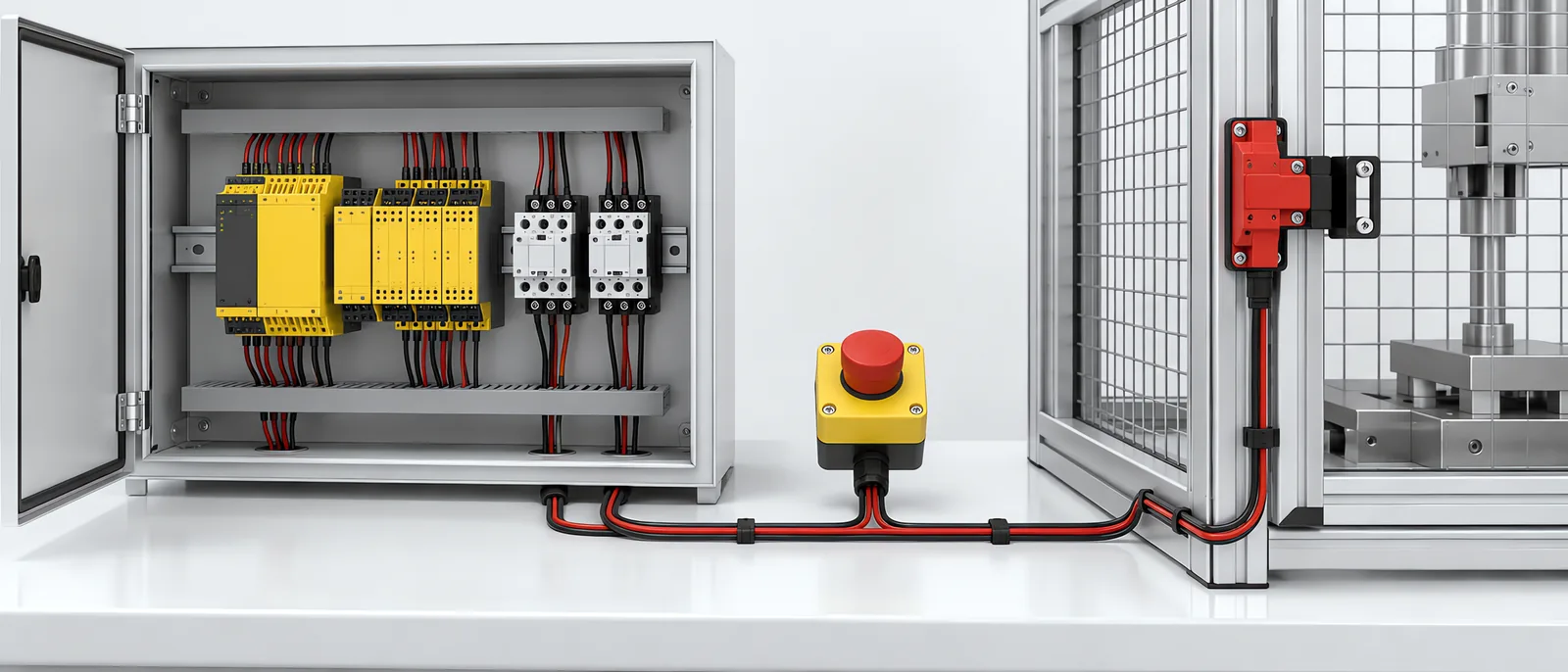
Conceptual equipment illustration.
A safety PLC executes the safety-related control logic of a machine. Choose it from the protective functions, operating modes and zone relationships the machine needs. The controller is one part of a chain that also includes sensing, wiring, communication and the final devices that bring the hazard to the required state.
A controller’s safety rating does not assign that rating to the whole machine. The complete function needs design evidence and validation, which sit within the wider machine safety engineering scope.
For an existing machine, include that work in the machine retrofit and modernisation plan, so the controller change, installed tests and shutdown window are scoped together.
Write the Function Before Choosing the Hardware
Begin with the machine safety risk assessment. For each protective function, identify the hazardous motion or energy, the event that demands protection, the required response and the conditions for restart.
A useful function record connects these decisions:
| Question | Information to record |
|---|---|
| What initiates the function? | Guard, emergency stop, scanner or other protective device |
| What must reach the defined state? | Named drives, actuators or energy-control devices |
| Which modes and zones does it affect? | Production, setup and access relationships |
| What happens after the demand clears? | Reset conditions and separate restart behaviour |
| What evidence closes the function? | Design analysis, circuit checks and installed tests |
Avoid starting with a count of buttons and doors alone. Two machines with the same I/O count can need different logic because one permits independent zone operation and the other has coupled motion.
Safety Relay, Configurable Controller or Safety PLC?
Pilz’s safe control technology range distinguishes hard-wired relays, modular relays, configurable small controllers and PLC controllers for more complex or decentralised applications. These are choices of architecture, not a ladder where the largest controller makes every application safer.
For a compact machine with a few stable functions, a relay arrangement may keep the logic easy to inspect. A configurable controller can suit multiple functions with clear relationships. A safety PLC becomes useful when the machine needs more extensive programmable coordination, distributed safety I/O or integration with a larger control platform.
Compare the complete engineering package: I/O compatibility, diagnostics, software access, version management and the maintenance team’s ability to recover the installed system. Function counts and supported modes are product-specific, so compare the actual proposed hardware and software versions.
Keep Production Logic and Safety Logic Distinct
Some platforms run ordinary automation and safety functions in an integrated system. Siemens describes this arrangement in its SIMATIC Safety Integrated portfolio, including fail-safe controllers and I/O.
An integrated engineering environment does not make an ordinary production tag a safety-rated signal. Define which data crosses between the two programmes and what the safety logic is allowed to depend on. An HMI message can explain why a machine stopped without being the device that establishes the protective state.
The PLC programming services scope covers production sequences, alarms and recovery. A quotation involving safety logic should identify that work separately, including access permissions, the verified configuration and the change records supplied at handover.
Follow the Function All the Way to the Output
An emergency-stop input that reaches the controller is only the beginning of the evidence trail. The required response must reach the named final devices and affect the hazard as specified. For a guard-access function, include what happens while motion is running down and what permits access afterwards.
Review feedback and fault detection with the selected devices. Do not assume that a spare standard input, a general-purpose network message or a drive’s ordinary stop command can substitute for the specified safety path.
Physical installation also matters. The control panel design and build scope should identify the safety devices and their wiring so the installed circuit can be checked against the approved design.
Include Validation and Change Control in the Purchase
Ask the integrator to map each function to the configuration, drawings and test evidence. The acceptance plan should cover protective demands, reset and restart, relevant operating modes and the fault behaviour identified by the design analysis. Where the protective arrangement depends on stopping performance, include the installed measurement and its relationship to the access arrangement.
Also ask how the system is restored after controller replacement. The handover should identify the programme version, device configuration, required engineering tools and the checks needed after a change. A backup without a clear restoration and revalidation procedure leaves part of the purchase unfinished.
Planning a new machine or a safety-control retrofit? Talk to Motionwell about the functions, controller architecture and validation scope.