
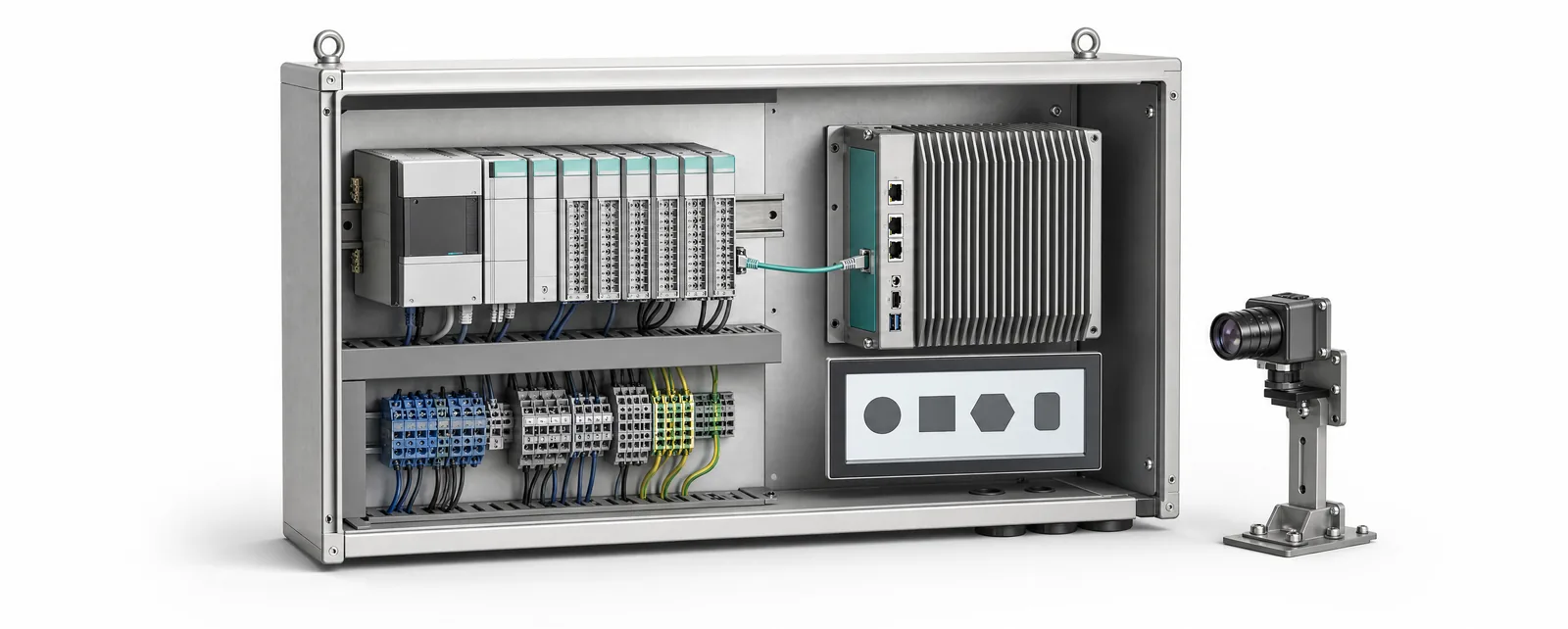
Conceptual equipment illustration.
An industrial PC and a PLC can work together, and an industrial PC can also host a PLC runtime. The right choice depends on the machine functions, required timing, supported software and how the system will recover from faults. Comparing the two boxes without their software architecture leaves the main decision unanswered.
For an existing machine, start by identifying what needs to change. Adding image processing or a production database may call for an IPC alongside a working PLC. Replacing the machine controller is a wider decision involving its I/O, motion, operating sequence and maintenance support.
Separate Hardware from the Control Runtime
An IPC is a computing platform built for an industrial installation. Its role depends on the software running on it. It may host inspection, operator interfaces or data services; with an appropriate real-time control system, it can also execute machine control.
For example, Beckhoff’s TwinCAT architecture provides real-time PLC, NC and CNC functions on PC-based hardware. That is a specific control architecture, not evidence that an ordinary desktop application provides the same timing behaviour. Evaluate the runtime, hardware, task configuration and supported operating environment together.
PLC platforms also differ. Available memory, communication services, motion functions and engineering tools vary with the selected controller. The comparison should therefore name the actual platforms and the work each will perform.
Divide the Machine into Responsibilities
For a retrofit that keeps the existing PLC and adds an inspection IPC, a proposed division could look like this:
| Responsibility | Proposed owner | Interface to define |
|---|---|---|
| Machine sequence and ordinary interlocks | Existing PLC | Conditions for requesting inspection and releasing the part |
| Image acquisition and processing | IPC application | Trigger, part identity, recipe revision and result |
| Operator commands and status | HMI connected to the control system | Command permission, acknowledgement and displayed state |
| Inspection image and result storage | IPC application or designated data service | File retention, record identity and storage-failure behaviour |
| Safety functions | The selected safety-related control system | Validated interfaces and machine behaviour for the required safety functions |
This is an architecture example to develop against the machine. It assigns each decision to an owner while keeping safety functions in their specified control system. The PLC programming and integration scope should identify the corresponding program changes and tests.
If the unresolved choice is the inspection platform itself, compare smart cameras and PC-based vision separately. Choosing an IPC for image processing does not require moving every machine function onto it.
Make the Inspection Handshake Unambiguous
Consider a part held at an inspection station. The PLC sends an inspection request with a part identifier and recipe revision. The IPC acknowledges the request, processes the image and returns a result associated with that same identifier. The PLC then applies the agreed release or reject sequence.
Define what happens if a result arrives late, belongs to the previous part or uses the wrong recipe. A result bit without its context makes those cases difficult to distinguish. The interface should also identify which side clears a completed request and when the next request can start.
Put timing in the interface specification: how long acquisition and processing may take, when the request times out and what the station does while waiting. The required timeout comes from the machine’s process and risk assessment, not from a generic IPC-versus-PLC benchmark.
Test Recovery Before Acceptance
| Test condition | Question the trial must answer |
|---|---|
| IPC restarts while a part is waiting | Does the controller retain the part state, and how is inspection resumed or repeated? |
| Network connection is interrupted | Is communication loss distinguished from a failed inspection? |
| Old result arrives after a timeout | Is it rejected or reconciled using the request identity? |
| Image storage becomes unavailable | Can the process continue under the agreed traceability requirement, or must it hold? |
| Recipe changes between products | Do both sides acknowledge the same active revision before the next cycle? |
Record the observed behaviour and any changes made during testing. These tests are useful even when the chosen hardware has ample processing capacity, because they examine coordination and recovery.
Budget for Software Support and Replacement
For each platform, list the engineering software version, runtime licences, application source, device configuration and backup method. Include the steps needed to restore a replacement controller or IPC. An image backup is useful only when the team knows which hardware and software it can restore onto.
Agree how operating-system and application updates will be tested and introduced. Identify the production window, backup, rollback method and person responsible for release. Keep remote access and user permissions within the site’s existing control arrangements.
These handover items matter when evaluating machine retrofit and modernisation. They let the maintenance team support the architecture after commissioning. For plant-wide process control requirements, the separate DCS versus PLC guide addresses a different scale of decision.
Adding vision, data or new control functions? Tell us about the controller and the functions you want to add. We can discuss a division of responsibilities that fits the equipment you already operate.