
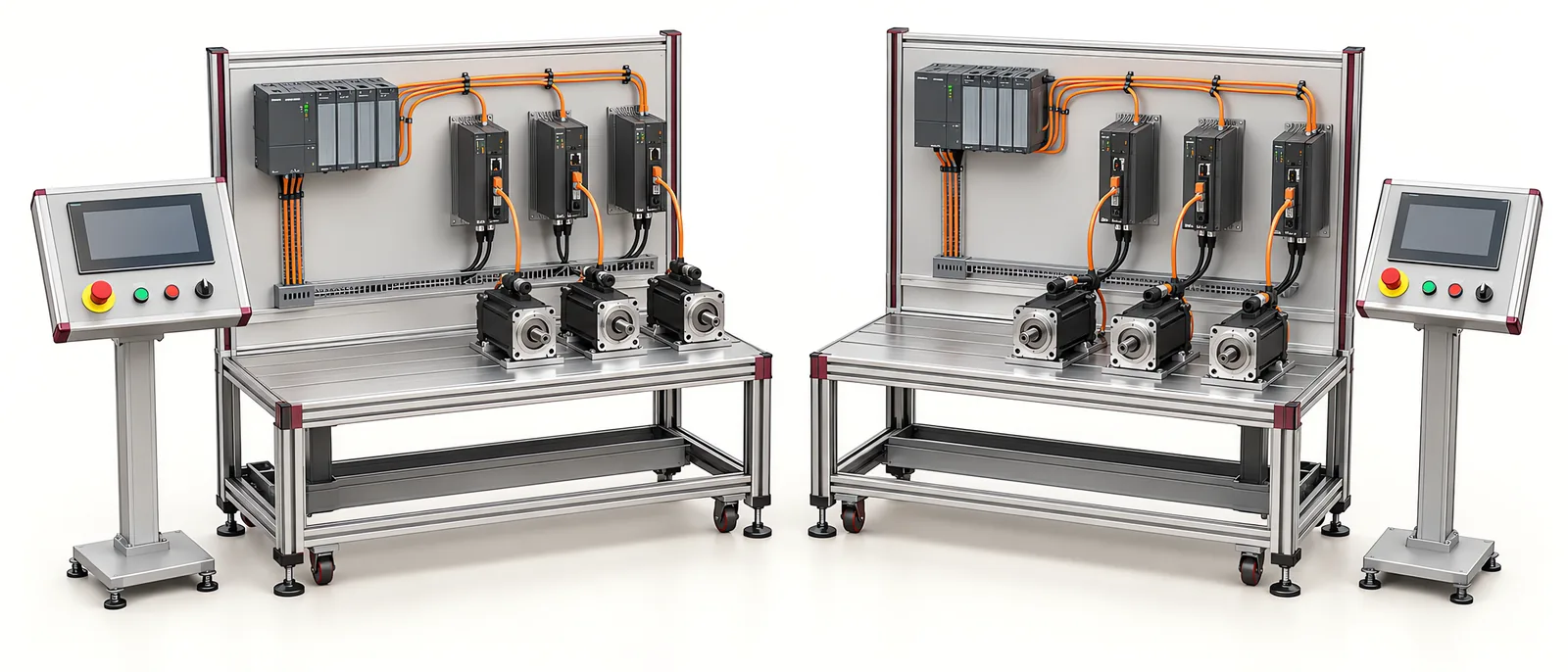
Conceptual equipment illustration.
EtherCAT vs PROFINET should be decided from the control task and supported equipment. Both can serve industrial machine networks, including demanding motion applications when the selected controller, devices and configuration support the required behaviour.
For a retrofit, first separate synchronized motion, ordinary cyclic I/O and higher-level data exchange. They impose different timing and integration requirements, and they do not all need to use the same communication path.
Compare the Timing Mechanism, Not Only a Headline Cycle
EtherCAT devices process addressed data as an Ethernet frame passes through them. Distributed clocks can synchronize local device actions when the participating equipment supports the feature. Beckhoff’s EtherCAT technology description explains these mechanisms.
PROFINET provides real-time I/O communication and an isochronous real-time option for tightly synchronized applications, alongside non-real-time communication. PI’s technology description distinguishes these functions. A comparison must identify the actual PROFINET mode and equipment support.
A network cycle is not the full sensor-to-actuator response time. Controller task scheduling, device sampling and actuator behaviour also contribute. Measure the complete response required by the machine.
Questions for the Proposed Hardware
| Requirement | EtherCAT proposal | PROFINET proposal |
|---|---|---|
| Coordinated axes | Confirm drive profiles, clock support and controller integration | Confirm motion functions, timing mode and supported drives |
| Distributed I/O | Check update requirements and supported modules | Check update requirements, device description and modules |
| Machine diagnostics | Demonstrate device and connection fault reporting | Demonstrate device, module and channel diagnostics |
| Expansion | Review topology and available controller capacity | Review topology, network components and controller capacity |
| Device replacement | Demonstrate identification and configuration recovery | Demonstrate naming, parameter recovery and replacement procedure |
Do not infer protocol compatibility from the presence of an Ethernet connector. The PLC programming scope should name the controller role, supported devices and the required communication functions.
A Servo Retrofit Can Change More Than the Network
When replacing a drive, check the motor, feedback, control mode, tuning and motion sequence as well as the fieldbus. The same commanded position can pass through different control layers in different architectures.
Our servo-drive retrofit guide covers those equipment dependencies. Replacing a network solely to obtain a faster advertised cycle may leave the actual mechanical or process constraint unchanged.
For an existing machine, identify which components can remain and which require replacement. A gateway can exchange selected data, but it should not be assumed to reproduce the timing and motion semantics of a native integrated drive system.
Keep Data Collection Out of the Critical Decision
A machine may use a tightly controlled network for motion and another supported interface for supervisory data. Define the data route without exposing the motion network to unnecessary traffic or uncontrolled configuration changes.
The PLC migration plan should preserve essential machine behaviour while documenting any changes to network topology, device addressing and diagnostics.
Accept the Network in the Machine
Run the intended axis and I/O load together. Verify the required synchronization or response, then test a disconnected device, power-cycle recovery and replacement of a configured component. Record which faults stop the machine and how production can locate them.
Retain the network layout, device versions and controller project with the test results. This gives maintenance a reproducible baseline, not just a protocol name on the electrical drawing.
Discuss your machine retrofit and modernization requirements with Motionwell, or contact us about the existing controls.