
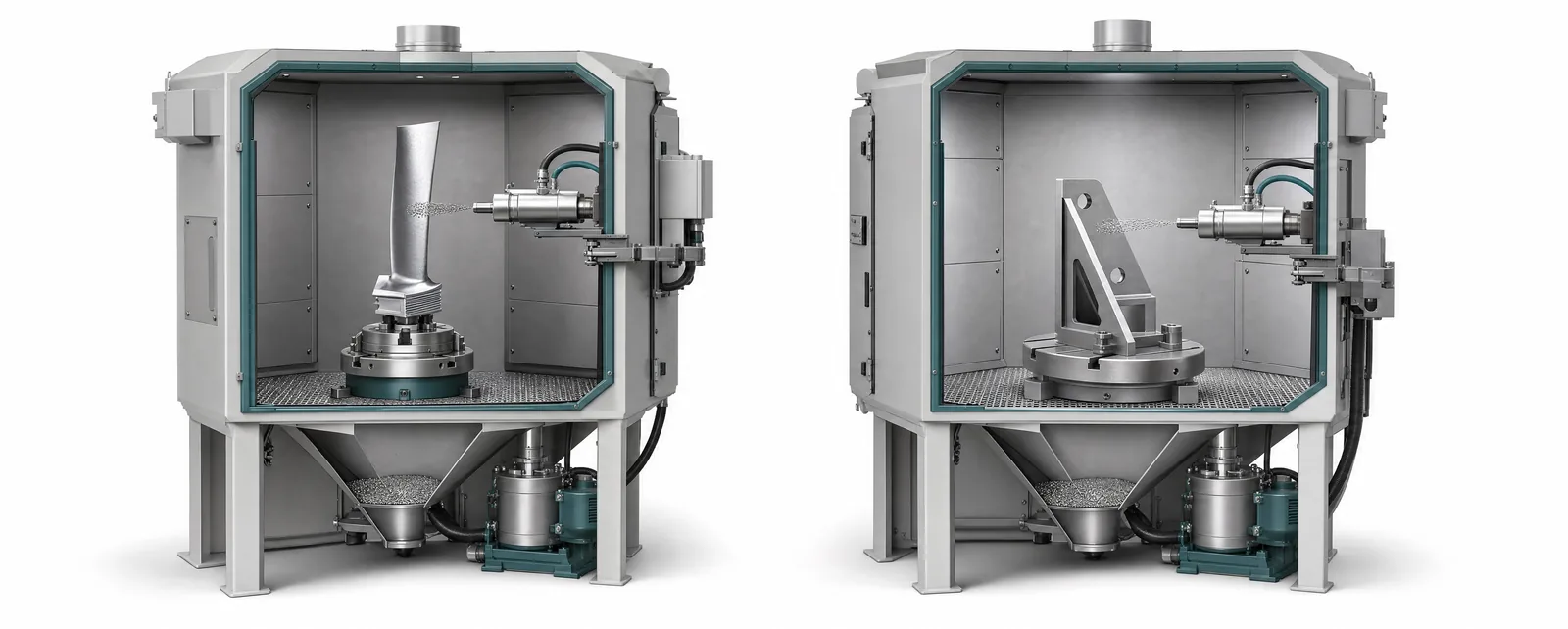
Conceptual equipment illustration.
Shot peening uses controlled impacts to introduce compressive residual stress in a component’s surface. Shot blasting is commonly specified for cleaning or preparing a surface, such as removing scale or producing a required finish. The process objective and acceptance requirements determine which machine you need.
A cabinet, nozzle and media stream can appear in either application. Their appearance tells you little about the process controls behind them. Start with the required condition of the finished part, then specify the handling, treatment and evidence needed to achieve it.
Separate the Process Goals
| Requirement | Shot peening | Blast cleaning or surface preparation |
|---|---|---|
| Main objective | Create the specified surface treatment associated with compressive residual stress | Achieve the specified cleanliness or surface condition |
| Process definition | Applicable peening specification, treated areas, intensity and coverage requirements | Surface preparation specification, areas to treat and required finish |
| Workpiece control | Repeatable presentation, exposure and protection of excluded areas | Access to the surfaces being cleaned and protection of excluded areas |
| Acceptance evidence | The process checks and records required by the peening specification | The inspection and records required for the cleanliness or finish specification |
Curtiss-Wright’s explanation of peen forming describes the compressive stress and local deformation created by controlled shot impacts. The useful distinction for machine procurement is the required process result. A visually uniform surface alone does not establish that a specified peening process has been achieved.
Media selection follows that process definition. Metallic shot is used in both blast cleaning and peening, as illustrated by Ervin’s shot and grit applications. Specify the material, size and condition of the media required for your application. Avoid choosing a machine solely because its supplier uses the same general name for the treatment.
Intensity and Coverage Answer Different Questions
Intensity characterises the peening process using the specified Almen-strip procedure and saturation assessment. It is not a direct reading of residual stress in the production part.
Coverage concerns the extent of treatment on the relevant workpiece surface. Part geometry, material and access affect how it is assessed. A result on an Almen strip and coverage on a complex component therefore need their respective checks.
The Shot Peener’s technical FAQ on intensity and coverage explains this distinction. When preparing an equipment brief, carry both requirements from the applicable part or process specification into the machine acceptance plan. Record the inspection method and where the checks will be performed.
For an automated cell, this leads to practical design questions. Can the fixture repeatedly present the required areas? Can the nozzle reach them through the full programmed path? How will the system identify a completed cycle and preserve the required process record? These questions are more useful than a generic comparison of cabinet size or media delivery rate.
Translate the Requirement into a Machine Brief
Give the machine builder a drawing showing the surfaces to treat and the surfaces to protect. Include the part variants, loading method and the treatment specification. Then review the following items against the proposed layout.
| Machine feature | What to settle during design |
|---|---|
| Fixture and part location | How the part is located, retained and presented repeatably |
| Masking | Which features must be protected and how correct masking is confirmed |
| Nozzle and part movement | Reach, orientation, path and access around the fixture |
| Media handling | Supply, collection and the inspection or separation arrangements specified for the process |
| Monitoring and records | Required process variables, fault indications and record identity |
| Loading and changeover | Handling of each variant, fixture changes and recipe selection |
| Enclosure and extraction | Containment, maintenance access and the extraction arrangements for the application |
Develop these design-review items around the actual part and process. The automated aerospace surface-treatment page sets out the equipment-engineering scope, while mechanical design and simulation covers the fixture, movement and access work behind it.
Our CNC shot-peening machine case study provides a separate equipment example. Use it to discuss the machine arrangement, then develop the new fixture and treatment requirements around your own component.
Compare Quotes by the Acceptance Plan
Ask each bidder to connect its proposed equipment to the same process and acceptance requirements. Identify what will be demonstrated with representative parts, which records will be supplied and what must be repeated after a fixture or recipe change.
Keep the loading time, treatment time and unloading time visible in the proposed cycle. Include the planned checks and changeovers when discussing output over a shift. A fast treatment pass and a high sustained production rate are different measures.
For an aerospace automation project, agree the responsibilities for part approval, process requirements and equipment acceptance early. This gives the machine design a clear target and keeps the supplier comparison focused on what must be delivered.
Planning automated surface treatment? Tell us about the part and the treatment it needs. We can discuss the fixture, machine movements and controls around that process.