
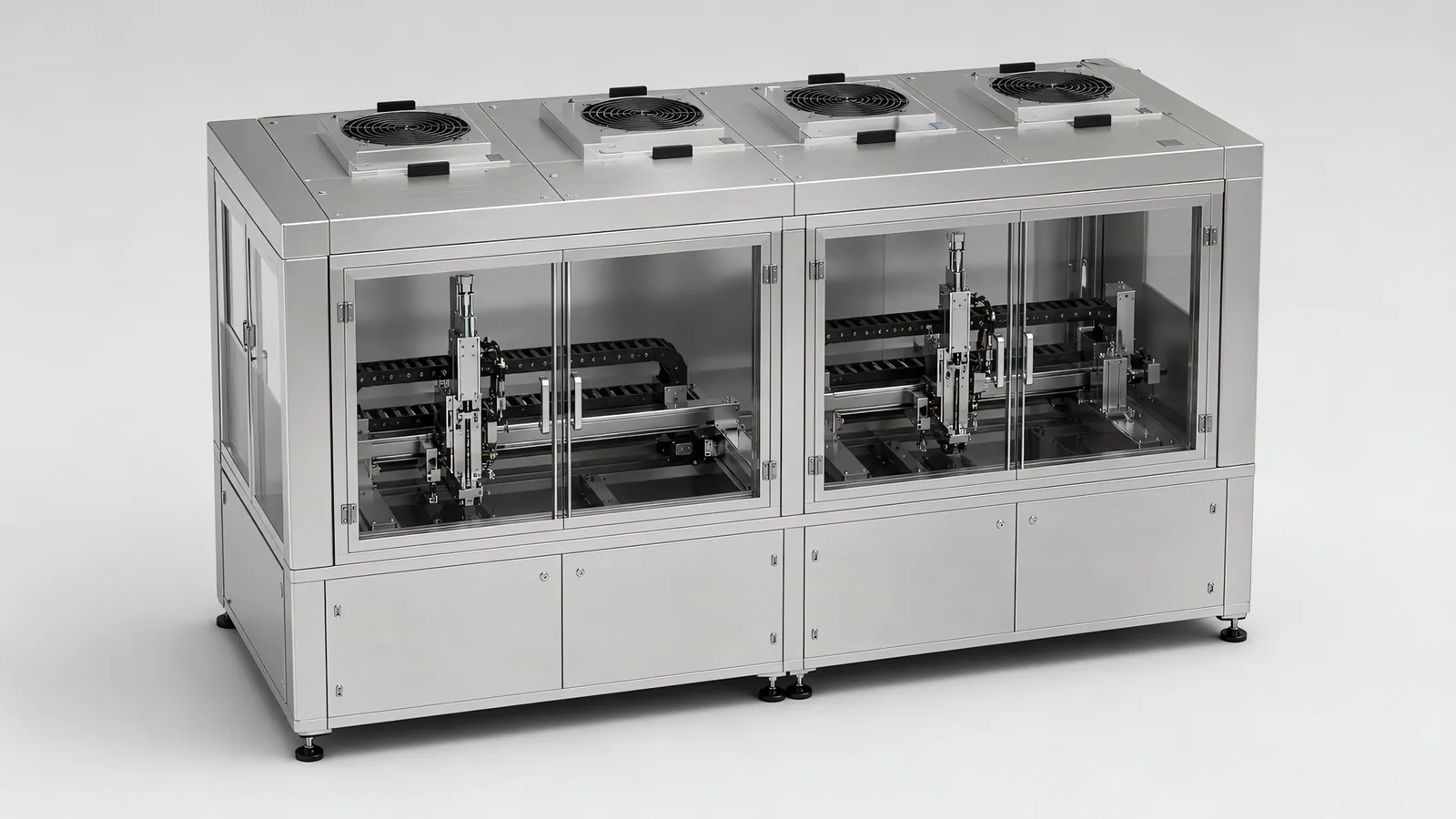
ISO 14644 cleanroom standards define how cleanrooms and clean zones are classified, monitored and assessed. For equipment buyers, ISO 14644-1 provides the airborne particle classification; the machine specification then defines the operating state, protected area and verification needed for the process.
Motionwell builds equipment with filtered enclosures and designs machines for use in cleanroom facilities. The test-equipment layouts use ceiling fan filter units over the fixtures; filling and sealing equipment has different product-exposure and cleaning needs. The protected zone and its verification belong in the specification for each project.
The short answer. ISO 14644-1:2015, reviewed and confirmed in 2021 and still the current edition, classifies the air cleanliness of a cleanroom or clean zone by the concentration of airborne particles per cubic metre of air, at threshold particle sizes from 0.1 to 5 micrometres, measured with light-scattering particle counters at designated sampling locations. ISO Class 5 to ISO Class 8 are points on that scale, and the lower the number the cleaner the air. The classification belongs to a volume of air in a stated condition, which means it belongs to the room or the zone and not to any object standing in it. A request for a “Class 7 machine” therefore has to be read as one of two things: a machine that does not push a Class 7 room out of Class 7 while it runs, or a machine whose own enclosure is the clean zone being classified. The machine’s contribution to the room is the subject of a separate part of the series, ISO 14644-14 on equipment suitability, and the specification for the machine should be written in those terms.
What we build is the machine and, where local filtration is required, its enclosure and airflow arrangement.
This page reads the standard from the buyer’s side. The design consequences of a class, meaning materials, drives, cables, lubricants and fan filter units, are on our cleanroom machine design guide, and the choice between a classified room and a machine that carries its own zone is on our cleanroom automation equipment page.
What Does ISO 14644-1 Actually Define?
One thing, done carefully: a way of stating how clean the air in a defined space is, in terms a particle counter can verify.
The full title is “Cleanrooms and associated controlled environments, Part 1: Classification of air cleanliness by particle concentration”, and every word in it is doing work. Cleanliness is defined by particle concentration and by nothing else. The particles counted are airborne, so what has settled on a bench or a fixture is outside the scope. The concentration is stated per cubic metre of air at one or more threshold sizes, from 0.1 micrometres at the fine end to 5 micrometres at the coarse end, so a classification is always a count of particles at or above a stated size. And the count is taken with a light-scattering airborne particle counter at sampling locations designated by the method in the standard, which is what makes the classification a measurement and never a description.
The current edition is ISO 14644-1:2015, the second edition, which ISO reviewed and confirmed in 2021. That matters when you read a specification or a supplier’s datasheet, because a document that cites the standard without an edition has left open which sampling method and which class table it means, and older documents on the same subject do exist.
What the standard is silent on is at least as useful to a buyer as what it says.
| Inside ISO 14644-1 | Outside it, and where to look instead |
|---|---|
| The ISO class scale, from the cleanest class to the coarsest, defined as permitted airborne particle concentrations | Room design and construction, air handling, gowning and material flow, which the rest of the ISO 14644 series and the facility designer own |
| The threshold particle sizes at which a class can be stated | Surface cleanliness, meaning what has settled on the product, the fixture or the machine |
| The measurement method: light-scattering particle counters and designated sampling locations | Viable contamination, meaning microbial limits, which come from the GMP regime the plant operates under and never from ISO 14644-1 |
| The requirement to state which occupancy state the classification was made in | Chemical contamination, temperature, humidity, pressure and vibration, each of which has its own specification |
| A way of reporting the result so another party can read it | Anything about what the equipment in the room is made of, how it is guarded, or how it is cleaned |
Read the right-hand column before writing a requirement. Several of the things a buyer wants from a “cleanroom machine” are in it, and each of them needs its own line in the specification because the class number will not carry them.
What Does a Class Number From 5 to 8 Mean?
It sets a ceiling on airborne particle concentration, and the ceiling tightens as the number goes down.
At the same particle-size threshold, each step from Class 5 towards Class 8 permits ten times the concentration. The following comparison uses particles 0.5 micrometres and larger, per cubic metre:
| ISO class | Maximum concentration at ≥0.5 µm, particles/m³ |
|---|---|
| Class 5 | 3,520 |
| Class 6 | 35,200 |
| Class 7 | 352,000 |
| Class 8 | 3,520,000 |
These particle thresholds also appear in Table 1 of the FDA aseptic-processing guidance. The table compares airborne particles; microbial monitoring uses separate criteria. Specify the required particle sizes, sampling plan and occupancy state alongside the class. Our cleanroom machine design guide translates that target into equipment materials, airflow and emission-control choices.
Two things a class number carries that are easy to drop in conversation. The first is the particle size. A class is stated at one or more threshold sizes, and the limit at each size is different, so the test behind the number is a count of particles at or above a stated size. The second is the occupancy state. A classification is made with the room in a declared condition, and the standard requires that condition to be stated with the class, because the same room reads differently empty, at rest with the equipment installed, and running with product and people inside it. A class without a state is half a specification.
The table below collects the phrases that reach us in enquiries and what the standard makes of each.
| What the enquiry says | What ISO 14644-1 makes of it | What to write instead |
|---|---|---|
| “A Class 7 machine” | Nothing, because the standard classifies a room or a zone, not an object | “For installation in an ISO Class 7 room, operational state” or “with an integrated clean zone held to ISO Class 7 over the product, operational state” |
| “Cleanroom grade” or “cleanroom compatible” | No such term in the standard, so it means whatever the supplier decided it means | The class, the occupancy state, the volume that holds it, and the cleaning regime, each as its own line |
| “Class 8 is basically a clean factory” | Class 8 is a classification proved by a particle counter; a factory bay that has never been measured is unclassified | If the machine carries its own zone, the bay stays unclassified and the enclosure is what gets classified |
| A GMP requirement quoted where the class should be | Not an ISO class, and not something ISO 14644-1 defines; the microbial side belongs to the GMP regime the plant runs under | The ISO class the room is classified to and its occupancy state, with the GMP requirement carried on its own line and owned by that regime |
| “Class 5 over the product” | A clean zone classified separately from the room around it, which the standard allows | State the zone boundary, the class inside it, the class outside it, and the occupancy state for each |
The last row describes a local clean-zone arrangement: the protected volume is assessed separately from the surrounding space. Draw both boundaries and define their operating conditions.
Why Does the Standard Classify the Room and Not the Machine?
The classification report identifies the room or clean zone, particle sizes, sampling locations and occupancy state. A machine contributes emissions and may also provide local filtration, so its operating configuration belongs in the test plan.
Write acceptance criteria around the protected process and its operating conditions. Room classification measures the combined effect of air handling, people, materials and equipment. Equipment suitability testing can separately characterise particle release from the machine under defined conditions, providing evidence for its introduction into the room.
Two arrangements satisfy that request, and they are classified in different places.
The room is the classified volume. The facility assessment includes the machine’s operating state alongside air handling, people and materials. For filling and sealing equipment, define where product is exposed and how machine emissions and cleaning affect the room’s target. The acceptance plan then identifies the measurements needed in the installed arrangement.
The enclosure provides a local clean zone. Fan filter units and an enclosure can protect a defined process volume within a larger room. The cleanroom ATE case study shows the equipment arrangement. Specify the target class and test conditions for that zone, then verify them by measurement; the presence of filtration alone does not establish a class.
The difference decides who can prove what, and when. A zone inside our own enclosure can be measured wherever the enclosure stands. A machine destined for your room can only be shown not to spoil your room in your room. The consequences for factory and site acceptance are set out on the factory acceptance test checklist, and the decision between the two arrangements, with what each costs, is on the cleanroom automation equipment page.
One more consequence for a buyer with an existing room. The occupancy state in which the room was classified is part of its classification. A room classified at rest, before the line was installed, has been classified in a condition that no longer exists once the machine runs. If the class matters during production, the room needs a classification in the operational state, and the machine is part of that state. That is a facility-level measurement; assign its scope and responsible party in the project plan.
What Is ISO 14644-14, and What Does Equipment Suitability Mean?
ISO 14644-14:2026 addresses equipment suitability in relation to airborne particle concentration. It helps frame the assessment of equipment intended for a classified space. State the applicable edition and test conditions in the equipment specification.
The idea behind the title is enough to change how a requirement is written. Suitability means the equipment is characterised as a particle source in its own right, under a stated operating condition, so that its effect on the room is judged before it is installed instead of discovered afterwards. The room designer holds a budget for particles; the equipment assessment says how much of that budget one machine consumes. That is a different question from whether the machine is made of stainless steel or whether its drives are enclosed. Those are design answers to the emission question, and they are good ones, but a description of the machine is not a measurement of it.
For a buyer the practical shift is in what counts as evidence. A materials list and a wipeable enclosure are the design basis. A measurement of the machine as a source, with the axes moving, the cylinders firing and the counters positioned in relation to the product, is the evidence. When a supplier claims suitability for a class, ask which of the two is being offered.
For an integrated clean zone, define its boundary, operating sequence and particle-measurement plan. For equipment installed in a customer’s room, review its emission and airflow effects with the facility team. Our cleanroom automation equipment page covers those two design and acceptance routes.
How Should the Cleanroom Requirement Be Written Into the Equipment Specification?
Write it as several short lines, none of which is “cleanroom compatible”. Each line answers a question the class number cannot.
| Line in the specification | Why it needs its own line | What a usable version looks like |
|---|---|---|
| Class and occupancy state | A class without a state does not name a condition anyone can measure | “ISO Class 7 to ISO 14644-1:2015, operational state” |
| Which volume holds the class | Room, local zone and machine enclosure are classified in different places by different parties | “The room, classified by the facility” or “a zone inside the machine enclosure, classified by the supplier” |
| The machine’s allowed effect on the room | This connects equipment operation to the room’s agreed classification criteria | “The machine shall not cause the room to exceed its class at the designated sampling locations during operation” |
| Threshold particle sizes | The room is classified at stated sizes, and the machine’s assessment has to use the same ones | The sizes at which the room’s classification is stated, copied from the room’s report |
| Sampling locations relative to the machine | Whether any designated location sits inside the machine’s working envelope changes what the count measures | Locations marked on the layout drawing, agreed with whoever classifies the room |
| Condition at acceptance | The same room gives a different count depending on what is running and who is present, and the acceptance count has to say which | The occupancy state named, with product present or absent stated |
| The room’s own status | A machine cannot be shown not to spoil a room that has not been classified | The date of the room’s last classification, the state it was made in, and who holds the report |
| Cleaning regime | The class says nothing about chemistry, and the chemistry sets surfaces, seals and labels | The compound and the frequency, named, as our URS guidance describes |
| Evidence expected at handover | A class claim without records is an opinion | Material certificates and finish records for product-contact parts, and the particle measurement records for any zone the supplier classifies |
Three of those lines are argued about late when they are missing early. The occupancy state, because a machine that passed at rest and a room that fails in operation are both telling the truth. The sampling locations, because a location inside the machine’s envelope measures the machine and a location across the room measures the room, and the two can disagree. And the room’s own status, because without a report to compare against, the machine’s effect on the room cannot be separated from whatever the room was doing before the machine arrived.
Where the machine also carries safeguarding, the guards and interlocked doors are contamination boundaries at the same time as they are safety hardware, but the two assessments are separate deliverables with separate owners. The class assessment says nothing about the performance level a safety function has to reach under ISO 13849-1, and the safety file says nothing about particles, so a specification that has one line is not halfway to the other. The safety side is set out in our guide to machine safety risk assessment.
What Should You Ask a Supplier Who Says “Cleanroom Compatible”?
Ask enough to find out which of the standard’s terms the phrase is standing in for, because the standard does not contain it.
| Question | An answer that holds up | An answer that does not |
|---|---|---|
| Which class, at which occupancy state? | A class from the ISO 14644-1 scale and a named state, in one sentence | “Cleanroom grade”, or a class with no state |
| Which edition of the standard? | ISO 14644-1:2015 | “ISO 14644” with no part or year |
| Is the class held by your room or by the machine’s enclosure? | A clear statement of which volume is classified and by whom | The supplier does not know which arrangement is being offered |
| Has the machine been measured as a particle source, and in what condition? | Measured with the axes moving and the actuators cycling, counters positioned relative to the product | “The frame is stainless” or “we use sealed bearings”, which are design answers to a measurement question |
| Where were the counters? | Positions on a drawing, with the product location marked | “In the room” |
| For an enclosed zone, what holds the enclosure positive, and what happens when it stops? | A pressure differential read on an instrument, with an alarm and a stated response | Positive pressure asserted from the fan rating alone |
| Who signs the class at acceptance? | A named party for the room and a named party for any zone the supplier holds | “The class is guaranteed” |
The fourth row is the one that separates a machine designed for the class from a machine that happens to be built of the right materials. A catalogue machine with a “cleanroom option” has usually been designed to emit less, which is worth having, but the option is a design claim until somebody has measured the machine as a source. The standard’s own vocabulary makes the distinction visible: a class is measured, and everything else is described.
For either arrangement, agree the design target and the evidence required at acceptance. A test report should identify the actual zone, operating state and sampling locations to which its class result applies.
What Does the Class Not Tell You About the Machine?
It leaves out almost everything a buyer usually wants to know, which is why the class is where a specification starts and never where it ends.
It does not say what the machine is made of. Frame material, finish, seal compounds, cable jackets and lubricants are chosen against the cleaning regime and the emission target, and the same class can be met by different material sets. It does not say how the machine is cleaned, or how often, and cleaning is the daily event that ages the machine. It does not say whether the product may touch the machine, or what the product-contact surfaces have to be; that is a product and regulatory question. It does not say how the machine is guarded, or what performance level its safety functions need; the safety assessment runs on its own standards, and a guard that is also a contamination boundary is designed twice. It does not say how the machine gets into the room, in what sections, through which door.
And it does not say what happens when the boundary is opened. Every format change, fault clearance and consumable change that opens the enclosure or brings a person to the machine is an event in the room’s occupancy state, so a machine that needs the door open often is holding its class for less of the shift than the datasheet implies. Designing changeovers so that they happen from outside the boundary, or in fewer and shorter openings, is the same work as designing them to be fast, which is why our guide to how to reduce changeover time reads as a cleanroom document in places.
Each of those gaps is answered somewhere. The material and design answers are on the cleanroom machine design guide. The qualification pack, where the machine is bought under a GMP regime, is on our computer system validation page. The safeguarding is on our machine safety and compliance page. Use those pages to complete the equipment specification alongside the classification target.
What Does the Standard Give You, and What Does It Leave Out?
ISO 14644-1 is a short, exact standard that defines a scale of air cleanliness by airborne particle concentration and a method for measuring it, and it classifies a volume of air in a declared condition. Everything else a buyer means by “a Class 7 machine” is outside it. The useful translation is a machine that does not push a Class 7 room out of Class 7 while it runs, or a machine whose enclosure is the Class 7 zone, and the specification should say which, at what occupancy state, measured where and signed by whom. Get those lines written and the machine design questions have something to be designed against.