
TL;DR: An AGV follows predefined routes, using guidance such as tape, wire, markers or wall-mounted laser reflectors. An AMR uses a map and onboard navigation to plan paths within the routes and traffic rules it is allowed to use. Compare AMR vs AGV against layout stability, peak transport demand, shared traffic and docking requirements. Both need a defined handover at each station and an interface to the system dispatching their work.
Motionwell integrates AGVs and autonomous mobile robots into production and laboratory workflows in Singapore. We select the vehicle as a subsystem and engineer its station interfaces, controls and recovery sequence. This guide works through the route, load and operating decisions behind that selection.
What Is an AGV (Automated Guided Vehicle), and When Do Fixed Routes Still Win?
An Automated Guided Vehicle (AGV) follows predefined routes. The guidance may be on the floor or provided by surveyed reflectors and a programmed route network. A route change involves updating and validating the affected guidance, traffic rules and station approaches.
On a stable, high-duty-cycle loop, predefined paths make transport sequences predictable. The fleet controller still needs traffic reservations, blocked-route handling and a recovery procedure, especially where vehicles share junctions or people cross the route.
| Guidance method | Typical signal | Facility impact | Best fit |
|---|---|---|---|
| Magnetic tape | Magnetic track on the floor | Floor work at install and at every route change | Stable routes, fast commissioning, controlled aisles |
| Painted or optical line | Visual line tracking | Line maintenance, clean floor required | Simple paths, low traffic |
| Wire guidance | Embedded wire with electromagnetic field | Highest install complexity, floor cutting | Long-term fixed layouts where the path must be physically enforced |
| QR codes or markers | Fixed markers at defined points | Marker placement and upkeep | Defined checkpoints, repeatable docking |
| Laser reflectors | Triangulation off wall-mounted reflectors | Reflector survey and line-of-sight planning | Large open warehouses with pallet-level flows |
Choose an AGV when transport demand is predictable, the route will outlive the product, and floor work is acceptable during a shutdown window.
What Is an AMR (Autonomous Mobile Robot), and What Does the Navigation Stack Buy You?
AMR stands for autonomous mobile robot. It is frequently written as “automated mobile robot”, which is the wrong word: the distinction from an AGV is precisely that the vehicle decides its own path.
An Autonomous Mobile Robot (AMR) navigates from a map it maintains itself. There is no infrastructure on the floor. Route changes are made in software, which means a layout change costs engineering hours.
| Navigation element | What it does | What you get in practice |
|---|---|---|
| SLAM | Simultaneous localisation and mapping | The map survives minor layout changes without re-surveying |
| LiDAR | Distance sensing and scan matching | Localisation plus obstacle detection from the same sensor |
| Cameras | Visual features and docking support | Better perception where the LiDAR plane is ambiguous |
| Path planning and avoidance | Dynamic route generation | Fewer hand-written traffic rules, easier growth from 2 robots to 10 |
The trade is that an AMR’s behaviour is probabilistic. It will get there, but the exact path and the exact time vary. If your downstream station cannot tolerate that variation, you have to engineer the buffer.
How Do AGVs and AMRs Differ Where It Matters?
Most comparison tables list sensors. The differences that change a project plan are these.
| Factor | AGV | AMR |
|---|---|---|
| Navigation | Fixed routes | Dynamic routes from a map |
| Layout change | Physical rework, shutdown window | Mostly software, plus re-validation |
| Arrival predictability | Very deterministic on the lane | High, but depends on traffic policy and mapping |
| Deployment speed | Medium; infrastructure work comes first | Faster; mapping and commissioning |
| Failure mode when confused | Stops on the line, easy to find | Re-plans or blocks an aisle, needs recovery logic |
| Best environment | Stable, high-volume flows | Dynamic, mixed pedestrian and forklift traffic |
| Integration focus | Fleet control plus traffic rules | Fleet control, localisation, and safety policy |
Which Specifications Look Decisive, and Which Ones Actually Are?
A datasheet comparison is usually the first thing a buyer assembles, and it rarely settles the question. Payload, top speed, battery runtime and quoted positioning accuracy overlap across the two categories, because what separates an AGV from an AMR is how the vehicle decides where to go. Two vehicles can match line for line on paper and still belong to different projects.
The properties that decide it belong to your building, and none of them appear on a vehicle specification.
- Whether a route is allowed to become a permanent fixture of the floor, and who has the authority to say so. In a leased building that is a landlord question, and it can close the argument before engineering starts.
- Who else uses the aisle, on what equipment, at which hours, and where they put things when they are in a hurry.
- How much variation in arrival time the receiving station absorbs before a person has to step in.
- Who owns the map and the traffic rules once the integrator has gone.
All four are answerable before a vendor is contacted, and all four are cheaper to answer now than to discover later.
One specification does deserve early attention, and it is the least interesting one on the sheet. Compare the vehicle envelope, with a load on it, against the narrowest thing on the route: the aisle at its tightest, the turn at the end of it, the clear width of a doorway with the door furniture in place. A purchase order can change a vehicle. It cannot change a column.
The other thing a datasheet cannot give you is throughput. A quoted speed describes a vehicle alone on a clear floor. The figure a plan runs on is delivered moves per hour with traffic rules, charging behaviour and station dwell already inside it, and that figure belongs to the system. How that system is engineered around either platform is on our AMR and AGV integration page.
Which Fits Your Facility: AGV, AMR, or a Hybrid Fleet?
Read down the left column, find the constraint that dominates your site, and the fit follows. If two constraints conflict, that is the argument for a hybrid fleet, and compromising on one platform will cost you both.
| Your constraint | Better fit | Why, from an integrator’s view |
|---|---|---|
| Routes rarely change, aisles are fixed | AGV | The guidance infrastructure becomes part of your plant standard and stays cheap to extend |
| Frequent layout changes, seasonal SKU mix | AMR | You avoid floor work; the cost moves to map governance and software validation |
| Heavy pedestrian and forklift interaction | AMR or hybrid | Either way you need safety zoning and a documented risk assessment before the first robot moves |
| Heavy loads on a repetitive loop | AGV or hybrid | Determinism and high duty cycles favour guided routes |
| Pick and place at the destination as well as transport | AMR plus cobot | Docking, perception, and manipulation become the real engineering problem; see the cobot safety design rules before fixing the tooling |
| No floor modification allowed, or a leased building | AMR | Ramp-up is faster when nothing has to be cut, cured, or reinstated |
| Strict traceability and audit trail | Either | The architecture matters far more than the robot type: interfaces, IDs, and state machine |
| Pallets between racking, docks, and staging | AGV | Pallet-level flows in a warehouse and intralogistics setting are usually stable enough to guide |
How Do You Split a Hybrid Fleet Without Inventing a Second Problem?
Running both is normal, for the same reason a plant runs conveyors and forklifts at the same time. Whether the hybrid helps depends on where the boundary is drawn, and there is a right way to draw it.
Split the fleet by flow. A trunk flow that is heavy, repetitive and unlikely to move for the life of the building is what guidance infrastructure exists for. A branch flow that touches people, changes with the product mix, or ends inside a fixture is what free navigation exists for. Draw the line around a zone, and you leave an aisle both fleets have to use, which is where the design starts costing money.
Two fleet controllers sharing one aisle have no arbiter between them. Each holds a complete picture of its own vehicles and none of the other’s intentions, so neither can grant or withhold right of way. What is left in that segment is on-board protective sensing, which exists to stop a vehicle safely and was never built to keep traffic moving. The usual outcome is not a collision. It is two fleets waiting politely in front of each other at the hour of the day when the throughput figures both were sold on stop being true.
The workable boundary is a piece of equipment. Give each fleet a station it delivers to and the other collects from, owned by one side, with a ready signal in each direction and a defined behaviour for when the station is full. That costs a stand or a short conveyor and buys a clean line of responsibility. It also keeps each map under a single owner, which matters more than it sounds, because a map with two editors drifts and nobody notices until a vehicle stops somewhere it used to fit.
Apply the commercial test before the technical one. A hybrid doubles the interfaces, the vendors in a commissioning meeting and the people who need training, and those costs land whether or not the second fleet is busy. Two flows that genuinely differ in stability and traffic justify paying them. Hedging a decision you have not made does not.
What Do These Choices Look Like in Delivered Projects?
Two Motionwell references sit on opposite sides of this decision.
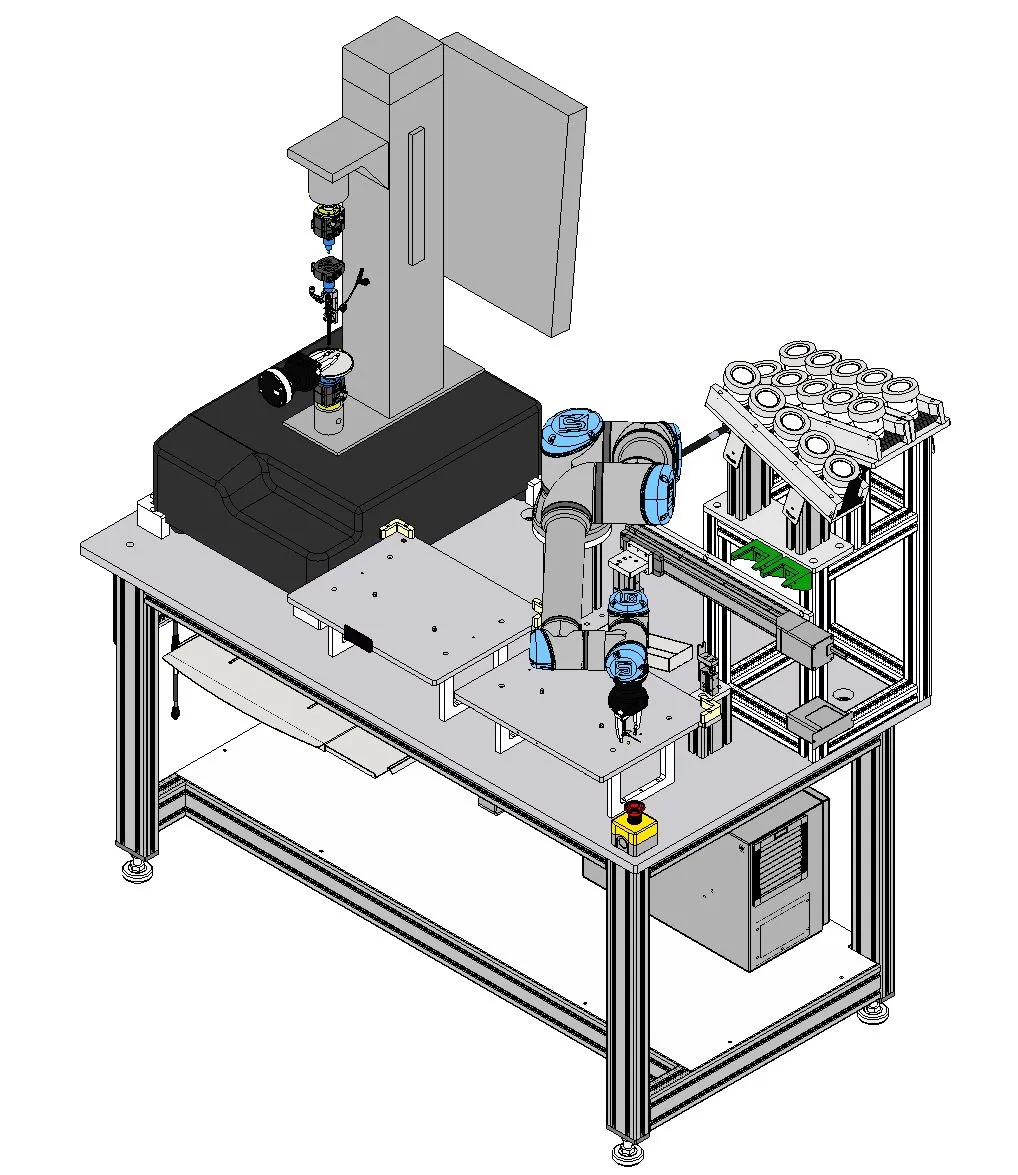
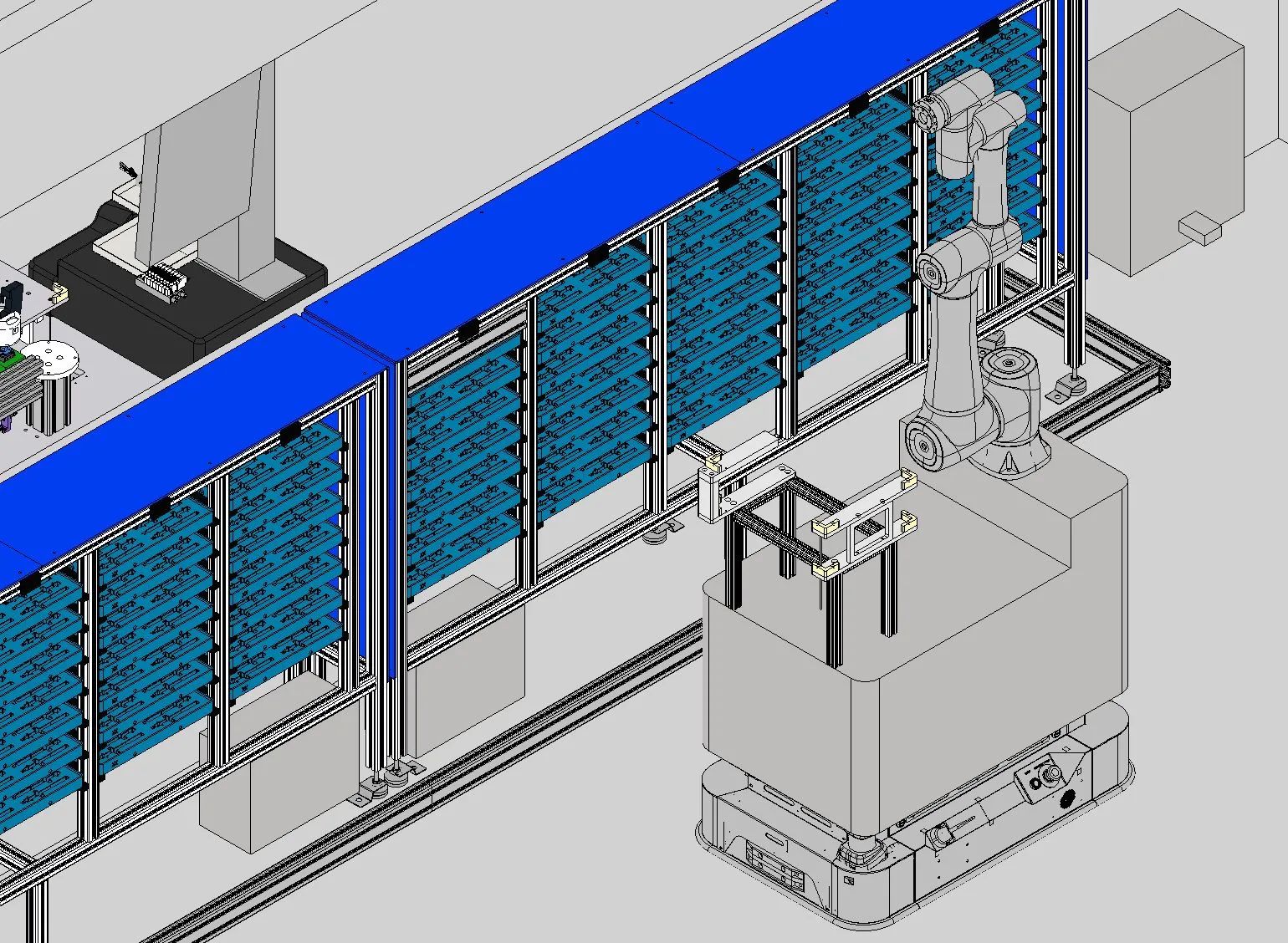
Reference 1: QA lab transformation
This is a high-mix, high-traceability workflow in which the layout and the instrument mix both keep moving. The programme has run for four consecutive years of repeat orders and is now being replicated for other customers. Full detail is in the QA lab automation case study.
| Aspect | Delivered implementation |
|---|---|
| Business goal | Automate sample logistics and material testing in a high-throughput QA lab |
| Mobile platform | AMR base with server-based task dispatch and autonomous navigation |
| Manipulation | Collaborative robot arm on the AMR for tray pick and place, with vision support |
| Storage model | 70 positions across 7 racks, managed as inventory states |
| Instrument integration | PLC orchestrates multiple universal tensile testing stations and sample state transitions |
| Data handling | Test files are auto-named and uploaded to a server for traceability |
The reason this workflow suits an AMR is not the navigation. It is that new instruments and new sample types arrive every year, and a taped route would have been re-cut annually. The same reasoning drives most laboratory automation projects.
Reference 2: Guided pallet transport in a high-volume warehouse
This one is the opposite pattern. Pallet flows between racking, receiving docks, and shipping staging are fixed, high-volume, and heavy. Laser-guided AGVs with chain-conveyor tops handle the transport legs, interfacing conveyor-to-conveyor at each handoff point so no fork tines or lifting mechanism is needed on the vehicle. Keeping the lifting off the vehicle is what makes the fleet cheap to grow: the vehicle stays a transport deck, so one more of them adds a vehicle to the traffic plan, with no second mechanism to maintain, and the load is transferred by a station that is bolted down and can be sensed. RFID verification at every handoff feeds the customer’s WMS. The warehouse automation case study covers the fleet and traffic design.
| Aspect | Delivered implementation |
|---|---|
| Flow type | Pallet transport between storage, receiving, and shipping staging |
| Vehicles | Laser-guided AGV fleet with chain-conveyor top modules |
| Handoff method | Conveyor-to-conveyor, removing lifting mechanisms from the vehicle |
| Traceability | RFID verification at dock, storage entry, and staging |
| End of line | Robotic palletizing cell integrated with conveyor and safety fencing |
| Why guided wins here | When the flow is fixed and the duty cycle is high, determinism beats flexibility |
What Actually Drives the Cost of a Mobile Robot Deployment?
Comparing an AGV quote against an AMR quote unit-for-unit is the wrong comparison. The vehicle is one line item among several over the life of the system. Compare the full engineering footprint instead, then check the payback assumptions against the warehouse automation ROI method.
| Cost driver | AGV pattern | AMR pattern |
|---|---|---|
| Infrastructure | Higher: routes, markers or reflectors, station hardware | Lower: mapping plus docking targets |
| Layout changes | Physical change orders, shutdown time | Software changes plus re-validation |
| Maintenance profile | Simpler sensors, more floor upkeep | More sensors and software, less floor upkeep |
| Commissioning | Infrastructure first, then traffic rules | Mapping, traffic rules, perception tuning |
| Fleet growth | Cheap on an existing route, expensive on a new one | Cheap in software, limited by traffic congestion |
| Integration effort | Comparable | Comparable |
The two costs that surprise people are traffic engineering and recovery. Traffic engineering is what stops eight robots from queueing at one junction. Recovery is what happens when a pallet is left in an aisle at 2am, and it determines whether your operators trust the system in month three.
Can a Risk Assessment Overturn the Platform Choice?
It can, and the order in which the two happen decides whether that costs a meeting or a redesign.
The comparison above puts floor work on the AGV side and software on the AMR side. A risk assessment moves items across that line. Where a free-navigating route crosses a pedestrian corridor, a doorway or a bay worked by manual trucks, the reduction measures that come out of the assessment can include physical separation, an interlocked opening, or a speed limit low enough that the throughput target no longer holds. Each of those is construction work, a shutdown window or an extra vehicle, landing on the option that was chosen because it needed none of them.
It runs the other way as well. A guided route through a space people have no reason to enter can carry a lighter safety case than a free-navigating vehicle in a shared corridor, because fixed geometry removes an interaction.
Neither result is predictable from the vehicle type, which is the argument for assessing both candidate concepts while they are still route sketches. It is an ordinary machine risk assessment, made under ISO 12100; the method is set out in our note on machine safety risk assessment.
What it needs from you at this stage is modest: the routes under consideration, who else uses those spaces and when, and what happens on the floor outside production hours. What it hands back is the safety scope attached to each option. That is the part of the comparison that usually surfaces during commissioning instead, and it is the part that changes the answer.
What Should You Settle Before You Request a Quote?
Each item below changes the mechanical design, safety concept or fleet size. Resolve these inputs before comparing vehicle quotations so that each supplier prices the same transport task.
| Decision | Why it matters |
|---|---|
| Payload, cycle time, and station dwell | Determines fleet sizing and queue strategy |
| Docking tolerance at each station | Drives mechanical design, sensor selection, and recovery logic |
| Traceability model: IDs, states, audit trail | Prevents the “robot works but the data is wrong” failure |
| Safety strategy: zones, speed limits, e-stops, recovery | Avoids late redesign and commissioning delays |
| Floor condition, ramps, door interfaces, lift access | Quietly decides whether a platform is viable at all |
| Who owns the map and the traffic rules after handover | Determines whether the fleet still works after your third layout change |
If you cannot answer half of these yet, that is normal, and it is exactly what a site assessment produces. The framework for judging the partner who runs that assessment is in our guide on choosing a system integrator.
How Should You Make the Call?
There is no universal winner. Stability of layout, traffic complexity, traceability requirements, and how often you rearrange the floor decide it, and those four are facility properties.
Motionwell integrates guided and free-navigating fleets alongside collaborative robots and fixed automation, and designs the fleet architecture around your workflow and your validation needs. What we take responsibility for is the part that decides whether a fleet is still trusted in month three: the docking tolerance at each station, the traffic rules where aisles are shared with people, and the interface that tells your WMS what actually moved.
Ready to size a fleet? Contact us with your transport volumes, floor plan, and shift pattern for a site assessment.