
What Did the AGV Fleet Actually Take Over?
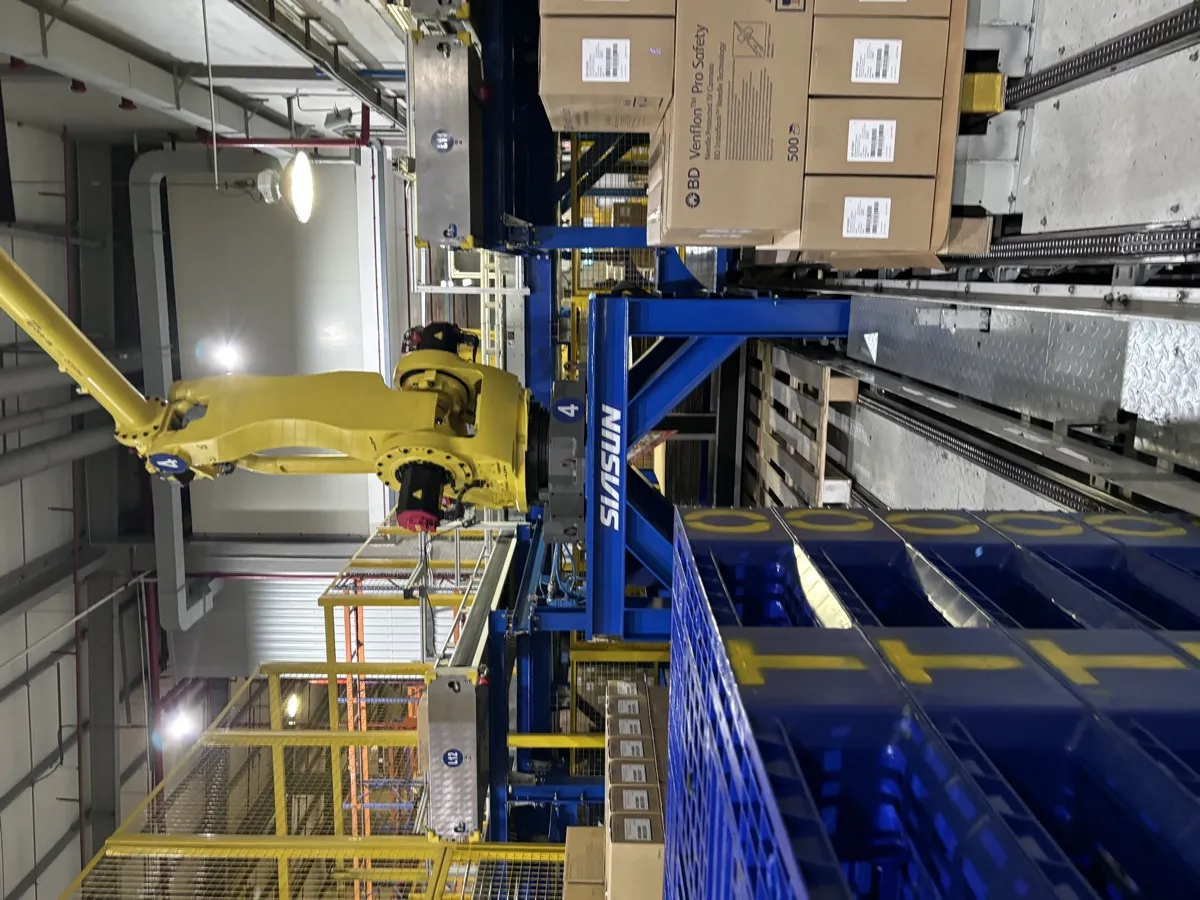
Motionwell integrated AGV pallet transport with automated storage and warehouse control in Singapore. The integration coordinates movement between storage, transfer stations and staging areas, with pallet identity carried through the handoff. Outbound palletizing is sequenced with storage retrieval so material arrives in the required order.
Motionwell has been the authorised SIASUN AGV distributor for Southeast Asia since 2017. The integration scope connects vehicles, conveyors, fleet software and WMS messages with the storage vendor’s equipment. Shared transfer-state definitions allow each controller to confirm when a load has arrived and which system owns the next movement.
The question worth asking before any of this is whether the transport problem is worth automating at all. Storage density is a racking decision. Vehicle count is a throughput decision. They are usually confused with each other, and the difference is where most warehouse business cases go wrong; we work through the arithmetic in our note on warehouse automation ROI, and Motionwell’s broader work in this sector is set out on the warehouse and intralogistics page.
What Is in the Installation?
ASRS Racking and Retrieval
The storage installation uses double-deep pallet locations served by stacker-crane retrieval. The layout coordinates storage capacity, retrieval rate and the AGV handoff positions:
- Stacker crane with telescopic fork for double-deep pallet access, rated against the specified pallet and load
- Multi-deep storage configurations for high-volume SKUs with FIFO (first-in-first-out) lane management
- RFID-tagged locations using UHF passive tags at every storage cell for real-time inventory tracking
- Crane sequencing in its own PLC, linked to the fleet management server over industrial Ethernet, so store position and vehicle mission refer to the same pallet identity, with neither side tracking a location the other cannot see
AGV Fleet and Traffic Control
The AGV fleet connects the storage system, receiving and shipping staging areas. Vehicle payload and conveyor ratings are matched to the complete pallet load, while mission timing includes travel, docking and transfer:
- RFID floor references for route and docking-position verification
- Defined travel lanes and intersection permissions shared by the fleet controller
- Fleet traffic management software coordinating multi-vehicle routing, deadlock avoidance, and intersection priority scheduling
- Charging locations and occupancy included in the vehicle-availability calculation
- Fleet expansion assessed against traffic capacity, server capacity and software licensing
Route flexibility, docking accuracy and mixed traffic determine the navigation approach. Our AMR versus AGV guide compares those operating requirements.
Integration Architecture
The warehouse interface defines transport requests, pallet identity, station availability and completion messages:
- WMS interface for inbound/outbound work order management and task prioritization
- RFID-based inventory verification at every handoff point (dock, ASRS entry, staging)
- Web-based fleet management dashboard with real-time AGV position, battery status, and task queue monitoring
- Exception handling workflows with automatic rerouting and manual override via handheld terminals
How Does the Fleet Handle Pallets and Stay Charged?
AGV Chain Conveyor Modules
Each AGV in the fleet is equipped with a chain conveyor module mounted on its top platform, enabling automated pallet loading and unloading without forklifts or manual intervention. The AGV chain conveyor interfaces with stationary chain conveyors at the ASRS entry/exit points, receiving docks, and shipping staging areas.
The pallet transfer sequence operates as follows:
- The AGV navigates to the target station and aligns with the stationary chain conveyor using its onboard sensors
- The AGV’s chain conveyor and the stationary conveyor activate simultaneously at matched speed
- The pallet transfers laterally from one conveyor to the other under chain drive power
- Photoelectric sensors at both ends of the conveyor confirm pallet presence and transfer completion
- The AGV’s chain conveyor stops, and the AGV proceeds to its next mission
The conveyor-to-conveyor handoff transfers the pallet at a common height using supported chain decks. Vehicle, conveyor and storage-interface load ratings are checked against the same pallet specification.
RFID Floor-Embedded Navigation Tags
The AGV navigation system uses RFID tags embedded in the warehouse floor at decision points throughout the travel network. Each RFID tag contains a unique position ID that the AGV reads via an undercarriage-mounted UHF RFID reader as it passes overhead.
Each floor tag identifies a known point on the configured route. The vehicle controller uses that reference with its navigation feedback to confirm the current route segment or station approach.
Tags are installed at:
- Every intersection and branch point in the travel network
- Docking positions at the ASRS entry/exit conveyors
- Charging station approach points
- Receiving and shipping dock positions
Tags installed in shallow floor recesses are protected from direct vehicle contact. Inspection and replacement access remain part of the maintenance plan, with read checks used to detect damaged or poorly read locations.
Fleet Management Software
The fleet management server coordinates all AGV routing and pallet assignment across the fleet. The software manages:
- Mission dispatching: Incoming transport requests from the WMS are queued and assigned to the nearest available AGV based on current position, battery level, and estimated travel time
- Traffic management: The server maintains a real-time map of all vehicle positions and planned routes. When two vehicles would converge at an intersection, the server assigns priority based on payload urgency and assigns hold/proceed commands to prevent deadlocks
- Route optimization: Travel routes are dynamically calculated to minimize total fleet travel distance. The server considers current traffic density, blocked lanes (maintenance zones), and one-way restrictions when computing routes
- Pallet tracking: Every pallet is tracked from pickup to delivery, with the fleet management server updating the WMS inventory database at each handoff point. This provides end-to-end material traceability without manual scanning
The fleet management dashboard displays real-time AGV positions, battery status, active missions, queue depth, and throughput metrics on a web-based interface accessible from any workstation on the facility network.
Automatic Contact-Based Charging
Automatic contact charging is scheduled alongside transport demand. The fleet manager sends a vehicle to an available charger using the battery operating limits, state of charge and queued missions. Charger locations and the reserve fleet capacity are evaluated across the required shift pattern.
The charging sequence:
- The AGV navigates to the charging station and aligns with the charging contacts using its precision docking routine
- Spring-loaded contact plates on the AGV make electrical connection with the station’s charging pads
- The charger and battery system establish the permitted charging state and current
- When the release conditions are met, charging stops and the vehicle is assigned a transport mission
Opportunity charging uses available windows between transport missions. Fleet sizing includes charging occupancy, battery condition and route demand, so enough vehicles remain available for the required service rate. A sustained-run test checks that balance across representative shift patterns.
Battery health monitoring data (charge cycles, cell voltage balance, temperature history) is logged by the fleet management server and used to schedule preventive battery maintenance before degradation affects operational availability.
Which Four Decisions Shaped This Fleet, and What Did Each Cost?
Chain conveyor decks instead of fork tines or a lifting mast. A forked AGV can pick a pallet off the floor anywhere, which is the most flexible option and the reason most people expect it. It was rejected because tines and a mast add height, weight, cost and a maintenance item to every vehicle in the fleet, and because pallet pick-up from the floor needs tighter approach accuracy than a conveyor handoff does. The consequence has to be designed for up front: every station the fleet serves needs a mating powered conveyor at matched height and speed. There is no such thing as a quick free-standing drop point in this layout, and adding one later is a conveyor project.
RFID floor tags layered on top of laser navigation. Pure laser SLAM would have avoided cutting and grouting tags into a concrete floor, which is disruptive civil work in a live warehouse. It was not trusted on its own here for a specific reason: a warehouse changes shape as stock moves, so the environmental silhouette the scanner matches against is not stable, and wheel-encoder dead reckoning drifts between corrections. Absolute position references at every intersection, dock and charger fix that. The tags are grouted below floor level so cleaning equipment and any remaining forklift traffic cannot damage them.
Opportunity charging. Swapping batteries gives the shortest possible vehicle downtime, but it needs a swap station, a charged battery inventory and a person or a mechanism to do the swap. Contact charging in gaps between missions removes all of that and makes 24/7 operation a scheduling problem. What it constrains is route planning: charger placement is now part of the traffic design, and a fleet running consistently near its throughput ceiling will find the charging windows competing with transport missions.
A fleet sized at 8 vehicles for a system that supports 20-plus. The traffic management server was specified with headroom above the fleet it was bought for. That costs nothing in licence terms and means growth is a vehicle purchase. It also means the initial fleet is not the constraint anyone should benchmark the design against.
Where Else Does This Engineering Show Up?
The same fleet and controls work runs through our projects for the warehouse and intralogistics industry, and commonly sits alongside end-of-line automation such as the robotic carton palletizing cell that feeds the pallets it moves. Where scope boundaries between vendors matter, our note on what turnkey automation includes and the checklist for choosing a system integrator are the place to start.