
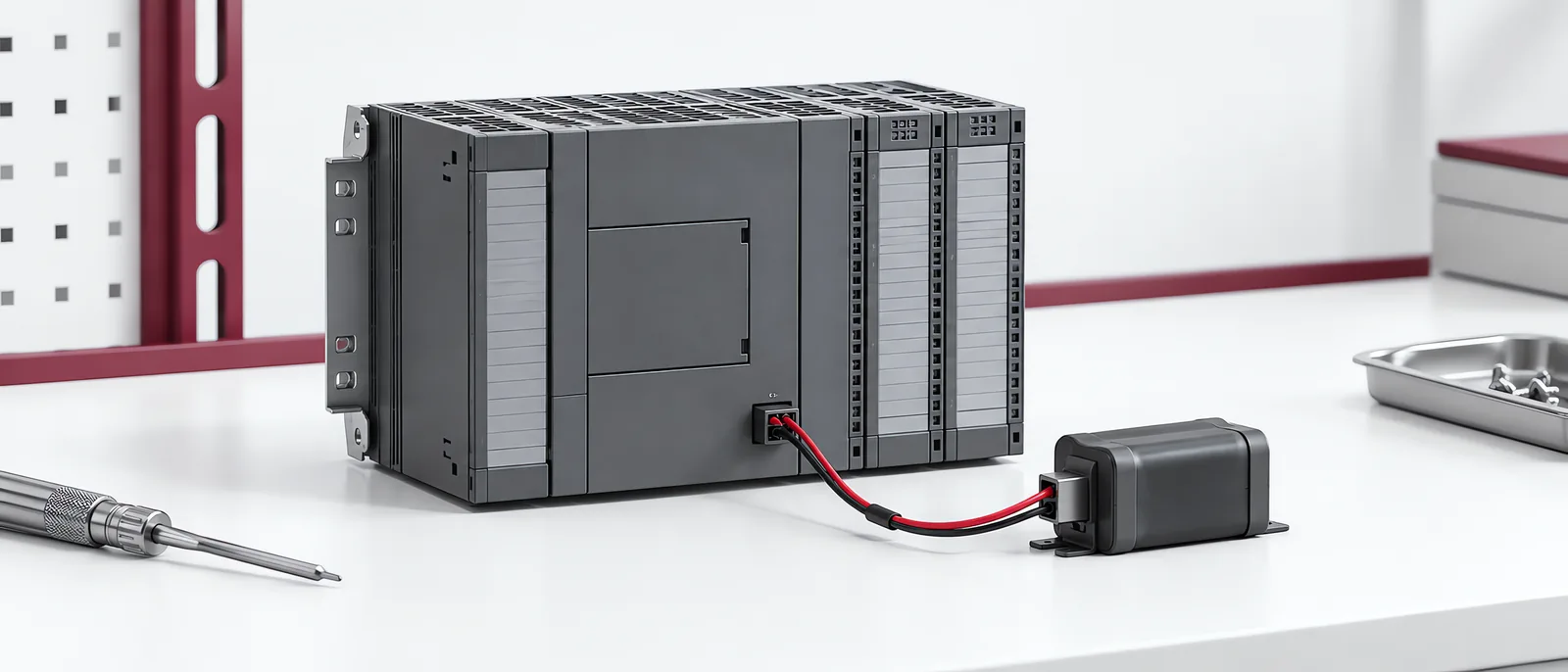
Conceptual equipment illustration.
PLC battery replacement is a model-specific maintenance task. Some controllers use a battery for memory or clock retention; others use different retention technology. Identify the exact processor and its documented requirement before planning the intervention. The visible battery and its age do not establish one universal replacement sequence.
For equipment under a machine-retrofit programme, maintain the controller configuration as a recoverable asset, not only a file on an old laptop.
Confirm What the Battery Retains
Read the processor’s maintenance instructions and approved battery details. Rockwell Automation’s SLC 500 manual has separate instructions for different SLC processor groups. That distinction is a reason not to generalize one family’s power or retention conditions to another controller.
Record the processor part number, relevant revision and current retention/fault indication. Include any HMI, drive or recipe system with a separate backup requirement; a PLC battery does not protect all of them.
Make the Backup Useful Before Maintenance
A saved engineering project and the running controller state can differ. Establish which programme, parameters and retained data need to be recoverable for this machine.
The backup review should answer:
- Can the file be opened with the available engineering software and licences?
- Does it correspond to the installed programme and hardware configuration?
- Are required recipes, setpoints or retained counters captured separately?
- Are the communication settings and restore route documented?
The PLC programming scope covers maintaining the executable configuration. A file named “latest” without a verified relationship to the controller is not a demonstrated recovery source.
Plan the Intervention for the Exact Model
Use the manufacturer’s replacement sequence, required power state and permitted retention interval. These conditions differ by product. Do not adopt a generic powered or unpowered swap procedure from another PLC family.
Define the production stop and how the machine reaches the intended maintenance state. Record the new approved battery identity and completion date so that future maintenance is based on the actual intervention.
Check the Machine after the Intervention
Confirm the documented battery/retention status, programme identity, clock and required retained values. Check that the machine can execute the relevant operating sequence before releasing it to normal production.
If recovery requires downloading a programme, treat that as a controlled configuration action with the appropriate checks. The PLC migration guide covers the wider change when hardware obsolescence makes replacement necessary.
A verified recovery path also supports unplanned-downtime reduction. Contact Motionwell to discuss the controller backup and maintenance scope for the machine.