
Two-Level Packaging Conveyor With a Lifter for a Medical Device Manufacturer
We built a two-level packaging line conveyor system with a lifter for a medical device manufacturer. It was assembled at our Woodlands Link facility before shipment.
- A two-level packaging line conveyor system
- A lifter carries product between the lower and upper level
- Assembled at Woodlands Link before shipment
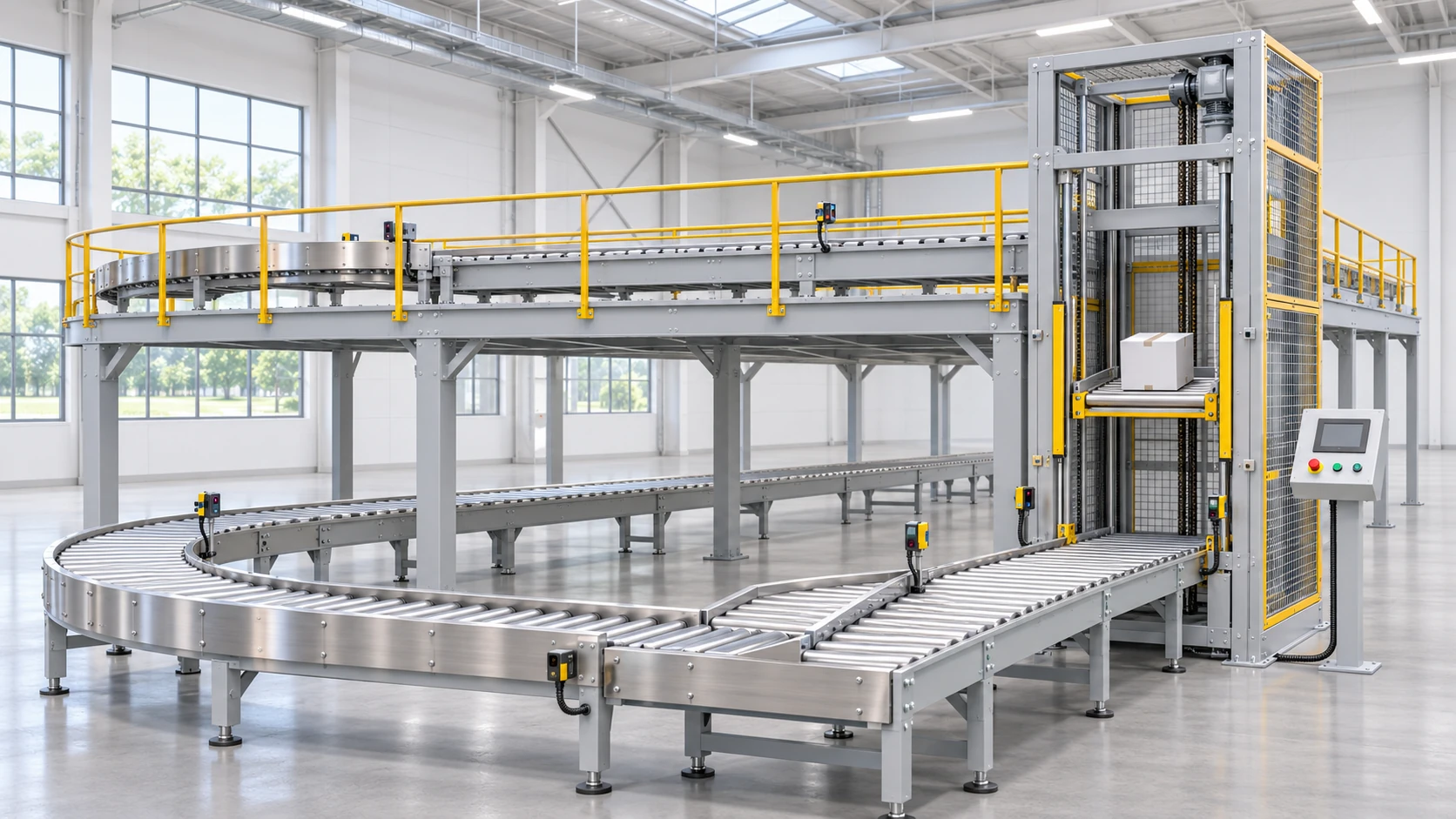
A vertical conveyor is a machine that moves product automatically from one level to another as part of a conveyor system. This case study shows the two-level packaging line conveyor system with a lifter that we built for a medical device manufacturer. It is one of the systems behind our conveyor and material handling work in Singapore.
A general reference gives the same definition:
“A vertical conveyor is a machine which can be used to move products automatically from one level to another.”
Source: Wikipedia, Vertical conveyor
What Are the Main Types of Vertical Conveyor?
Vertical conveyors are grouped by how they carry the load up or down. Some carry product in a steady stream. Others carry one load per trip on a platform.
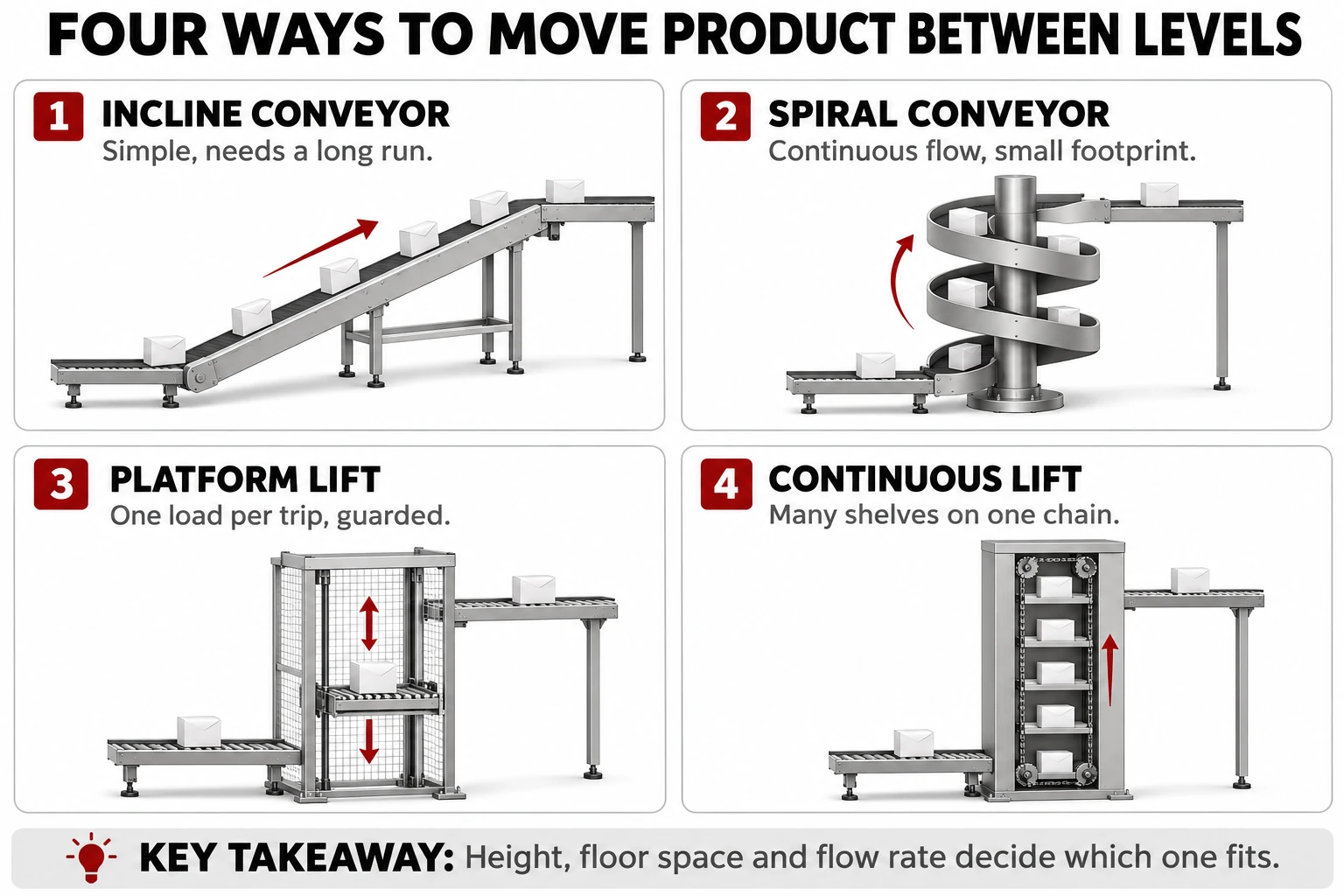
| Type | How it moves product | Fits |
|---|---|---|
| Incline conveyor | A belt or roller run slopes between the levels | Small height changes with room for a long run |
| Spiral conveyor | Product travels along a helical track round a column | Steady high flow on a small footprint |
| Platform lift (lifter) | A platform with its own conveyor carries one load per trip | Lower flow, heavier loads, tight floor space |
| Continuous lift | Many shelves on a moving chain carry loads at once | Higher flow where loads stay level |
To choose between them, a supplier needs five inputs: the heaviest load, the loads per minute, the lift height, the floor space and the type of conveyor at each end. Matching the lift’s carrying surface to the conveyors at each end gives the smoothest transfer.
The system in this case study uses a lifter. Our spiral conveyor guide compares the spiral with the incline and the lift in more depth.
What Did the Customer Need?
The customer needed a packaging line conveyor system on two levels, with a lifter to carry product between them.
How Does a Two-Level Conveyor System Work?
A two-level conveyor system is built from four kinds of section:
- Straight conveyors: Carry product along each level between stations.
- Curved conveyors: Turn product round corners without stopping it.
- Merging conveyors: Join two streams of product into one.
- Lifter: Carries product between the lower level and the upper level.
A merging section needs control logic as well as steel. Sensors watch both incoming streams, and the controls hold one stream for a moment so that two loads never meet at the join. Curves need guide rails and roller spacing matched to the smallest and largest pack, so the pack turns without twisting or jamming.
How Does a Conveyor Lifter Move Each Load?
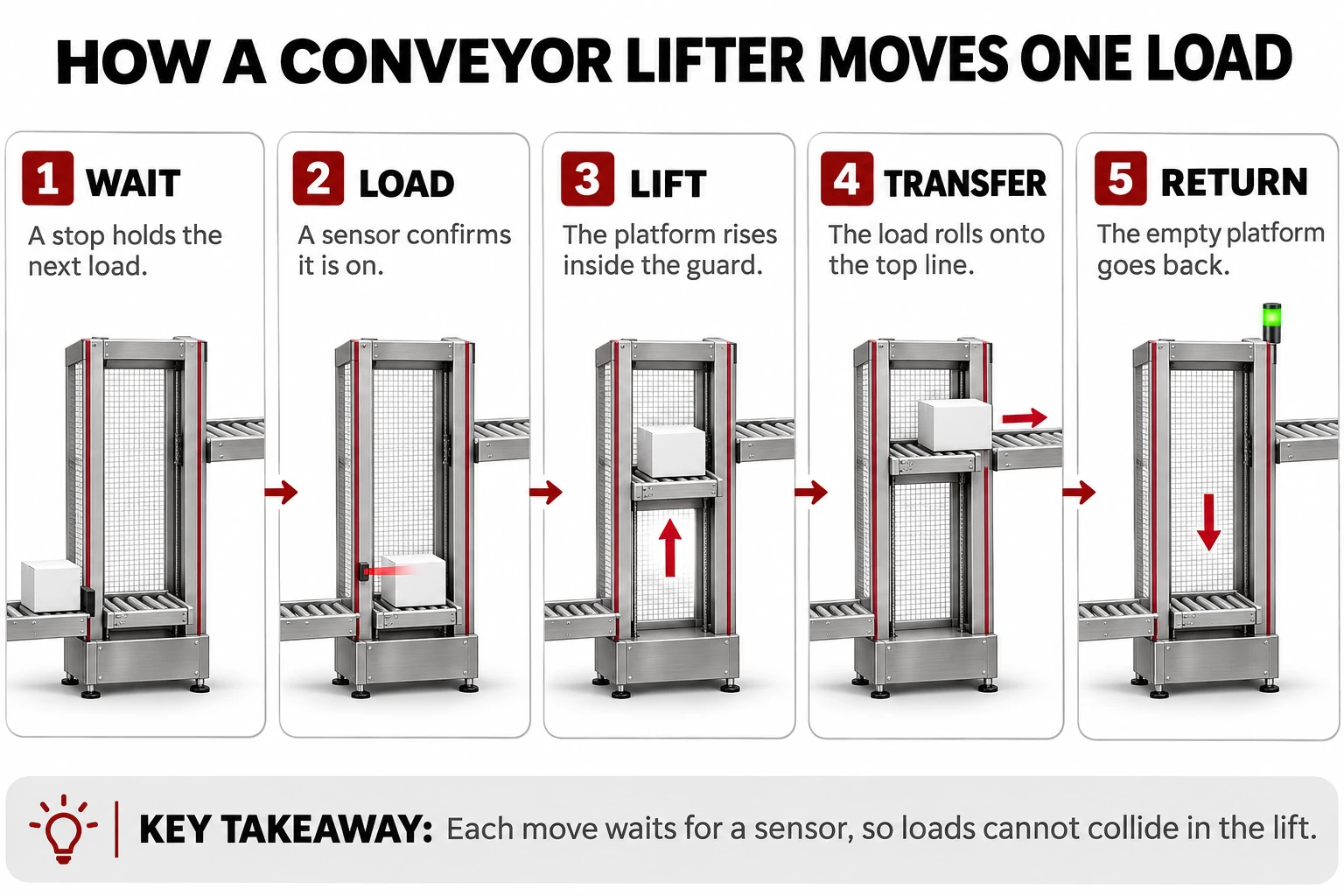
A conveyor lifter is a vertical lift conveyor with a short powered conveyor on its platform. It works in a fixed cycle, and each step starts once the step before it is confirmed.
| What sets the result | Why it matters |
|---|---|
| Cycle time per trip | Sets how many loads per hour the lifter can pass |
| Platform position at each level | The platform conveyor must line up with the fixed conveyor so loads roll across cleanly |
| Load sensors and stops | A load moves onto the platform when the platform is empty and in place |
| Guarding and door interlocks | Keep people out of the lift path when the platform moves |
Loads cannot arrive faster than the lifter completes its trips. If they do, they pile up at the infeed, and a load that meets the platform mid-move can tip or fall. The infeed conveyor therefore releases a load only when the platform is in place and empty.
The lifter is the one point where both levels depend on a single machine. When it stops, both levels stop feeding each other. We design the controls so that the conveyors before the lifter hold product in a queue and never push it into a stopped lift.
- 2Conveyor levels joined by one lifter
- 150+Automation projects delivered in Singapore since 2014
How Is a Lifter Made Safe?
A lifter has a platform moving up and down inside a frame, so the risk assessment decides the guarding. We design lifters with a fixed guard round the lift path, interlocked access doors and openings just where the conveyors pass through. Emergency stops, and overload or obstruction sensing where the risk assessment calls for them, complete the safety functions. A vertical lift conveyor is built for goods only. It never carries people. Our machine safety and CE marking page explains how the risk assessment sets these choices.
How Was the System Tested Before Shipment?
We assembled the system at our Woodlands Link facility before shipment. Machines we design are assembled and tested there before factory acceptance. Assembly in the workshop lets the conveyors, the lifter and the controls run together before anything reaches the customer’s floor. For a two-level system like this, the checks cover:
- Transfers: Loads pass from each conveyor onto the lifter platform and off again at both levels.
- Merges: Two streams join without loads touching.
- Curves: The smallest and largest packs turn without jamming.
- Safety functions: Opening a guard door stops the lifter.
We design in SolidWorks and design and build our own control panels. Precision machining and sheet metal work are placed with Singapore subcontractors and inspected on receipt at our facility.
Where Else Does This Engineering Apply?
Two-level layouts appear wherever floor space is short: packing halls, warehouse picking areas and lines that feed a mezzanine.
Vertical conveyors do three common jobs in a plant:
- Floor to floor: Moving loads between storeys, or between a mezzanine and the floor.
- Feeding storage: Raising loads to the infeed of an automated store and taking them back down.
- Level changes inside a line: Lifting product over an aisle, or onto a sortation or accumulation level.
Our packaging line integration page covers how conveyors join the packing machines, and our comparison of conveyor types explains the main kinds of conveyor. For regulated plants, see medical device automation.
Start with the layout
Send Us Your Floor Plan
Tell us the product and its packaging, the rate you need and where product enters and leaves each level, and add a floor plan or photos. We reply with a conveyor and lifter layout that suits it.
Discuss Your Conveyor Layout →FAQs
What is a vertical conveyor?
A vertical conveyor is a machine that moves products automatically from one level to another inside a conveyor system. Common kinds are incline conveyors, spiral conveyors, platform lifts and continuous lifts.
What is the difference between a conveyor lifter and a spiral conveyor?
A conveyor lifter carries one load or one group of loads at a time on a platform that moves up and down. A spiral conveyor runs without stopping along a helical track. A lifter suits lower flow, heavier loads and tight floor space, and a spiral suits steady high flow.
Can a vertical lift conveyor carry people?
A vertical lift conveyor cannot carry people. It is built for goods only, and guards and interlocks keep people out of the lift path.
How is a conveyor lifter kept safe?
A conveyor lifter runs inside a fixed guard. Interlocked doors stop the lift when they open, and sensors confirm each load is on the platform before it moves. The safety functions follow the machine risk assessment.
What should we send to plan a two-level conveyor system?
Send a floor plan with both levels, the product and its packaging, the rate you need, and where product enters and leaves each level. Photos of the current line help.
Get a quote
Not sure what configuration fits your product?
Send us the part and the target rate. We respond within one business day.
- What the machine or line has to do, and the rate you need
- A drawing, a sample photo or the model of the existing machine
- Where it will be installed and when you need it running
- Call+65 8102 9575
- WhatsAppMessage us on WhatsApp
- Emailinfo@motionwell.com.sg
- HoursMon to Fri, 8:30 AM to 6:00 PM