
Robot Maintenance Support for a Medical Device Manufacturer
We hold a year-round support account with a Singapore medical device manufacturer. It covers spare parts, troubleshooting visits and technical support for the robots on the customer's production lines.
- Spare parts supplied under one account
- Troubleshooting visits to the customer's site
- Technical support for the robots in production
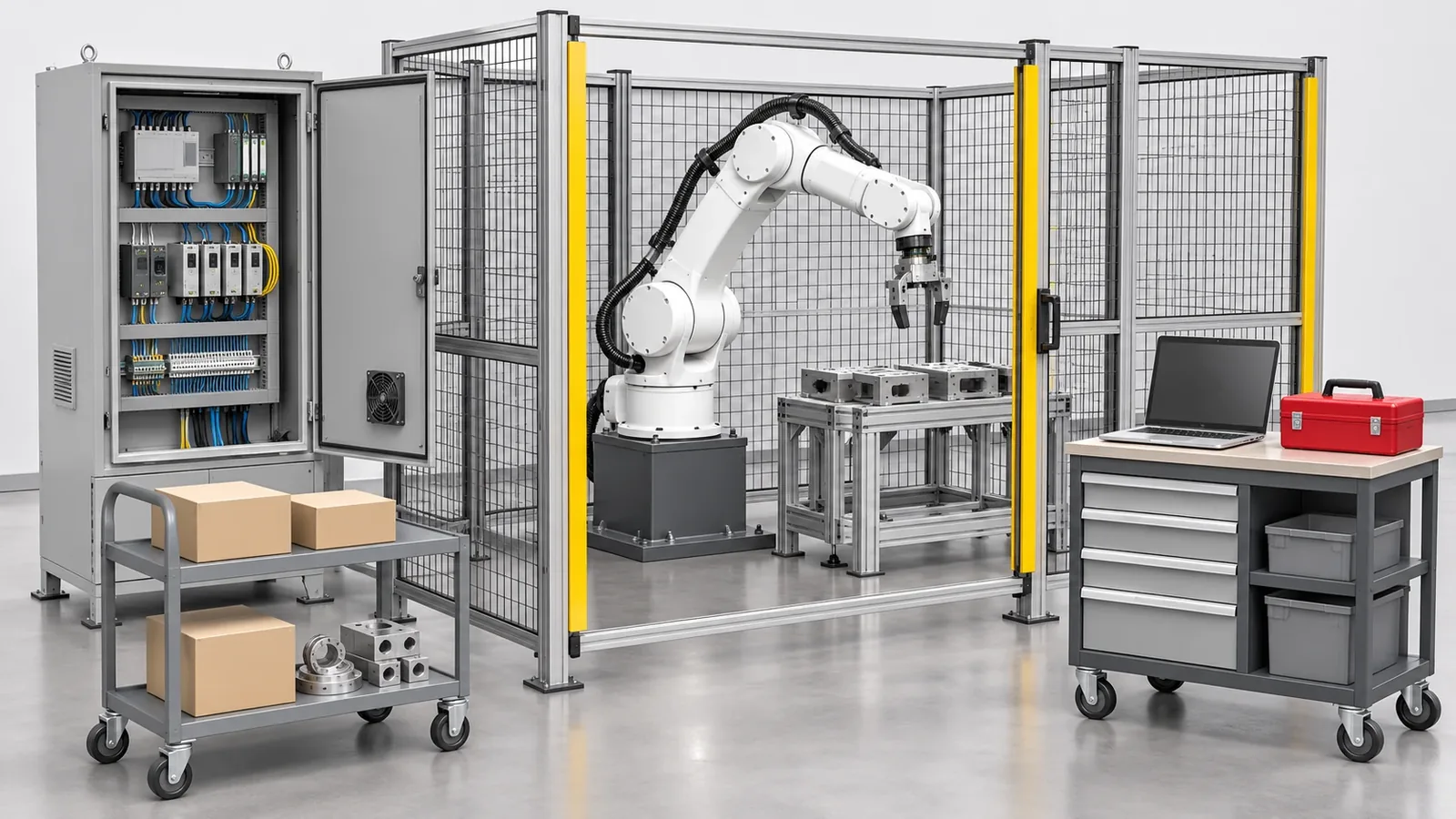
Robot maintenance is the inspection, servicing and repair work that keeps an industrial robot running between planned stops. This case study shows the year-round support account we hold with a Singapore medical device manufacturer. The account covers spare parts, troubleshooting visits and technical support for the robots on its lines. It is part of our robot integration work in Singapore.
What Are the Main Types of Robot Maintenance?
Wikipedia describes maintenance in general terms:
“The technical meaning of maintenance involves functional checks, servicing, repairing or replacing of necessary devices, equipment, machinery, building infrastructure and supporting utilities in industrial, business, and residential installations.”
Source: Wikipedia, Maintenance
Robot maintenance is grouped by when the work happens. Some work is planned before anything fails. Other work answers a fault.
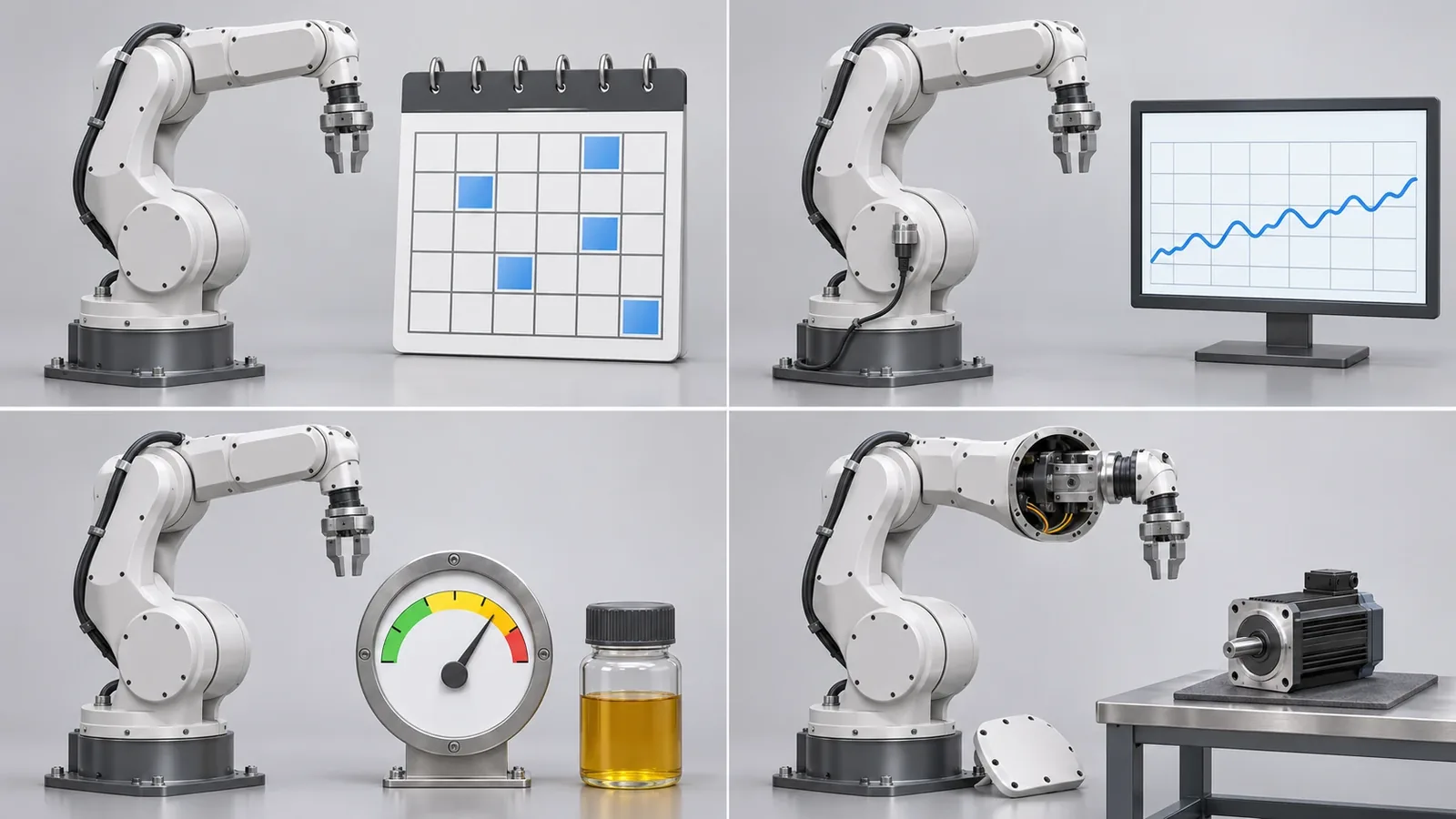
| Type | When the work happens | Typical tasks |
|---|---|---|
| Planned maintenance | At fixed hours or dates from the robot maker’s manual | Gearbox oil, battery change, cable checks |
| Condition-based maintenance | When a measured value crosses a limit | Acting on motor current, temperature or vibration trends |
| Predictive maintenance | Before a forecast failure | Changing a gearbox when its wear trend points to failure |
| Corrective maintenance | After a fault or breakdown | Fault finding, part replacement, restart and test |
Troubleshooting after a robot fault is corrective maintenance. Spare parts and site visits shorten the time a robot is down after a fault. Our machine condition monitoring guide covers the sensors behind condition-based and predictive work.
Who Is the Customer?
The customer is a Singapore medical device manufacturer that runs industrial robots in production. Our support account with it covers spare parts, troubleshooting visits and robot technical support.
What Does the Support Account Cover?
| Part of the account | What it covers | Why it matters |
|---|---|---|
| Spares | Supplying replacement parts for the customer’s robots | A missing part keeps a robot down longer than the repair itself |
| Troubleshooting visits | Our engineers going to site to find and fix a fault | Some faults only show on the running cell |
| Robot technical support | Answering technical questions on the robots in production | The account gives the customer a contact for robot technical questions |
The account runs all year. The customer calls one team for all three. Our workshop is in Woodlands, Singapore.
What Does a Robot Maintenance Checklist Include?
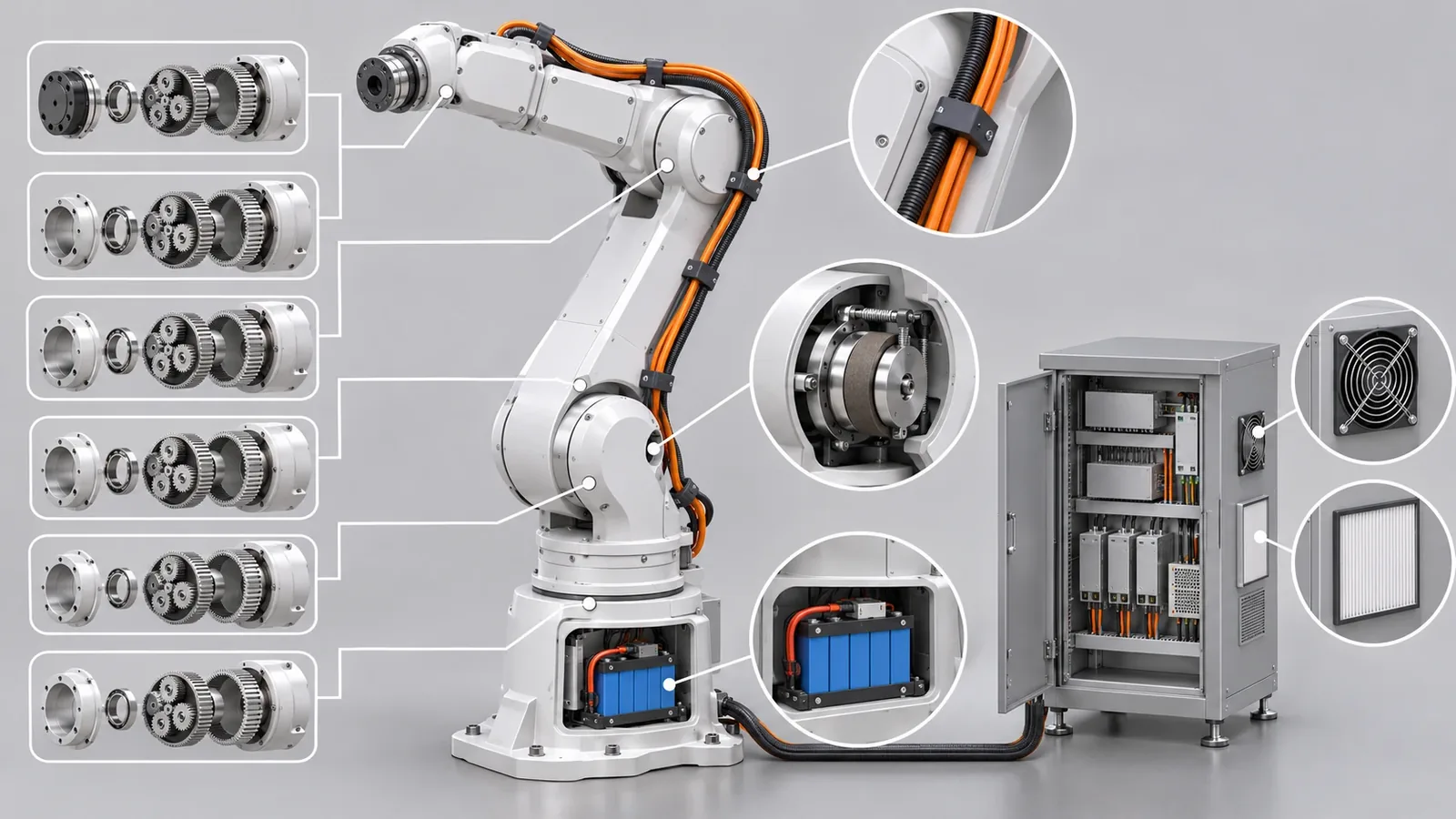
A planned check on an industrial robot follows the intervals in the robot maker’s manual. Most checklists cover the same parts:
- Gearboxes: Check for oil leaks and change the oil or grease at the set interval.
- Cables and hoses: Look for wear where the cable set flexes with the arm.
- Brakes: Test that each axis holds its position with the power off.
- Encoder battery: Change the battery that keeps the robot’s position memory when the power is off.
- Controller: Clean the cooling fans and filters in the control cabinet.
- Programs: Back up the robot programs and settings before and after any change.
- Tooling: Check grippers, suction cups and tool changers for wear.
- Safety functions: Test the emergency stops, door interlocks, brakes and teach pendant switches.
- Records: Log each check, part change and fault. The log helps find the cause of the next fault and supports warranty claims.
What Is a Typical Robot Maintenance Schedule?
The robot maker’s manual sets the intervals for each model. Most plans group the work into four levels:
| Interval | Typical tasks |
|---|---|
| Daily | Look over cables and connectors, listen for new noise, check the gripper and clear any fault codes |
| Weekly | Check for gearbox leaks, look for chafed cables and clean the robot and its tool mount |
| Monthly | Check fasteners, the teach pendant cable and the controller filters, and run a repeatability test |
| Yearly or by operating hours | Change gearbox oil, change batteries, back up all programs, update controller software where the maker advises, and test brakes and safety functions |
A robot that runs two or three shifts a day reaches its hour-based service points sooner. Track service against operating hours as well as dates. Heat, humidity, dust and chemicals also shorten the intervals, so adjust the plan to the site.
What Are the Warning Signs Before a Robot Fails?
A robot shows signs before many failures. Catching them turns a breakdown into a planned stop.
| Sign | What it can point to |
|---|---|
| New noise or vibration from a joint | Gearbox or bearing wear |
| Oil or grease on the arm or the floor | A failing seal on a gearbox |
| Parts placed slightly off position | A loose tool, worn gearbox or lost calibration |
| The same error coming back after a reset | A damaged cable or a failing sensor |
| A hot controller cabinet | Blocked filters or a failed cooling fan |
Why Must Robot Maintenance Be Planned Safely?
Maintenance puts people inside the robot’s working space with the guards open. The UK Health and Safety Executive notes that maintenance always involves non-routine activities and that unsafe maintenance has caused many fatalities and serious injuries (HSE, Maintenance of work equipment). Safe work starts with isolating the robot’s energy sources and following the maker’s procedure. Our ISO 10218 guide explains the safety standard for industrial robots.
- 3Kinds of support in one account
- Year-roundAccount cover
- 150+Automation projects since 2014
Where Else Does This Engineering Apply?
The same support work applies to any plant running robot cells it did not build itself. On cells we build, support after handover is the last stage of our automation project process. When a robot cell is sound and its controls are worn out, machine retrofit and modernisation replaces the PLC, drives and HMI. For new robot cells on medical device lines, see our medical device assembly machine page and medical device manufacturing.
Start with your robots
Send Us Your Robot List
Tell us the robot makes and models you run, how many shifts they work and what has failed in the past year. We reply with the support we can cover and the questions for the next step.
Discuss Robot Support →FAQs
What is robot maintenance?
Robot maintenance is the inspection, servicing and repair work that keeps an industrial robot able to do its job. It covers planned checks such as gearbox oil and cables, and repairs after a fault.
How often does an industrial robot need maintenance?
The robot maker's manual sets the intervals for each robot model by operating hours or calendar time. Robots that run more shifts, carry heavier loads or work in dust reach those intervals sooner.
What does a robot support account cover?
The account in this case study covers spare parts, troubleshooting visits and technical support for the customer's robots. Other accounts can add planned maintenance visits, program backups or operator training.
Which spare parts should a plant keep for its robots?
Keep the parts whose failure stops the line and whose delivery takes longest. For most robot cells these include teach pendant cables, encoder memory batteries, gripper parts and the cable sets that flex with the arm.
What should we send for a robot support enquiry?
Send the robot makes and models, how many robots you run, how many shifts they work and what has failed in the past year. A list of the spares you hold today helps us see the gaps.
Get a quote
Not sure what configuration fits your product?
Send us the part and the target rate. We respond within one business day.
- What the machine or line has to do, and the rate you need
- A drawing, a sample photo or the model of the existing machine
- Where it will be installed and when you need it running
- Call+65 8102 9575
- WhatsAppMessage us on WhatsApp
- Emailinfo@motionwell.com.sg
- HoursMon to Fri, 8:30 AM to 6:00 PM