
Indexing Conveyor and Bowl Feeders for a Medical Device Manufacturer
For a medical device manufacturer we have delivered vibratory bowl feeders, an orientation proof of concept, an indexing conveyor with reject and bowl vision inspection.
- Vibratory bowl feeders and an indexing conveyor with reject
- Vision inspection on the bowl feeder
- ISO 9001:2015 certified, more than 150 automation projects since 2014
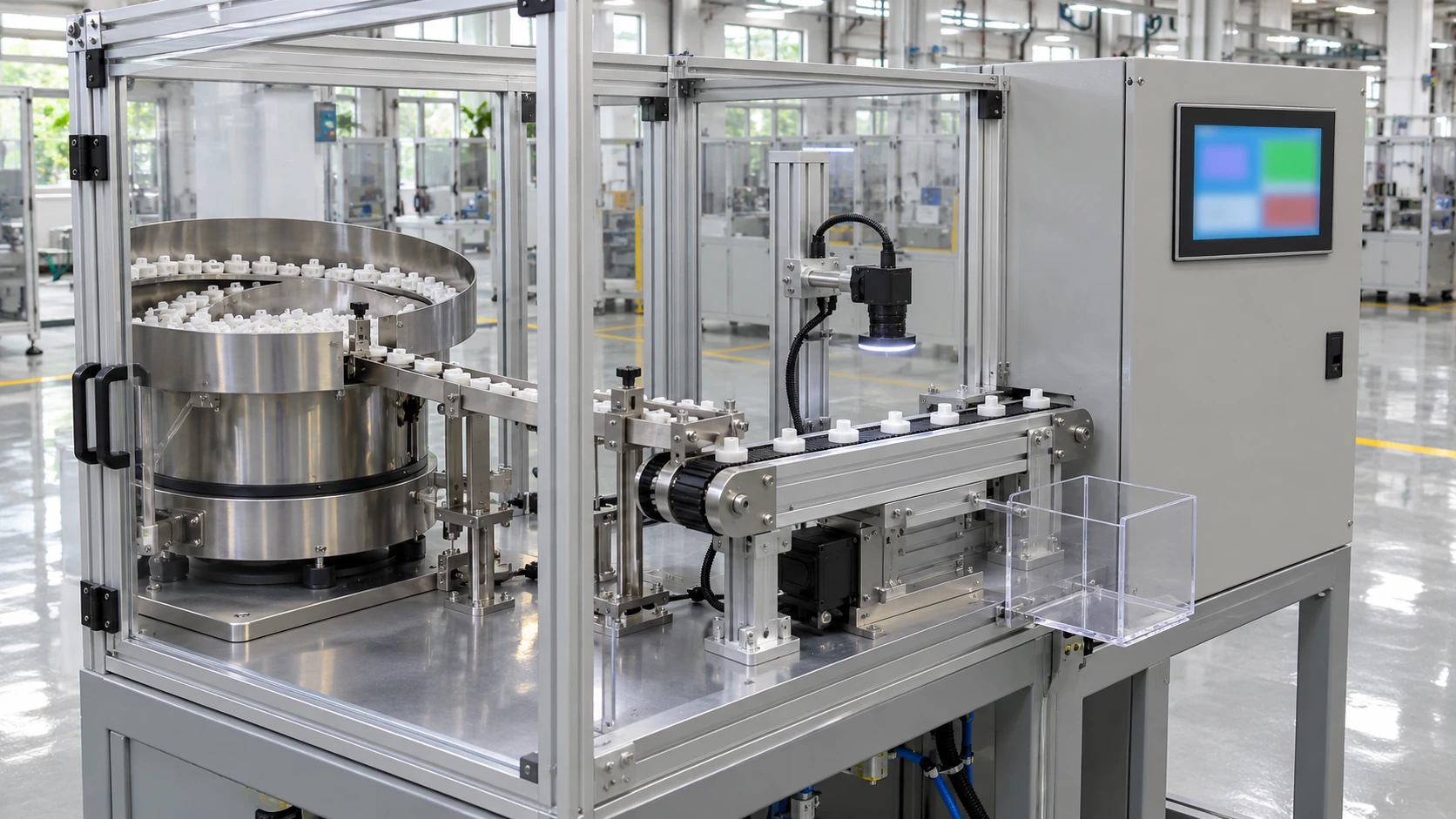
An indexing conveyor moves in fixed steps and stops for a set time, so each part arrives at the same position at every station. A vibratory bowl feeder sits upstream of it and turns loose bulk parts into a single row, all facing the same way. For a medical device manufacturer we have delivered vibratory bowl feeders, an orientation proof of concept, an indexing conveyor with reject and bowl vision inspection. This work is part of our part feeding systems in Singapore.
What Are the Main Types of Indexing Conveyor?
Indexing conveyors are grouped by what carries the part and how the step is made.
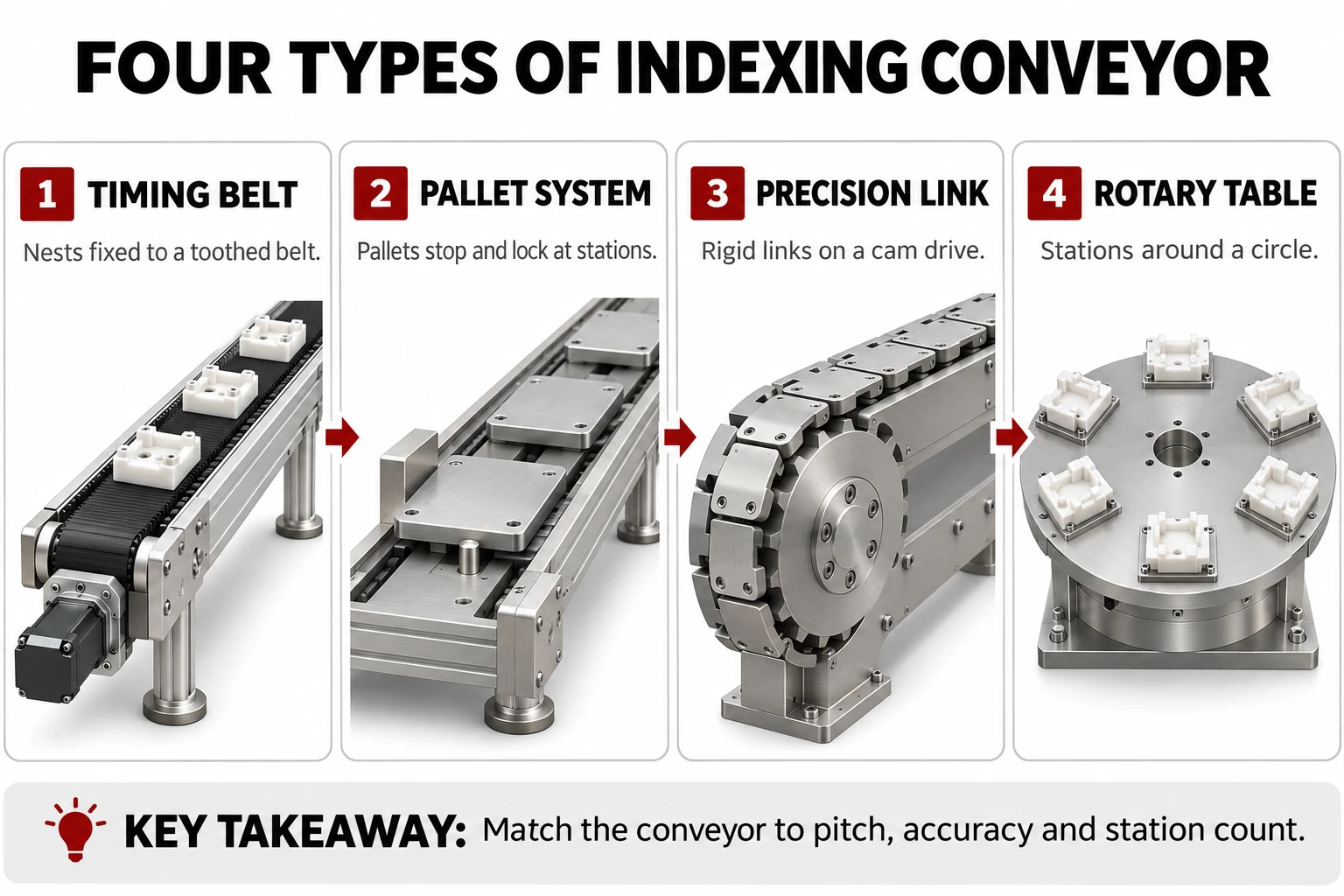
| Type | How it indexes | Suits |
|---|---|---|
| Timing belt | Nests are fixed to a toothed belt driven by a servo motor | Small, light parts at short pitch |
| Pallet system | Pallets ride on a belt or chain and stop against stops at each station | Long lines and stations that need a locked fixture |
| Precision link | Rigid machined links run on a cam or servo drive | Heavier parts and tight station positions |
| Rotary table | A round table turns one step at a time | A few stations in a small footprint |
A rotary table does the same job in a circle. Our page on rotary indexing and inline assembly compares the two layouts.
What Did the Customer Need?
The customer, a medical device manufacturer, needed small parts fed and oriented automatically before the next process. Any wrong part had to leave the flow. Motionwell delivered vibratory bowl feeders, an orientation proof of concept, an indexing conveyor with reject and bowl vision inspection.
How Does a Vibratory Bowl Feeder Orient Parts?
The Wikipedia article on bowl feeders describes when this kind of feeder is used:
“They are used when a randomly sorted bulk package of small components must be fed into another machine one-by-one, oriented in a particular direction.”
Source: Wikipedia, Bowl feeder
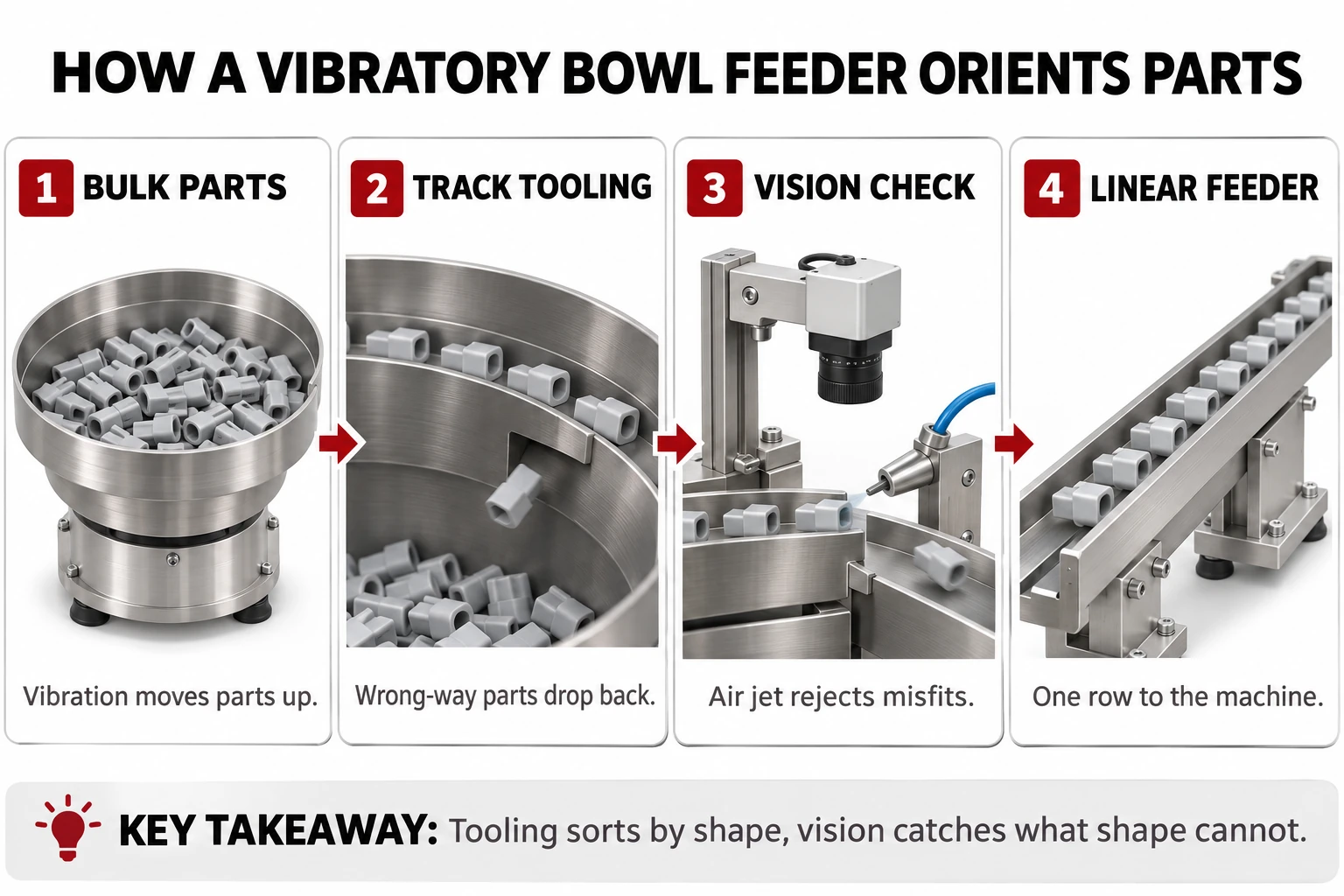
A bowl feeder line works in four stages:
- Bowl and drive: A drive under the bowl vibrates it. The parts climb a spiral track on the inner wall.
- Tooling: Wipers, slots, rails and air jets on the track let parts pass in one orientation alone. Parts in any other orientation fall back into the bowl.
- Vision: A camera at the track checks each part, and an air jet removes parts that are the wrong way round or faulty.
- Linear feeder: A straight vibrating track carries the row to the pick point and holds a short queue so the machine never waits.
What Decides the Feed Rate and Orientation?
The feed rate and the share of correctly oriented parts depend on the part and on how the feeder is tuned.
| Factor | What it changes | How it is set |
|---|---|---|
| Part shape | Whether tooling can sort it by its outline | Chosen at the proof of concept stage |
| Vibration amplitude and frequency | How fast parts climb the track | Drive controller settings |
| Bowl level | How evenly parts reach the track | A level sensor and a hopper that refills the bowl |
| Track surface | Grip, part damage and noise | Coatings and track material |
| Queue length on the linear track | Whether the next station runs short | Sensors that stop and start the bowl |
Why Start With an Orientation Proof of Concept?
An orientation proof of concept tests whether a part can be oriented reliably before a full feeder is built. Some parts look almost the same in two orientations, or tangle, or stick together. We run real customer parts through test tooling or a vision check and measure how many arrive the right way up and how fast. The result decides whether tooling alone is enough or the feeder needs vision. It also shows whether the part needs a different method such as a step feeder or a centrifugal feeder.
How Does an Indexing Conveyor Hold Position?
An indexing conveyor holds position by stopping the carrier at the same place each cycle and, where the tolerance is tight, locking it there.
- Drive: A servo motor or a cam drive moves the belt or links exactly one pitch per step.
- Location: Nests on the belt carry the part in a fixed position. Pallet systems add a locating pin that lifts into each pallet at the station.
- Timing: The PLC starts the next step only when every station has finished, so no tool works on a moving part.
- Reject: A part that fails a check is pushed or picked off into a reject bin. The PLC records the empty nest so the stations downstream skip it.
Which Drive Should an Indexing Conveyor Use?
The drive decides how fixed or flexible the step is.
| Drive | How it indexes | Suits |
|---|---|---|
| Cam indexer | A cam sets a fixed stroke and dwell for every cycle | One product at a fixed pitch and a high rate |
| Servo motor | The controller programs each move and its motion profile | Product changes, different pitches and smooth starts |
| Stepper motor | The drive sends a set number of steps for each move | Light loads at short travel where cost matters |
An open loop stepper system does not confirm its actual position. Position feedback comes from an encoder or a sensor that sees each pitch, and the conveyor checks its position on every cycle.
Which Specifications Matter When Choosing an Indexing Conveyor?
Positioning repeatability, index time, dwell time, load and pitch decide whether an indexing conveyor suits a process.
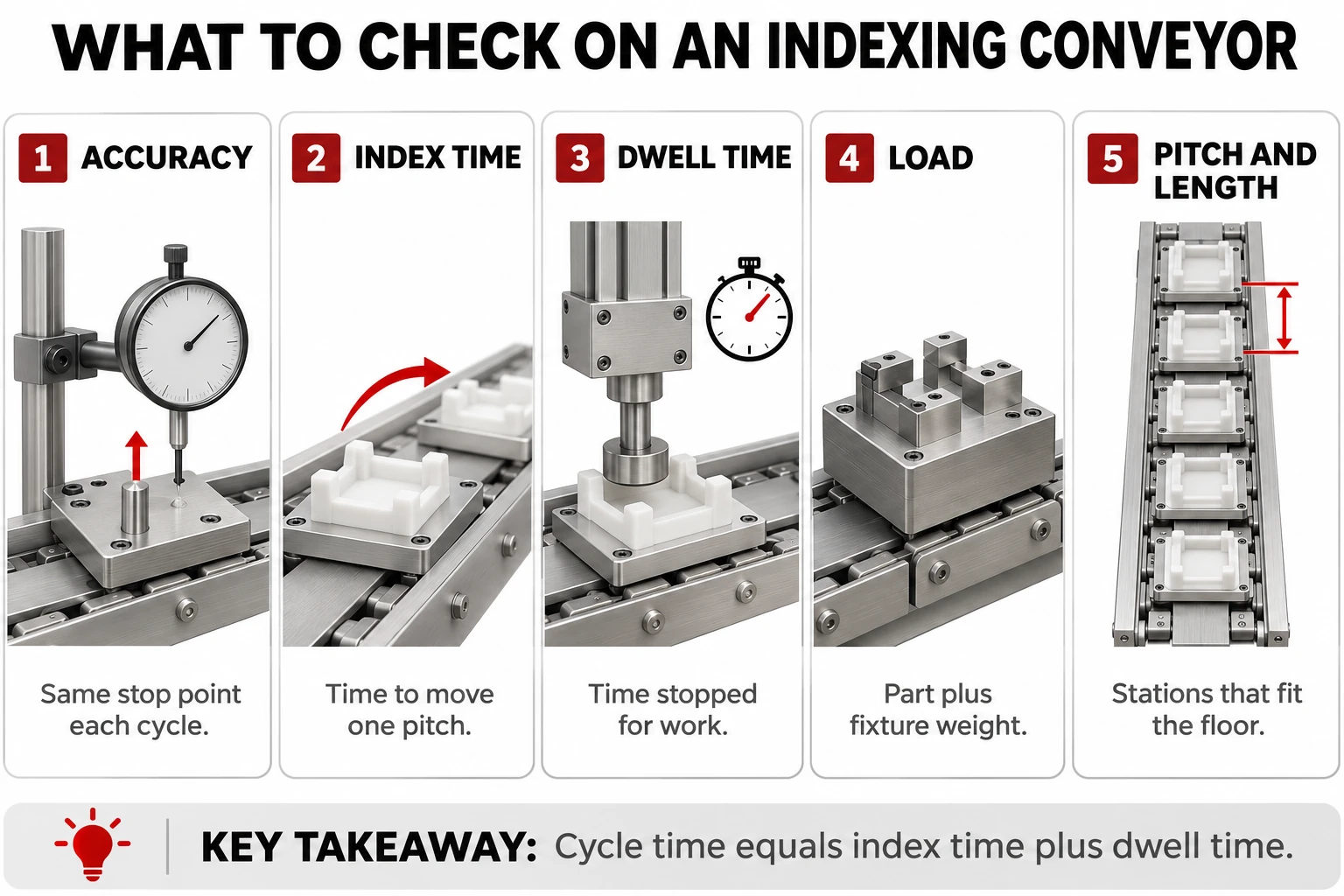
| Specification | What it means | What to check |
|---|---|---|
| Positioning repeatability | How close the carrier stops to the same point each cycle | Precision link conveyors locate fixtures more accurately than belt or pallet conveyors |
| Index time | The time to move one pitch | A short index leaves more of the cycle for work at the station |
| Dwell time | The time the carrier stays stopped at a station | The slowest station sets it |
| Load | The weight of the part and fixture on each carrier | Heavy duty links and belts carry heavier tooling |
| Pitch and length | The distance between stations and the total conveyor length | Together they decide how many stations fit the floor |
| Environment | Cleanroom, washdown or a dusty shop floor | Sets the materials, finish and covers of the conveyor |
Cycle time is the index time plus the dwell time. One link conveyor maker gives the example of a conveyor that moves 150 mm in 0.2 seconds inside a 0.58 second cycle, with a stated repeatability of ±0.06 mm.
How Is a Feeding Line Tested Before Handover?
A feeding and indexing line is tested with the customer’s own parts at the planned rate. We run a long batch through the feeders and count the parts that arrive in the wrong orientation or jam. We also check that each rejected part ends up in the reject bin and goes no further down the line. The same test runs again on site after installation. Floor vibration and room temperature change how a bowl feeder behaves.
Where Else Does This Engineering Fit?
The same feeding, indexing and inspection work runs inside larger machines. Our medical device assembly machine page shows how feeders and indexing combine into an assembly line. Our machine vision inspection page covers the cameras and checks, and conveyor and material handling covers longer transfers. For the sector, see medical device manufacturing.
Start with the part
Send Your Parts and the Orientation You Need
Send a drawing or samples, the orientation each part must have at the machine, the rate you need and what the next station does. We reply with questions about the feeding and indexing method.
Discuss Your Feeding Line →FAQs
What is an indexing conveyor?
An indexing conveyor is a conveyor that moves in fixed steps and stops for a set time, so each part or fixture arrives at the same position at each station. Assembly, inspection and marking happen during the stop.
What is the difference between an indexing conveyor and a continuous conveyor?
A continuous conveyor runs at a steady speed and parts keep moving. An indexing conveyor stops each part at a known position, so a tool or camera can work on a part that is not moving.
How does a vibratory bowl feeder orient parts?
A vibratory bowl feeder shakes the bowl so the parts climb a spiral track on its inner wall. Tooling on the track lets parts pass only in the correct orientation, and parts in any other orientation fall back into the bowl.
Why add vision to a bowl feeder?
Vision catches parts that pass the tooling in the wrong orientation or with a defect the tooling cannot sense. A camera checks each part at the track, and an air jet blows rejected parts back into the bowl.
What should we send for a first discussion?
Send a drawing or samples of the parts, the orientation each part must have at the machine, the rate you need and what the next station does with the part. We reply with questions about the feeding and indexing method.
Get a quote
Not sure what configuration fits your product?
Send us the part and the target rate. We respond within one business day.
- What the machine or line has to do, and the rate you need
- A drawing, a sample photo or the model of the existing machine
- Where it will be installed and when you need it running
- Call+65 8102 9575
- WhatsAppMessage us on WhatsApp
- Emailinfo@motionwell.com.sg
- HoursMon to Fri, 8:30 AM to 6:00 PM