
Pharmaceutical Conveyor Work on a Packaging Line
For a Singapore pharmaceutical manufacturer we modified a modular belt conveyor on a packaging line and service its hot-melt glue system.
- Modular belt conveyor modified on a running packaging line
- Ongoing service of the line's hot-melt glue system
- We integrate conveyors, glue systems and controls on packaging lines
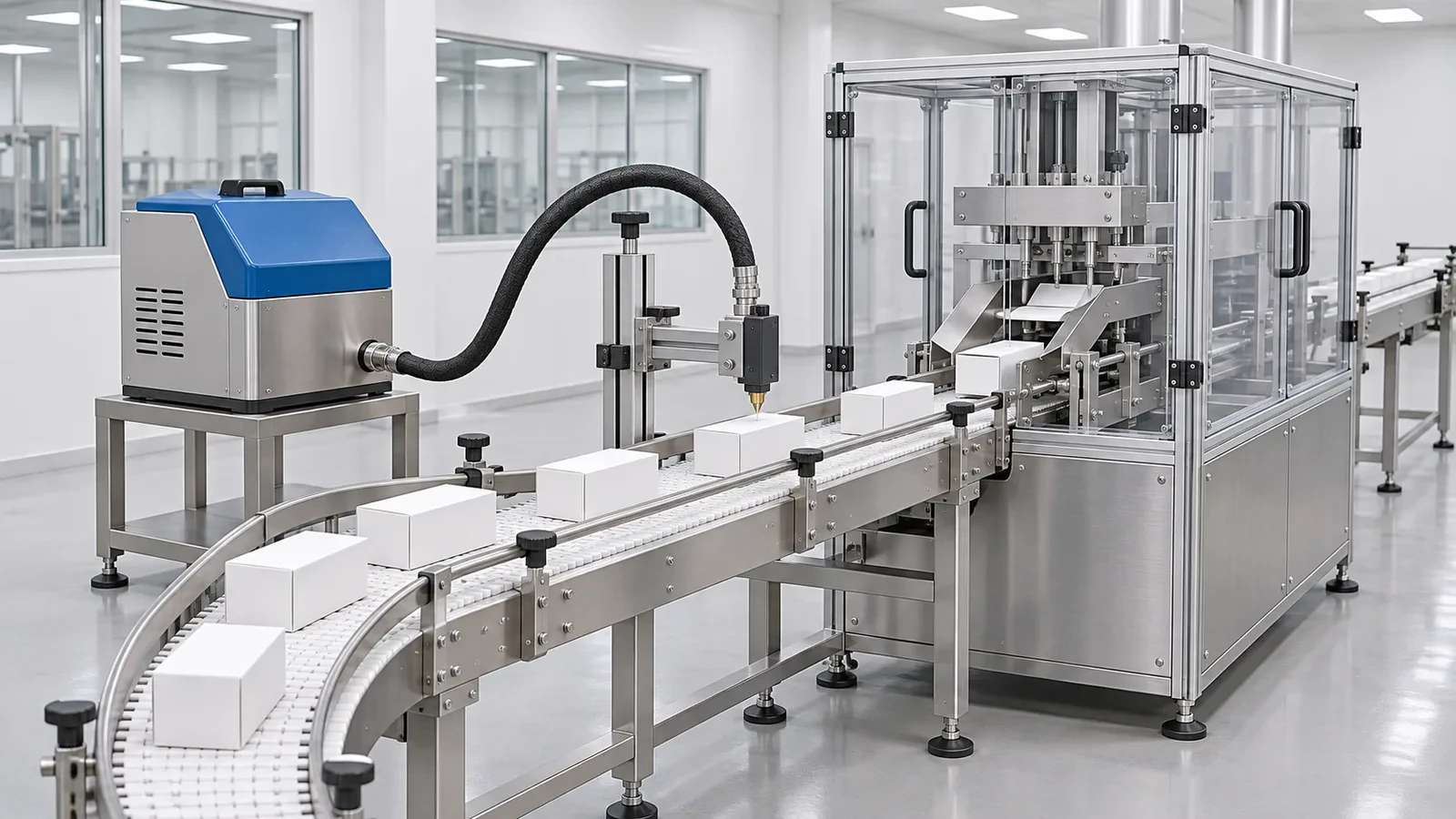
A pharmaceutical conveyor carries drug products and their packs between machines on a regulated line. Its frame and belt are built to be easy to clean. For a Singapore pharmaceutical manufacturer we modified a modular belt conveyor on a packaging line and service its hot-melt glue system. The work is part of our conveyor and material handling services.
Which Conveyors Run on a Pharmaceutical Line?
Pharmaceutical lines use a few conveyor types, each suited to a product and a route. The products include bottles of tablets, vials, syringes, blister packs, and the cartons and cases they are packed into.
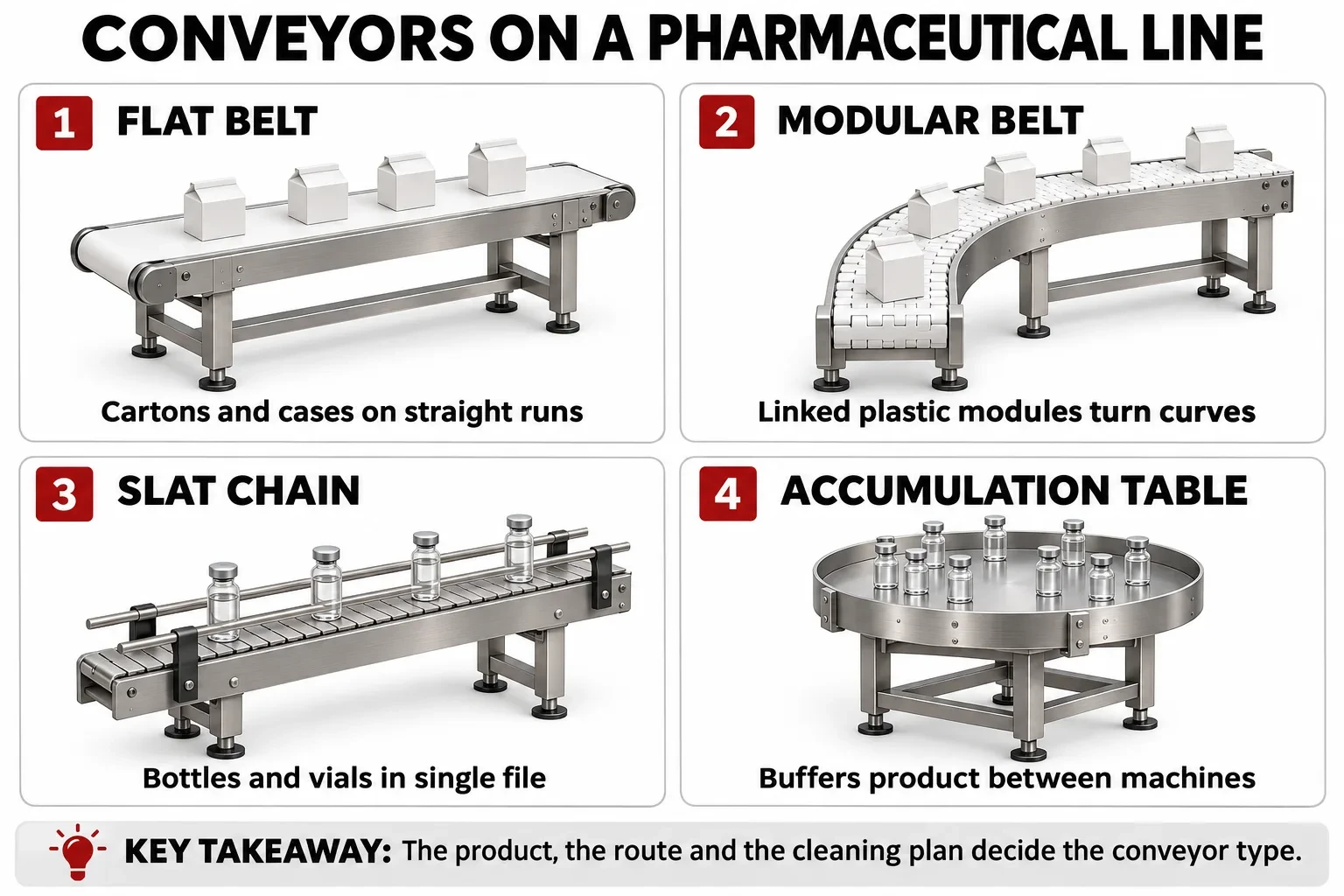
| Type | What it carries | Where it fits |
|---|---|---|
| Flat belt | Cartons, cases, trays | Straight runs between machines |
| Modular belt | Cartons and cases | Curves, merges and long runs |
| Slat chain | Bottles and vials | Single file into fillers and labellers |
| Accumulation table | Bottles and vials | Buffers between two machines |
The conveyor in this case study is a modular belt on the packaging side of the line. Our guide to types of conveyor systems covers the wider range.
Why Does a Pharmaceutical Line Need Accumulation?
Machines on a packaging line run at slightly different speeds, and each one stops from time to time for a reel change, a jam or a check. An accumulation section holds product between two machines. The upstream machine keeps running when the next one pauses, and the downstream machine keeps feeding when the one before it slows. Common designs are a turning table, a belt section that carries surplus containers back round in a loop, and a divert that sends product into a buffer lane. Size the buffer from the longest stop you want the line to ride through and the rate in containers per minute.
What Did the Customer Need?
The customer needed a modular belt conveyor on its packaging line changed, and support for the hot-melt glue system on the same line.
How Does a Modular Belt Conveyor Work?
A modular belt is built from moulded plastic modules joined by hinge rods, like a bracelet. Sprockets on a drive shaft mesh with the underside of the belt and pull it along. Because the belt is made of separate modules:
- Curves: The belt turns corners without a transfer plate between two conveyors.
- Repairs: A damaged section is cut out and replaced with new modules.
- Changes: The belt is lengthened or shortened by adding or removing modules.
Common changes on a running packaging line are guide rails moved for a new pack size, a new length or route, and extra sensors and stops. We design each change around the machines at both ends of the conveyor.
What Makes a Conveyor Suitable for Pharmaceutical Use?
A conveyor in a pharmaceutical area is designed to be cleaned and to shed as few particles as possible. A UK conveyor maker puts the frame choice this way:
“Stainless steel frames are preferred for their corrosion resistance, durability, and clean welds.”
Source: ENE Conveyors, Cleanroom Conveyors for Pharmaceutical Manufacturing
| Feature | Why it matters |
|---|---|
| Stainless or coated frame | Resists cleaning agents and rust |
| Open frame | Lets cleaners reach under the belt |
| Sealed or enclosed drive | Keeps lubricant and debris away from packs |
| Belt material with a food-contact or pharma rating | Suits product contact surfaces |
Frames come in two main builds. A welded stainless steel frame is the more durable choice and resists corrosion from cleaning agents. An aluminium profile frame is bolted together, so it is easier to extend or rearrange later.
How Do Conveyors Keep Vials and Bottles Upright?
Glass vials and small bottles tip over easily, and a tipped container jams the next machine. Conveyor makers handle this in four ways:
- Smooth belt surface: A fine-pitch belt leaves only small gaps, so a vial with an uneven base stays steady.
- Guide rails set to the container: Rails are adjusted for each container size, and covered where bare metal would mark the glass.
- Gentle starts and stops: Drives ramp the speed up and down so containers do not rock.
- Tipped-container reject: A shaped guide lets upright containers pass and drops fallen ones into a tray before the next machine.
How Does a Hot Melt Glue System Close a Carton?
A hot melt glue system melts solid glue and lays it on the flaps of a carton or case as it passes.
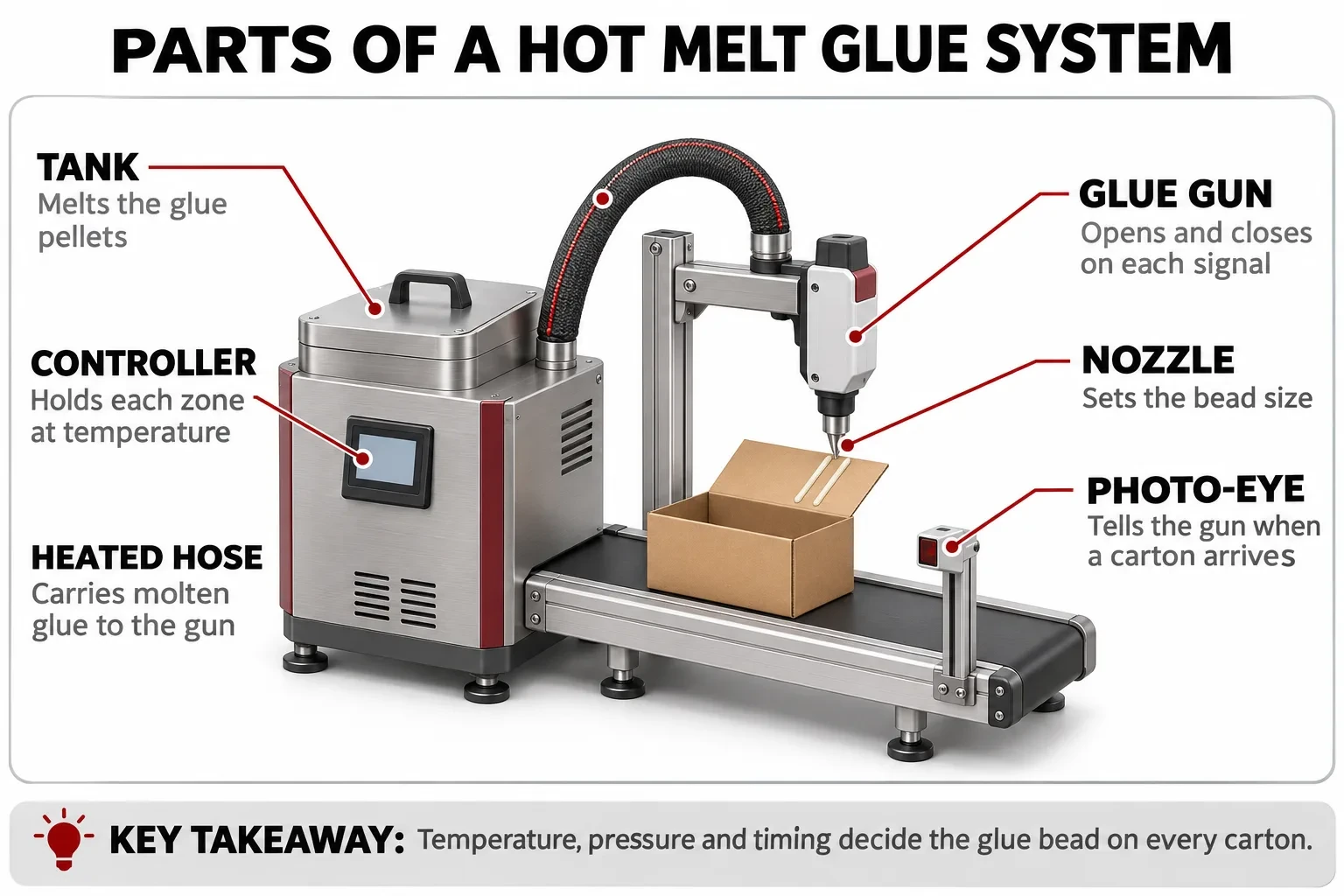
- Melt: Glue pellets melt in a heated tank.
- Pump: A pump pushes the molten glue through a heated hose.
- Detect: A photo-eye sees the carton coming.
- Apply: The gun opens for a set time and lays a bead or dots on the flap.
- Compress: The flaps are held together until the glue sets.
The bead depends on the temperature in each zone, the pump pressure, the nozzle size and the gun timing. Charred glue, a blocked filter or a worn nozzle changes the bead. Service follows the glue unit maker’s manual: clean the tank and filter, check the nozzles and hoses, and confirm each zone holds its set temperature. Our page on adhesive dispensing systems covers glue and adhesive work beyond packaging.
How Is a Change Checked Before the Line Restarts?
GMP sites handle equipment changes through change control: the change is assessed and approved before work starts, and checked before the line returns to production. Typical checks for a conveyor or glue change:
- Product flow: Every pack size runs through without jams, tipping or gaps.
- Transfers: Packs pass cleanly onto and off the changed section.
- Signals: Stops, sensors and the machines at both ends respond as designed.
- Glue: Each closed carton holds, with the bead in the right place.
Our factory acceptance test checklist lists the wider set of machine checks.
Where Else Does This Engineering Apply?
The same conveyor and glue work applies across our packaging line integration projects and our pharmaceutical packaging work. To keep packs moving without pressure between machines, read our guide to the zero pressure accumulation conveyor.
Start with the line layout
Send Us Your Packaging Line
Send a layout of the line, the pack sizes and the rate in packs per minute, photos of the conveyor or glue unit, and what you want changed. We reply with how we would approach it.
Discuss Your Packaging Line →FAQs
What is a pharmaceutical conveyor?
A pharmaceutical conveyor is a conveyor built to move drug products and their packs between machines on a regulated line. It uses materials and a frame design that are easy to clean and shed few particles.
Why use a modular belt conveyor on a packaging line?
A modular belt is made of linked plastic modules, so it turns curves without a transfer and damaged sections are replaced one at a time. It suits cartons and cases moving between packaging machines.
What does a hot melt glue system do on a packaging line?
It melts glue in a heated tank, pumps it through a heated hose and lays a bead on carton or case flaps from a gun that fires when a sensor sees the pack. The flaps are pressed together until the glue sets.
What should we send for a first discussion?
Send a layout of the line, the pack sizes and the rate in packs per minute, photos of the conveyor or glue unit, and what you want changed.
Get a quote
Not sure what configuration fits your product?
Send us the part and the target rate. We respond within one business day.
- What the machine or line has to do, and the rate you need
- A drawing, a sample photo or the model of the existing machine
- Where it will be installed and when you need it running
- Call+65 8102 9575
- WhatsAppMessage us on WhatsApp
- Emailinfo@motionwell.com.sg
- HoursMon to Fri, 8:30 AM to 6:00 PM