
HEPA-Filtered Workbench for a Medical Device Manufacturer
We built a HEPA-filtered workbench on an aluminium-profile frame with an industrial fan filter unit of around 1.2 m by 0.6 m for a medical device manufacturer, together with a mobile lifter for cleanroom use. We also supply and replace fan filter units and HEPA filters.
- HEPA-filtered workbench for a medical device manufacturer
- Industrial fan filter unit of around 1.2 m by 0.6 m
- A mobile lifter for cleanroom use in the same order
- Fan filter units and HEPA filters supplied and replaced
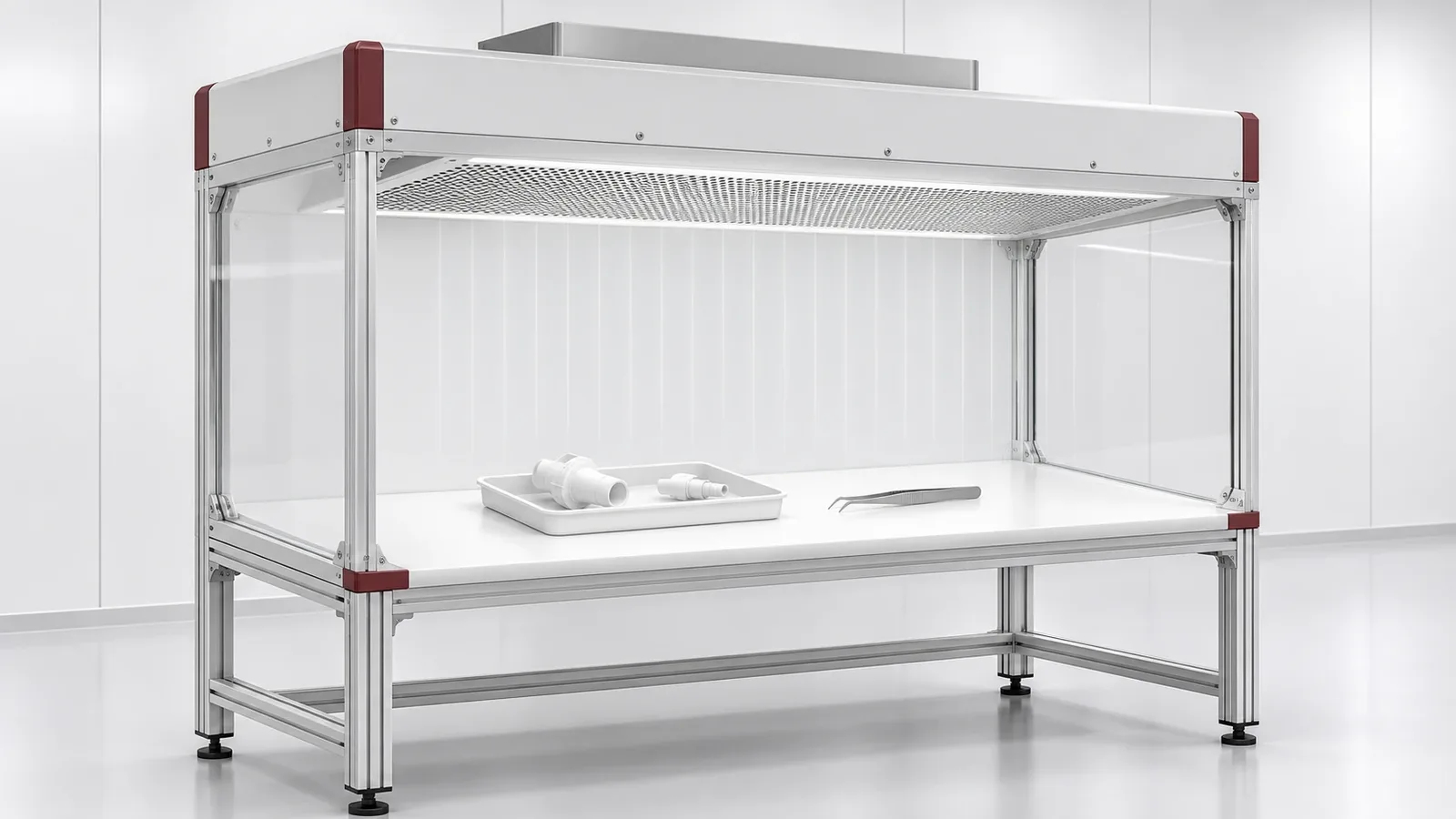
A laminar flow bench is a workbench that blows HEPA-filtered air in straight, parallel lines over the work surface, so room particles stay off the part. It is also called a clean bench or laminar flow hood. This case study covers one we built: a HEPA-filtered workbench on an aluminium-profile frame, with an industrial fan filter unit of around 1.2 m by 0.6 m, for a medical device manufacturer. It is part of our cleanroom automation equipment work in Singapore.
What Are the Main Types of Laminar Flow Bench?
A laminar flow bench comes in two main forms, vertical and horizontal. Both look like a biosafety cabinet. The direction of the air decides which one suits the work.
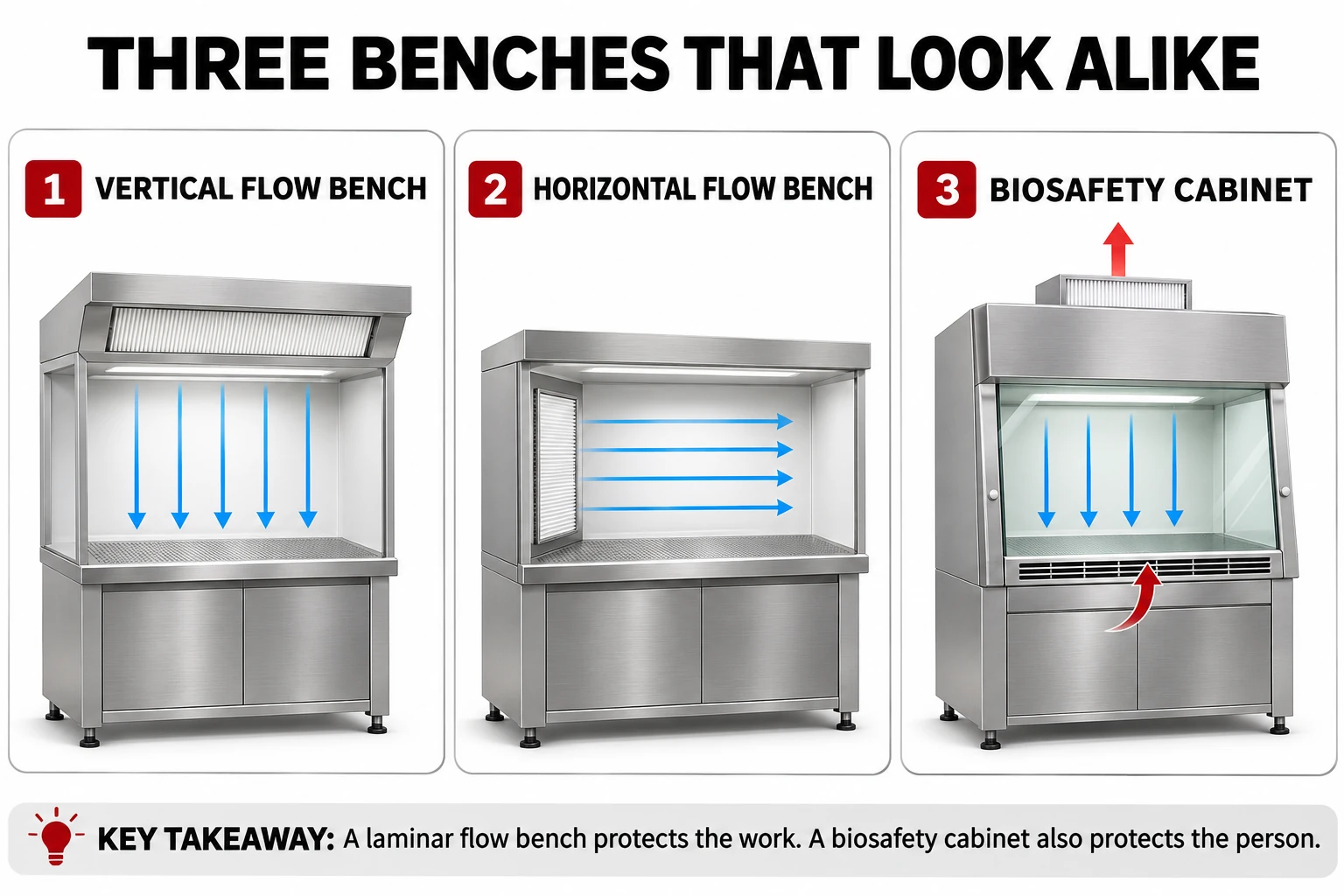
| Type | Where the air goes | What it protects |
|---|---|---|
| Vertical flow bench | From a filter in the roof down onto the work surface | The part on the bench |
| Horizontal flow bench | From a filter in the back wall across the work surface towards the operator | The part on the bench |
| Class II biosafety cabinet | Filtered air down onto the work, drawn with room air from the front window into the grilles, then out through an exhaust filter | The part, the person and the room |
Horizontal flow suits flat parts and work done directly over the part, since clean air runs between the part and the operator’s hands. A large object in horizontal flow blocks the air and leaves a turbulent zone behind it, so vertical flow suits large or tall parts. Benches for hazardous biological material are biosafety cabinets, built and certified to their own standards.
Where Are Laminar Flow Benches Used?
Laminar flow benches are used where a small work area needs cleaner air than the room around it. A bench costs far less than a full cleanroom for the same clean zone. The common uses are these:
- Electronics and semiconductor: Assembly and inspection of boards, wafers and optical parts.
- Medical devices: Assembly and packing of small parts that must stay free of particles.
- Pharmaceutical and hospital: Preparation of products that must stay clean.
- Laboratories: Cell culture and sample preparation with non-hazardous material.
Hazardous material belongs in a biosafety cabinet or a fume hood.
What Did the Customer Need?
The customer, a medical device manufacturer, needed a workbench with HEPA-filtered air over the work area. We built the bench on an aluminium-profile frame around an industrial fan filter unit of around 1.2 m by 0.6 m. A mobile lifter for cleanroom use went with it in the same order.
How Does a Laminar Flow Bench Work?
A laminar flow bench works by pushing room air through a HEPA filter and spreading it evenly across the work area. A general reference describes it this way:
“Air is drawn through a HEPA filter and blown in a very smooth laminar flow in a narrow vertical curtain, separating the interior of the cabinet from the environment around it.”
Source: Wikipedia, Laminar flow cabinet
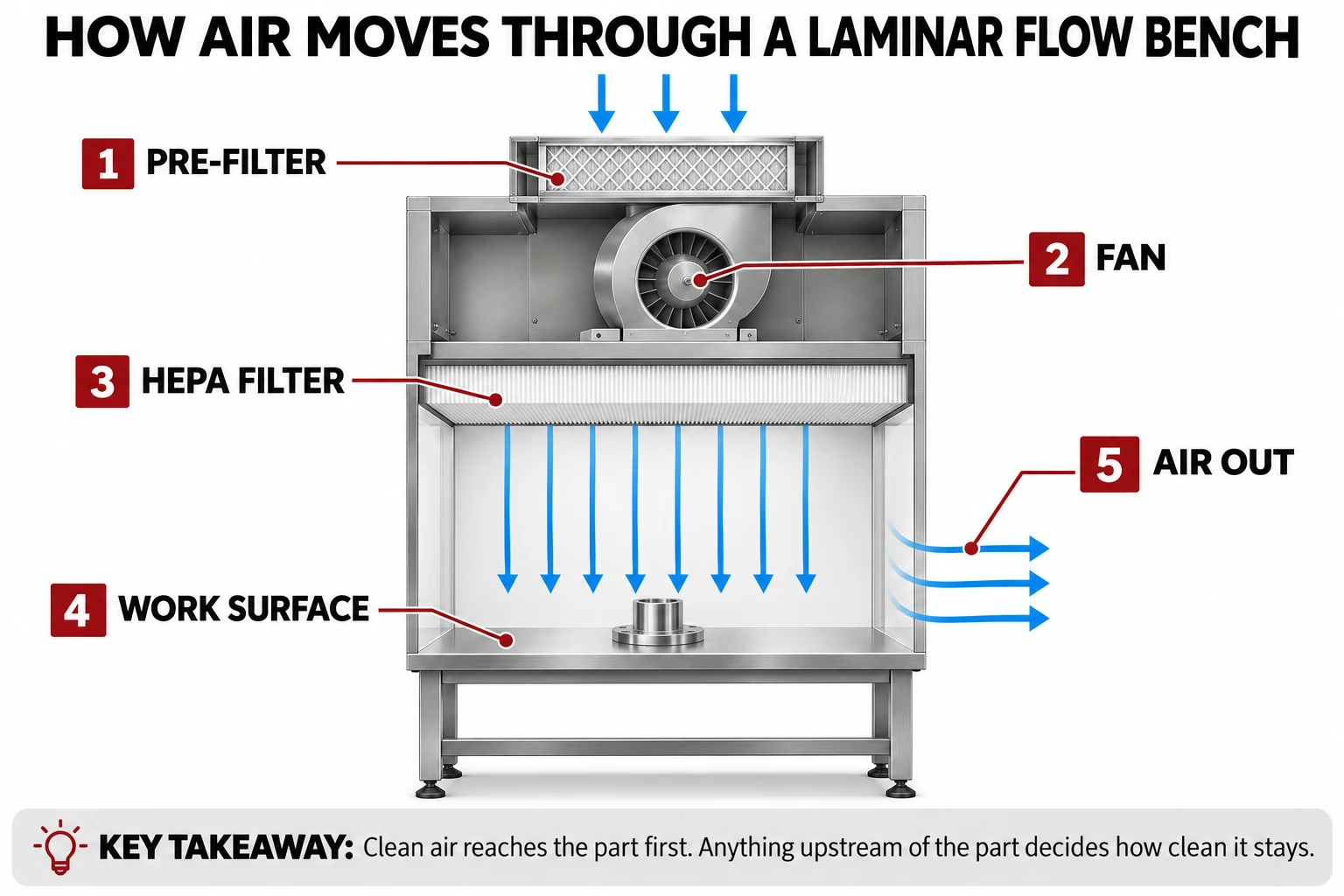
- Pre-filter: Room air enters through a coarse filter that catches the larger dust and protects the HEPA filter.
- Fan: A fan pushes the air into a chamber above the filter, so the pressure is even across it.
- HEPA filter: The air passes through the HEPA filter and leaves its face as a steady, even stream.
- Work surface: Clean air reaches the part before it reaches hands, tools or anything else.
- Air out: The air leaves at the open front and carries particles from the work area with it.
Rule of Thumb: Keep hands and tools downstream of the part. Anything between the filter and the part sheds particles onto it.
What Is a Fan Filter Unit?
A fan filter unit (FFU) is a fan and a HEPA or ULPA filter built into one housing. The same unit sits in a cleanroom ceiling grid or on top of a bench.
Filters are graded by how much of the hardest-to-catch particle size they stop. Under EN 1822, the common grades are:
| Grade | Efficiency at the hardest-to-catch particle size | Where it is used |
|---|---|---|
| H13 (HEPA) | At least 99.95% | Clean benches and cleanroom ceilings |
| H14 (HEPA) | At least 99.995% | Cleaner zones and critical work areas |
| U15 (ULPA) | At least 99.9995% | Semiconductor and other very clean work |
US practice defines a HEPA filter by a single test point: at least 99.97% of particles of 0.3 µm.
- ≈ 1.2 × 0.6 mIndustrial fan filter unit
- HEPAFilter grade over the work area
- 2Kinds of filtered-air work: a bench, and filter supply and replacement
How Is a Laminar Flow Bench Tested?
A laminar flow bench is tested by measuring its airflow, checking the filter for leaks and counting the particles over the work surface. ISO 14644-3 describes test methods for clean zones.
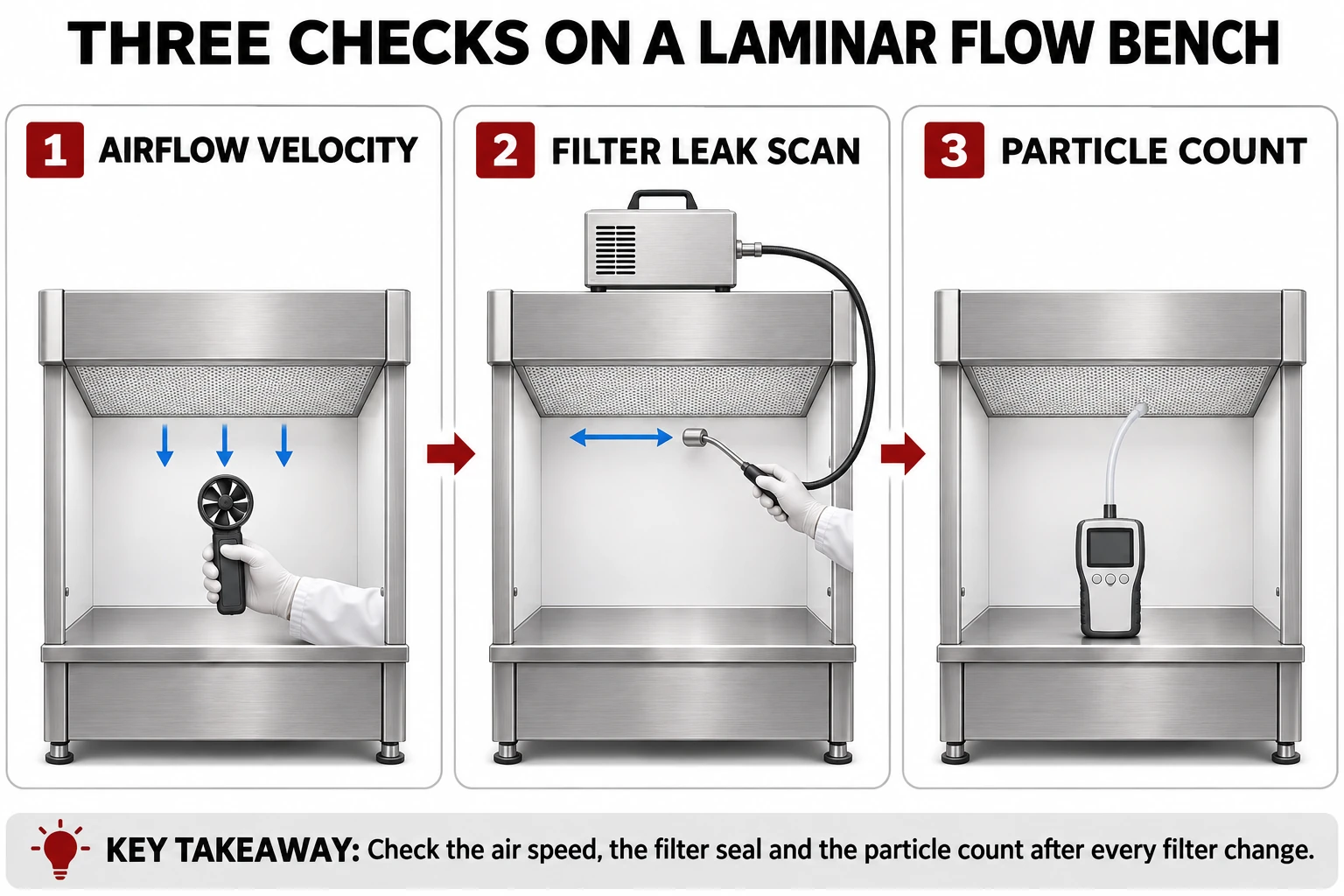
- Airflow velocity: An anemometer measures the air speed at points across the filter face. Bench makers quote about 0.35 to 0.45 m/s (70 to 90 ft/min).
- Filter leak test: An aerosol is released upstream of the filter. A probe then scans the filter face and its seal for leaks.
- Particle count: A particle counter samples the air over the work surface. The count is compared with the class limit in ISO 14644-1. ISO Class 5 allows 3,520 particles of 0.5 µm and larger per cubic metre.
We design machines for ISO Class 7 and 8 rooms, with material, surface finish and airflow decided in the mechanical design.
When Do Fan Filter Units and HEPA Filters Need Replacing?
Fan filter units and HEPA filters need replacing when the filter is loaded, damaged or no longer passes its leak test. A gauge across the filter shows the pressure drop rising as dust builds up. When it reaches the final pressure drop the maker gives, or the fan can no longer hold the airflow, the filter is changed. After a change, the leak test and the airflow check are repeated.
We have supplied and replaced fan filter units and HEPA filters for a Singapore medical device manufacturer.
Where Else Does This Engineering Apply?
The same filtered-air design applies to enclosures over assembly and test machines. Our cleanroom automation guide covers machine design for clean rooms, and our guide to ISO 14644 cleanroom standards explains the classes. For regulated lines, see medical device assembly machines and medical device manufacturing. You can contact our engineers with your bench size and class.
Start with the work area
Send Your Bench Size and Cleanliness Class
Send the size of the work area, what is handled on the bench, the cleanliness class you work to and photos of the room. For filter replacement, send the filter size and the label on the existing unit.
Discuss Your Clean Bench →FAQs
What is a laminar flow bench?
A laminar flow bench is a workbench that blows HEPA-filtered air in straight, parallel lines over the work surface. The clean air keeps particles from the room away from the part. It is also called a clean bench or laminar flow hood.
What is the difference between a clean bench and a biosafety cabinet?
A clean bench protects the part on the work surface. A Class II biosafety cabinet also draws air in at the front and filters the exhaust, so it protects the person and the room as well. Work with hazardous biological material needs a biosafety cabinet.
What is a fan filter unit?
A fan filter unit is a fan and a HEPA or ULPA filter built into one housing. It pulls air in, pushes it through the filter and blows clean air out of its face. Fan filter units sit in cleanroom ceilings and on top of clean benches.
How do you know when a HEPA filter needs replacing?
A gauge across the filter shows the pressure drop rising as the filter loads with dust. The filter is replaced when it reaches the final pressure drop the maker gives, when the fan can no longer hold the airflow, or when a leak test finds a leak that cannot be repaired.
What should we send for a clean bench quote?
Send the size of the work area, what is handled on the bench, the cleanliness class you work to, the room it stands in and photos of the space. For filter replacement, send the filter size and the label on the existing unit.
Get a quote
Not sure what configuration fits your product?
Send us the part and the target rate. We respond within one business day.
- What the machine or line has to do, and the rate you need
- A drawing, a sample photo or the model of the existing machine
- Where it will be installed and when you need it running
- Call+65 8102 9575
- WhatsAppMessage us on WhatsApp
- Emailinfo@motionwell.com.sg
- HoursMon to Fri, 8:30 AM to 6:00 PM