
Cobot Vision System for Gasket Assembly
We built a semi-automatic gasket system for a semiconductor equipment maker with a vision-guided cobot, an electric end effector and gasket presence sensing.
- Vision-guided collaborative robot
- Electric end effector and gasket presence sensing
- Light curtain and interlocked guard doors
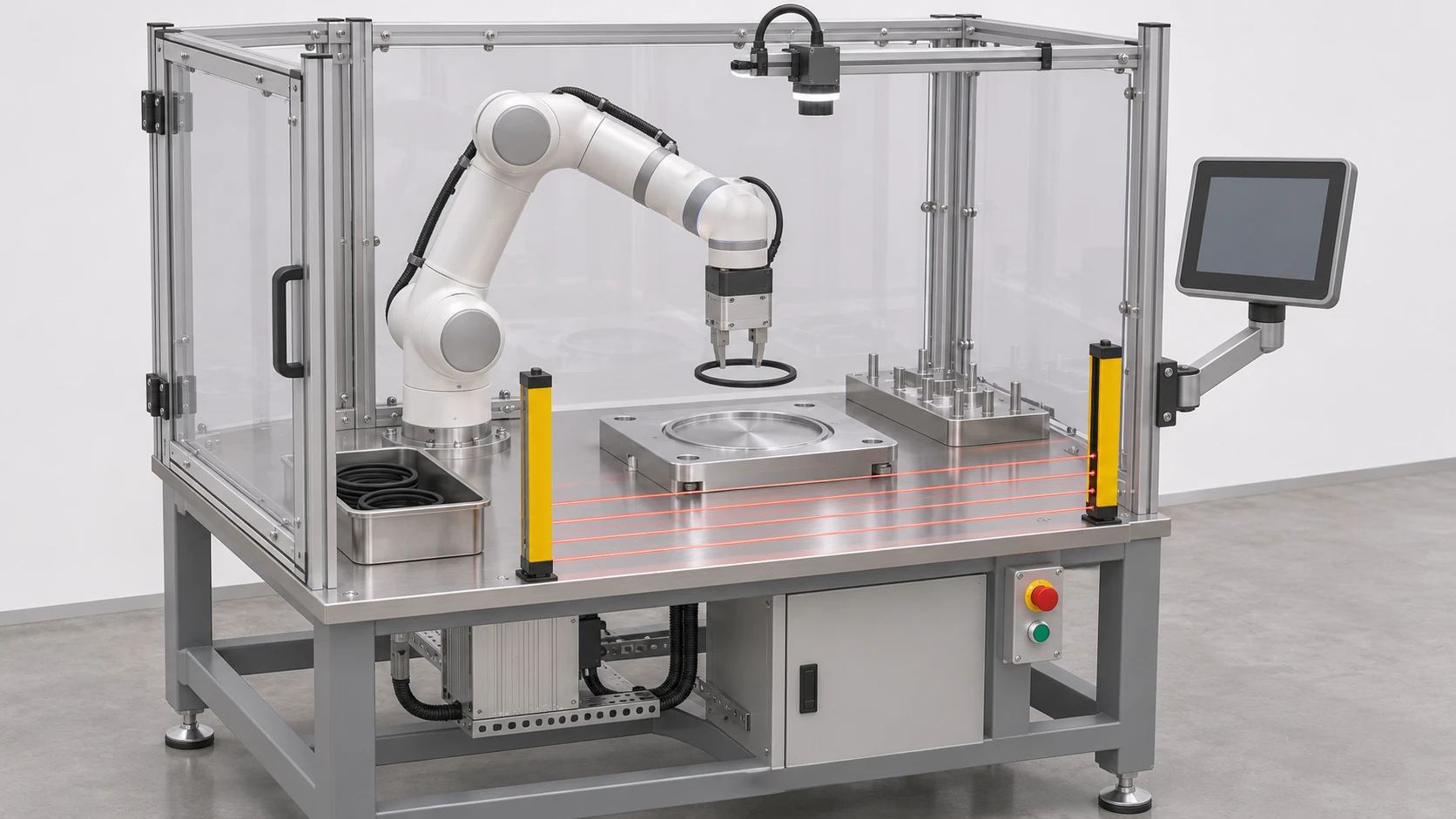
A cobot vision system is a collaborative robot paired with one or more cameras, so the robot finds each part from the image before it picks or places it. This case study covers one we built: a semi-automatic gasket system for a semiconductor equipment maker, with a vision-guided cobot, an electric end effector and gasket presence sensing. It is one of the cells behind our cobot applications work in Singapore.
What Are the Main Types of Cobot Vision Systems?
Cobot vision systems are grouped by where the camera sits and whether it measures depth. The part decides which one is needed.
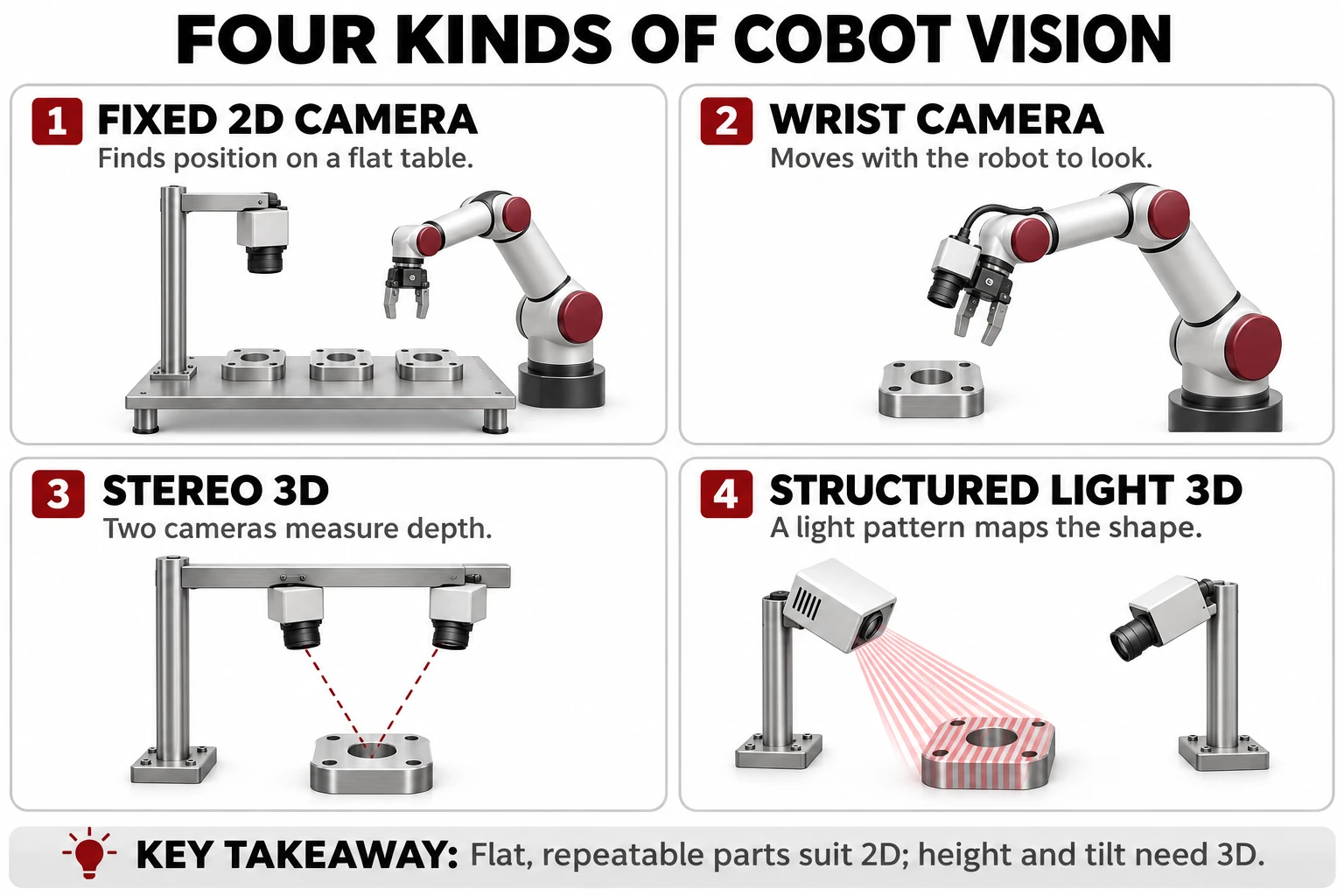
| Type | Camera position | Suits |
|---|---|---|
| Fixed 2D camera | Above the work area | Flat parts at a known height |
| Wrist 2D camera | On the robot wrist | Parts spread over a large area |
| Stereo 3D | Two cameras on one bar | Parts whose height or tilt changes |
| Structured light 3D | Projector and camera | Fine shape detail and bins of parts |
A gasket has to land in a groove or on a face, so the camera finds the part and the seat before the robot moves. Our guide to vision-guided robotics covers calibration and accuracy.
What Can a Cobot Vision System Do?
A camera gives a cobot five common jobs:
- Locate parts: The camera finds the position and angle of each part, which reduces the need for fixed locating fixtures or a sorted feed.
- Inspect: It checks for missing components, scratches, misalignment and other defects before the part moves on.
- Read codes: It reads barcodes, QR codes and printed labels for traceability.
- Measure: It checks length and width, and height as well with a 3D camera.
- Sort and pack: It tells part types apart and adapts the pick to different sizes and shapes.
Some vision systems add machine learning to sort defects that fixed rules miss. These jobs appear in assembly, inspection, machine tending, packaging and palletising cells.
How Is a Cobot Vision System Set Up?
A cobot vision system is set up in three steps:
- Mount the camera: The camera is fixed above the work area or mounted on the robot wrist, where it moves with the tool.
- Calibrate: A calibration routine links camera pixels to robot coordinates, so a position found in the image becomes a robot target.
- Teach the vision job: The camera software learns the part and sends its position or a pass or fail result to the robot program.
What Did the Customer Need?
The customer needed a semi-automatic system: an operator works at the cell, and a vision-guided cobot handles the gasket. Every gasket had to be confirmed in place before the part moved on.
How Does a Vision-Guided Gasket Cell Work, Step by Step?
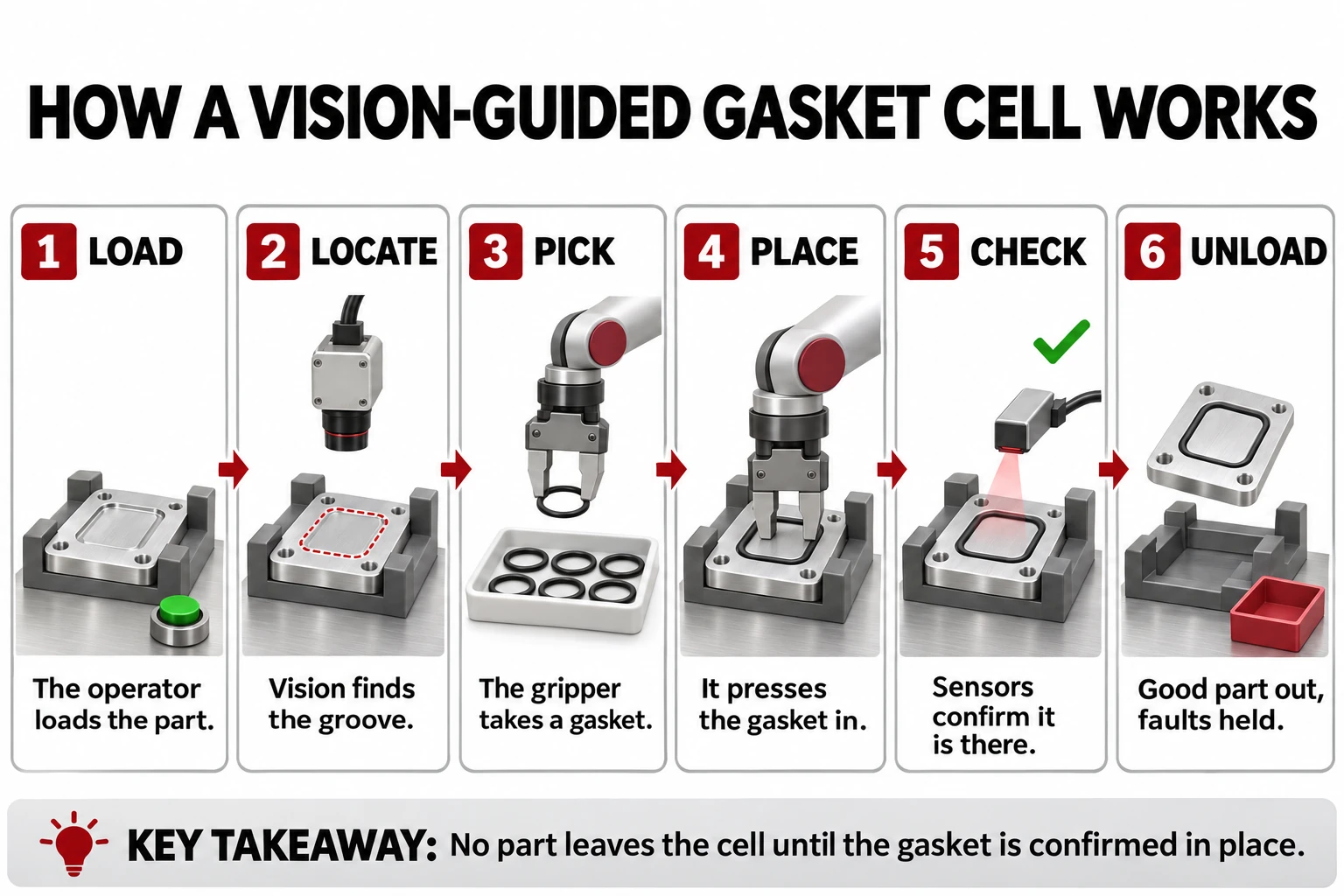
A semi-automatic gasket cell of the kind we design works in six steps:
- Load: The operator places the part in a fixture and starts the cycle.
- Locate: The camera finds the part and the gasket seat, and the robot corrects its path.
- Pick: The electric end effector takes one gasket.
- Place: The end effector sets the gasket into its seat with a controlled stroke and force.
- Check: Presence sensing confirms the gasket is in place.
- Unload: The operator removes the finished part. A part that fails the check is held for a person to look at.
Why Use an Electric End Effector?
An electric end effector is a robot tool driven by a motor, so its position, speed and force are set in the program. A soft gasket stretches or twists if it is gripped or pressed too hard, which makes that control useful.
| What it controls | Electric | Pneumatic |
|---|---|---|
| Finger position | Any point in the stroke | End stops only |
| Grip and press force | Set per recipe | Set by air pressure for the whole tool |
| Changeover | Program change | Mechanical adjustment |
| Air supply | None needed | Compressed air needed |
Our end-of-arm tool design page explains how we choose and test grippers with your parts.
How Is Gasket Presence Checked?
Presence sensing confirms that a gasket is in its seat before the part leaves the cell. The method depends on the gasket colour, size and what faults matter.
| Method | What it confirms | Limit |
|---|---|---|
| Photoelectric or fibre sensor | Something is in the seat | Cannot tell a twisted gasket from a good one |
| Laser displacement sensor | Height of the gasket in the groove | Checks one point or a short line |
| Camera inspection | Position along the whole seat | Needs steady lighting and contrast |
A gasket that sits high or rolls out of its groove leaks later, so the check runs on every part.
- 3Core parts: vision, electric end effector, presence sensing
- 2Safeguards: light curtain and interlocked doors
- 150+Automation projects since 2014
- ISO 90012015 certified quality system
How Is a Cobot Cell Made Safe?
A cobot is built to work near people, and the cell as a whole needs its own risk assessment. Wikipedia describes the standard written for this:
“A companion document was developed by ISO TC299 WG3 and published as an ISO Technical Specification, ISO/TS 15066:2016, which covers collaborative robotics, including their requirements and integrated applications.”
Source: Wikipedia, Cobot
A gripper, a sharp part or a pinch point between the robot and the fixture can cause harm. This system has a light curtain and interlocked guard doors. Our page on cobot safety standards explains the tests that go into a cobot cell’s acceptance record, and machine guarding design covers the guards.
Where Does This System Stand?
The gasket system is built. We test machines against an agreed list before they ship, and our factory acceptance test checklist shows what that list covers.
Where Else Does This Engineering Apply?
The same vision, gripper and presence checks apply to seals, O-rings and other soft parts placed into a groove. Our machine vision inspection page covers camera checks, and our electronics and semiconductor automation page covers the sector.
Start with the part
Send Us Your Part and Gasket
Tell us the part, the gasket, the number of parts per shift and how the gasket is placed today, and add photos or drawings if you have them. We reply with the vision and gripper approach that suits it.
Discuss Your Cobot Cell →FAQs
What is a cobot vision system?
A cobot vision system is a collaborative robot paired with one or more cameras. The camera finds the part, and the robot corrects its path to that position before it picks or places.
Is a 2D or 3D camera better for a cobot?
A 2D camera suits flat parts that sit at a known height. A 3D camera, stereo or structured light, suits parts whose height or tilt changes. The part and the tolerance decide which one is needed.
What does semi-automatic mean for a gasket cell?
In a semi-automatic cell an operator loads and unloads the parts, and the robot handles and places the gasket. It costs less than a fully automatic line and suits medium volumes or many part types.
Does a cobot cell still need guarding?
The risk assessment decides. A cobot limits its own force, and the gripper, the part and the task can carry their own hazards. Many cobot cells add a light curtain, guard panels or interlocked doors where the risk assessment calls for them.
What should we send for a first discussion?
Send drawings or photos of the part and the gasket, the number of parts per shift, the part types and how the gasket is placed today. We reply with the vision and gripper approach that suits it.
Get a quote
Not sure what configuration fits your product?
Send us the part and the target rate. We respond within one business day.
- What the machine or line has to do, and the rate you need
- A drawing, a sample photo or the model of the existing machine
- Where it will be installed and when you need it running
- Call+65 8102 9575
- WhatsAppMessage us on WhatsApp
- Emailinfo@motionwell.com.sg
- HoursMon to Fri, 8:30 AM to 6:00 PM