
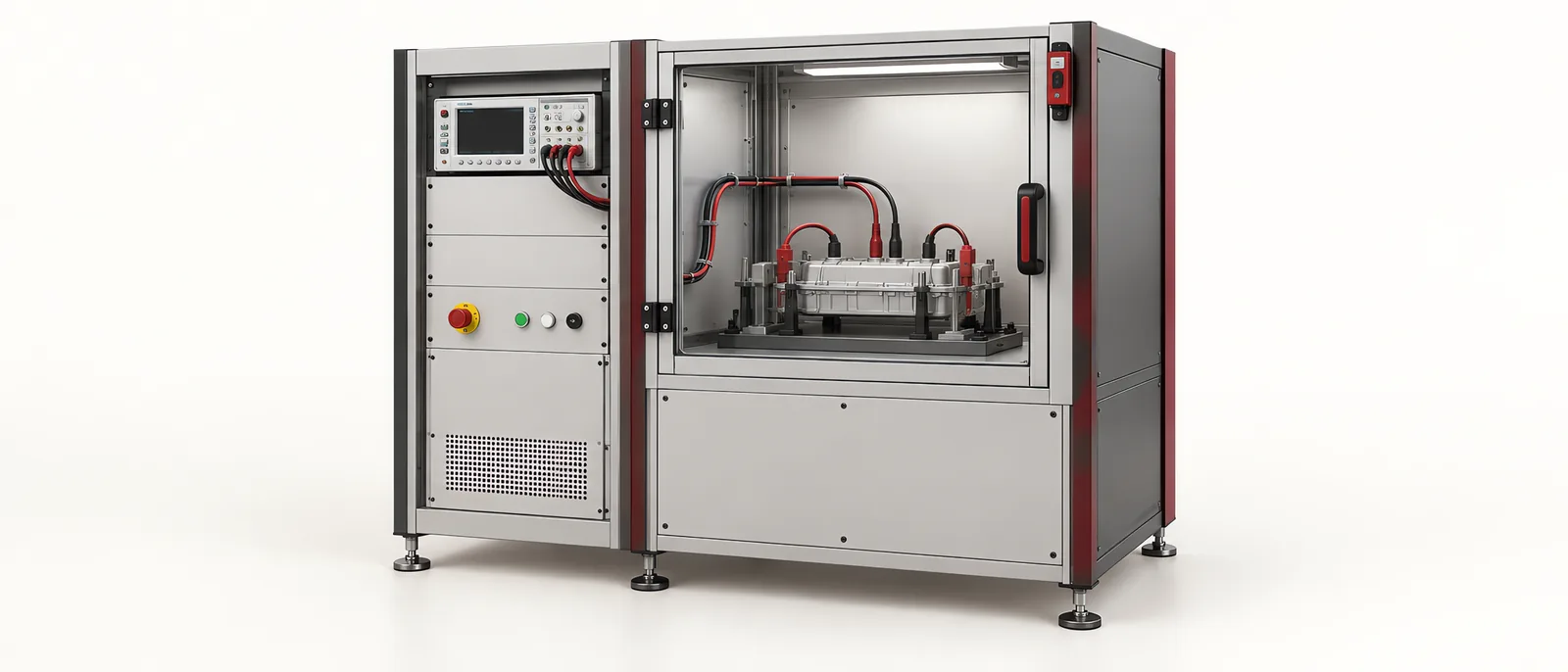
Conceptual equipment illustration.
Select hipot testing equipment by the electrical tests the product requires, then design the handling and test enclosure around those functions. Dielectric withstand, insulation resistance and protective-earth tests answer different questions; an instrument offering one does not automatically cover the others.
For an automated station, the specification also needs to define isolation, access control, test completion and the release of the product after testing. These requirements belong in the automated test equipment design from the beginning.
Identify the Test Before Choosing the Instrument
A dielectric withstand or hipot test applies a defined high-voltage stress across an insulation barrier and evaluates the resulting current against the test requirements. Insulation-resistance testing measures resistance under specified conditions. Ground-continuity and ground-bond testing examine the protective-earth path, with different equipment and test-current requirements.
The Associated Research electrical tester range lists these functions separately. Use the applicable product test specification to determine the required functions and settings, then compare instruments capable of performing that sequence.
| Selection item | What belongs in the requirement |
|---|---|
| Test function | AC or DC withstand, insulation resistance, earth-path test, or a defined combination |
| Electrical range | Required output and measurement ranges for the product test |
| Test sequence | Connection states, ramp, dwell, completion and discharge requirements |
| Connections | Test points, switching arrangement, insulation and accessible clearances |
| Automation | Ready, start, active, completed, result and fault interfaces |
| Records | Unit identity, method revision, measurements and reason for an incomplete test |
An advertised maximum voltage is only one line of this comparison. Check the instrument’s measurement capability at the conditions actually used, and whether each function is included in the proposed configuration.
Keep Test Access Under the Station’s Control
An enclosed fixture gives the machine a defined test space. Its access interlock, insulated connections and switching arrangement need to be designed as one system. A software message on a screen is not a physical barrier to an energised test circuit.
The HypotULTRA 7854 product information, for example, lists a safety interlock alongside its measurement functions. That is an instrument feature to integrate correctly, not a substitute for the complete station design.
Plan the electrical architecture with the control-panel and machine-wiring scope. Keep high-voltage paths and their switching equipment identifiable in the drawings, and establish how the machine confirms that the test has ended and the product can be released. A fixed delay should not silently stand in for an instrument status that the design requires.
Write the Sequence as States, Including Failed Tests
A useful sequence distinguishes loading, connection verification, test preparation, testing, completion and release. Give each state a clear entry condition and a defined response if the instrument reports a fault or communication is lost.
Consider an interrupted test. The product may have been stressed without completing the required measurement interval. Its record should say that the sequence was interrupted; it should not inherit the last passing result or be treated as an untested fresh unit without a defined disposition.
Similarly, a fixture can close correctly while a required connection is absent. Include an appropriate connection-validation method in the design and demonstrate its behaviour during station acceptance. The exact method depends on the instrument and circuit being tested.
Make the Result Belong to One Product
Store the device identity and selected method before the instrument is started. Retrieve the result for that test instance and check that it is complete before allowing a pass decision. Preserve fault and abort information alongside numerical measurements.
This data flow is particularly useful in electronics manufacturing automation, where a board or assembly may also pass through programming and functional tests. Define how a retest is recorded without erasing the original result.
The cleanroom automated test equipment case study provides a separate example of coordinated handling and measurement. The shared integration task is keeping specimen loading, test execution and the saved result in step.
What to Demonstrate Before Production Use
Include normal pass and fail artefacts, an open access interlock, a missing connection, an instrument fault and a lost result message in the acceptance plan. Confirm both the machine’s physical response and the record left behind. Carry out the electrical validation with the methods and equipment specified for the station.
Planning an electrical test cell? Tell us about the product and tests. We can discuss the instrument interfaces, guarded fixture and production sequence.