
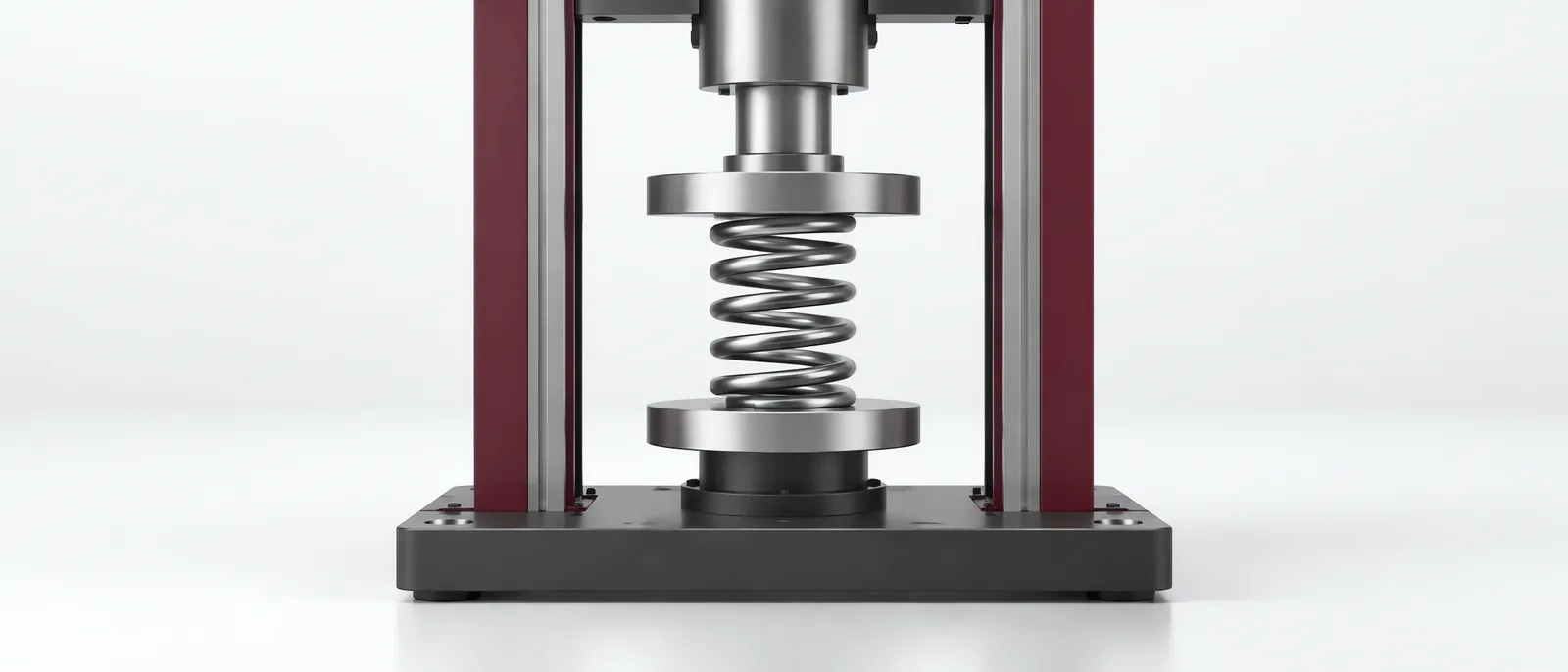
Conceptual equipment illustration.
A spring tester should report the force at the specified spring length or extension, with a defined loading sequence. Choose the instrument from the force range, travel and required result. A generic maximum-force rating will not explain whether the machine can distinguish acceptable springs at their working positions.
For production checks, the automated test equipment scope needs to include part presentation and the calculation that assigns pass or fail.
Define the Working Positions
For a compression spring, a drawing may specify force at two installed lengths. Testing only free length does not establish either force. For an extension spring, the hooks and mounting geometry are part of the load path.
Instron’s spring-testing guidance discusses testing springs in tension and compression. The instrument configuration needs to follow the spring and the requested characteristic.
As a simple illustrative calculation, assume the measured force rises from 20 N to 50 N over a further 5 mm of compression. The average rate over that interval is:
(50 − 20) N ÷ 5 mm = 6 N/mm.
This does not prove that the spring has that rate throughout its travel. A progressive spring can have a changing slope; specify the relevant interval or individual force points.
Keep the Loading History Consistent
Define seating force, test speed and any preconditioning cycles from the agreed method. A spring tested after an uncontrolled precompression is not necessarily comparable with one tested directly from its incoming condition.
For compression springs, check that the ends seat as intended and that lateral movement does not dominate the reading. Do not add a guide that changes the measured friction without evaluating it. For extension springs, check hook engagement before starting the pull.
Keep loading and unloading curves when hysteresis matters. A single peak number cannot show how the spring returns.
Separate Inspection from Fatigue
A short production load check and a long cyclic fatigue test answer different questions. Specify the required cycle history and damage assessment if fatigue is the task; do not infer service life from a small number of compression strokes.
For an automated station, include incorrect orientation, double loading and a missing spring in the trial. The QA laboratory case provides the broader instrument-coordination context. A tensile-testing frame may support some spring tests with suitable fixtures; compare the installed test setup.
A press-fit machine also records force and position, but its assembly curve is not automatically a calibrated spring-test method.
Discuss the spring characteristic with Motionwell to plan the test and its production interface.