
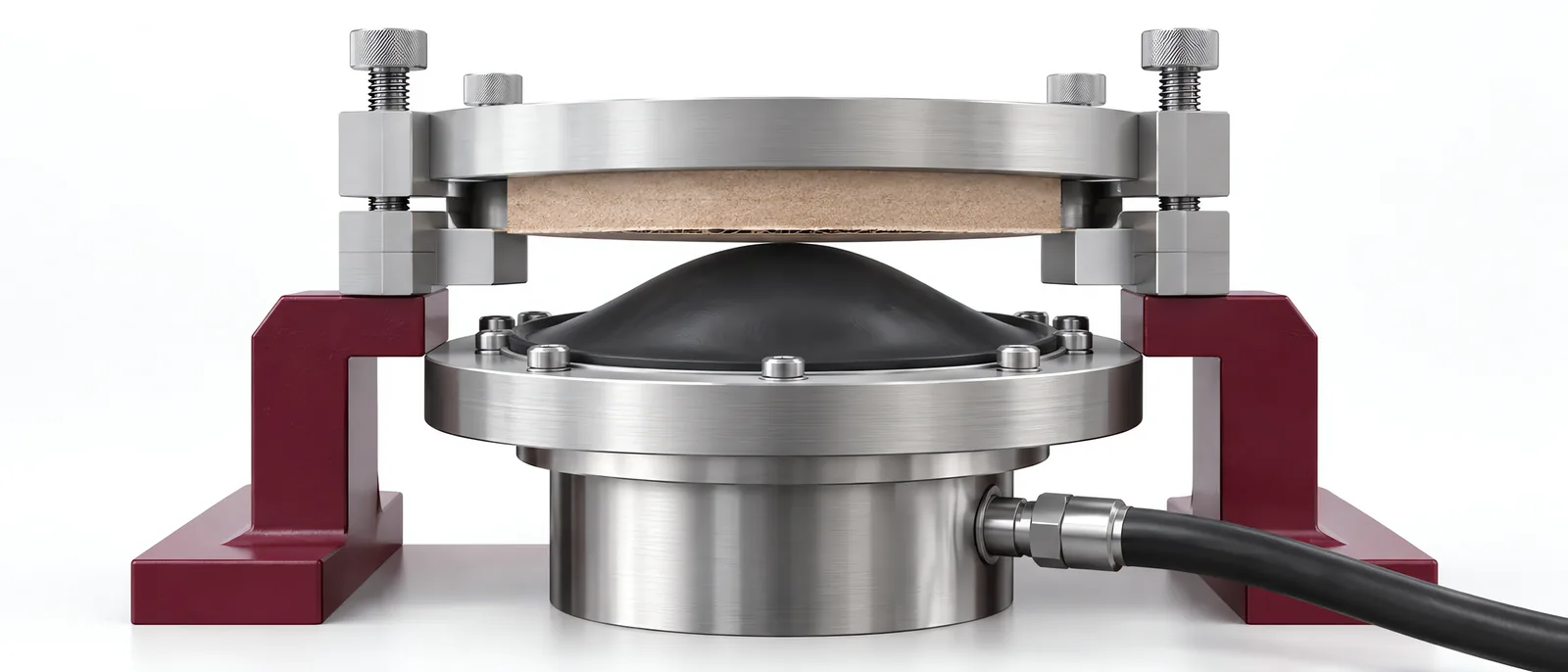
Conceptual equipment illustration.
A Mullen burst tester measures the pressure required to rupture a clamped paper or board specimen using a hydraulic diaphragm. It evaluates that material sample. It does not directly report how much load a finished carton can carry in a warehouse stack.
The instrument can be part of laboratory automation where sample handling and records follow a defined test method.
What the Pressure Result Represents
Thwing-Albert’s Rycolab burst-tester brochure describes different configurations for paper/paperboard and for paperboard/corrugated samples. Select the instrument range, clamps and diaphragm for the specified material and method.
During the test, the clamped specimen restrains the expanding diaphragm until rupture. Clamp condition and specimen seating therefore belong in the test configuration. A sample that slips or is damaged while clamping can give an unrepresentative result.
Burst, Edge Crush and Box Compression Are Different
The procurement question should identify the property being controlled:
| Task | What the result describes |
|---|---|
| Mullen burst | Hydraulic pressure at rupture of the clamped material specimen |
| Edge-crush test | Compression resistance of a specified board specimen arrangement |
| Box-compression test | Compression performance of the assembled box under the selected method |
| Pouch seal/leak test | Strength or integrity of a flexible package or its seal |
One result should not be relabelled as another. Finished-box performance also involves box dimensions, construction and load conditions. A burst reading alone cannot qualify the complete storage arrangement.
For cartons entering a case erector, keep incoming board checks distinct from machine trials with the assembled case. Both can matter, but they test different failure mechanisms.
Control the Specimen Before Adding Automation
Record the conditioning required by the selected method, specimen location and relevant board orientation. Cut specimens without damaging the test area. Select the stated number of locations from the applicable method instead of inventing one sampling rule for all grades.
An automated loader must present the correct test face and avoid creasing the board. The clamping and diaphragm sequence should remain controlled by the instrument; a transport robot should not create a new test method by changing how the specimen is restrained.
The result record needs the sample identity, method, pressure units and invalid-test status. Our existing QA laboratory case covers instrument commands and result association as separate responsibilities.
Define the Acceptance Evidence
Trial representative board grades, including the thickness extremes intended for the machine. Check reference and calibration procedures with the instrument supplier, then compare matched samples under the same conditions.
The packaging-line integration scope connects material quality with the downstream equipment. Contact Motionwell to discuss how laboratory results need to reach the production or quality system.