
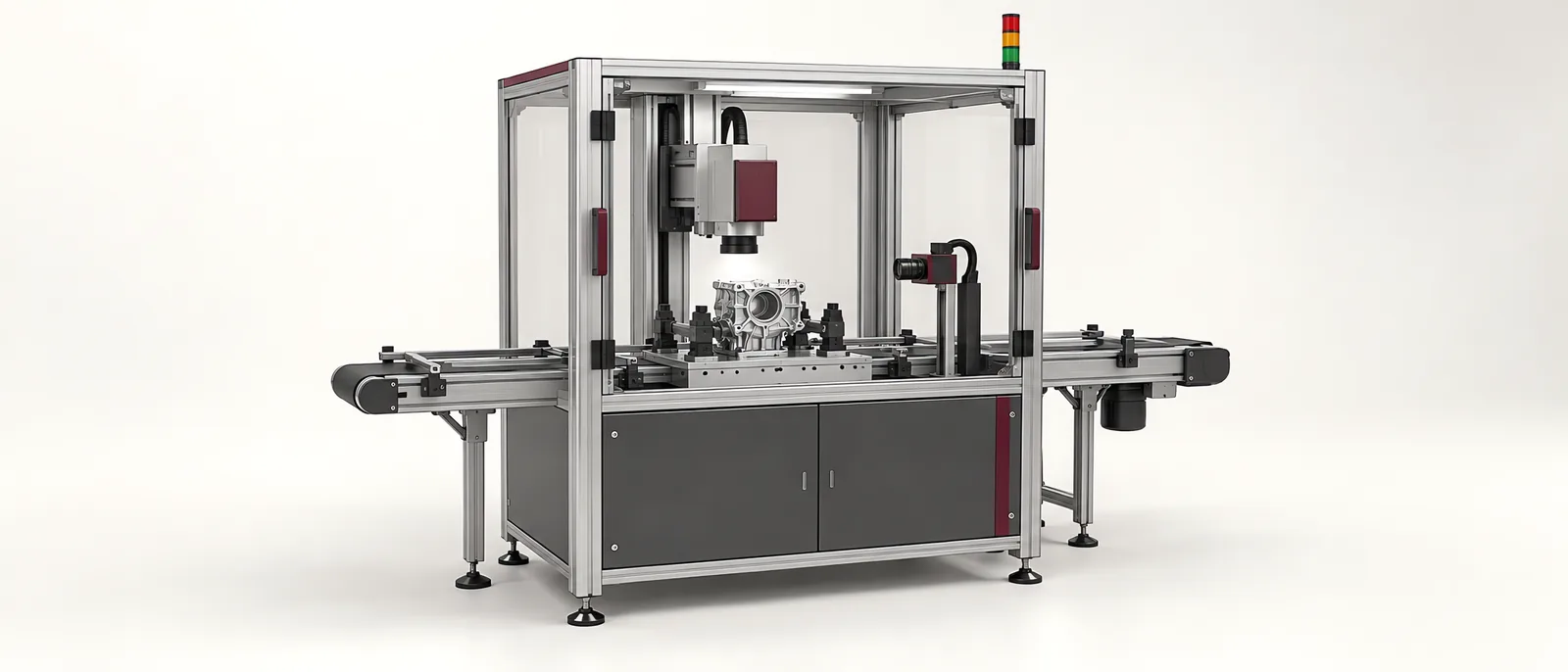
Conceptual equipment illustration.
A laser marking machine must create the required mark on the actual material and make it readable under the intended inspection conditions. Laser type, material response, mark size, focal position and cycle time should be evaluated together.
Start with the purpose of the mark. A visible part number, a durable identification feature and a machine-readable code can impose different requirements on contrast, geometry and subsequent verification.
Trial the Actual Material and Surface
Include the material grade, coating, colour, finish and permitted variation in the sample set. A result on one plastic formulation or metal finish does not establish the result on another.
KEYENCE’s fibre-laser overview describes different marking effects and material considerations. Compare fibre, CO2 and other laser families by trialling the required marking result on representative samples.
For each sample, record the mark appearance and any effect on the surrounding surface. If durability matters, include the actual cleaning, handling or exposure condition in the trial plan.
Design the Marking Position
A fixture should locate the marking area consistently within the available working field and focal arrangement. Check part height, tilt and surface curvature. Determine how the system recognises an incorrectly loaded or absent part before marking starts.
Include the complete machine cycle: load, locate, identify, mark, inspect and unload. The laser’s marking time is only one part of that cycle.
The station also needs an appropriate enclosure, access control and extraction arrangement for the process and material. These are machine components to design and verify, not additions to leave until after the laser has been selected.
Close the Data Loop
A traceable marking sequence has four distinct stages:
- Assign: Select the correct part identity or production data.
- Mark: Send the approved content and recipe to the marker.
- Read: Capture the resulting code or text from the physical part.
- Compare: Check the captured content against the expected value and retain the result.
A marker reporting completion does not confirm that the physical code contains the intended data. A reader successfully decoding a code does not establish that the value belongs to that part.
Our code reading and traceability page covers that association. Machine vision inspection can provide the physical checks around mark position, presence and readability.
Keep Readability and Verification Distinct
A production reader demonstrates that its configured setup can decode the mark. Where formal code-quality grading is required, specify the appropriate verification method and equipment as a separate requirement.
Also inspect the human-readable characters if they carry required information. A successful Data Matrix read does not automatically check every nearby character or logo.
For packages where a label or printed code suits the product better, compare the available labelling and coding systems. The choice should follow material, durability and production needs.
Test the Exceptions
Use a trial with missing parts, wrong recipes, communication interruptions and deliberately unreadable marks. Check what happens if data has been assigned but the part is removed before completion. Establish how duplicate marking and duplicate identity are prevented or detected.
In the packaging-line integration plan, retain the same identity through marking, inspection and rejection. This makes a failed mark a traceable event instead of an unexplained missing item downstream.