
Project Overview
Motionwell Automation designed and built a SCARA robot assembly line (Project P23045) for ifm, a global leader in industrial sensors and automation technology. The line assembles sensor panels with vision-guided component placement, supporting high-mix production with minimal changeover time.
System Architecture
Epson SCARA Robot
The assembly line centers on Epson T6-602S SCARA robots, a 4-axis unit with 600mm reach and 6kg payload capacity. The T6 series was selected for this application based on:
- High-speed pick-and-place with cycle times under 0.5 seconds per component
- Placement repeatability of 0.02mm, critical for sensor panel contact alignment
- Compact 174mm body width allowing tight station-to-station spacing on the line
- Integrated RC700A controller with fieldbus connectivity to the Mitsubishi iQ-R series PLC
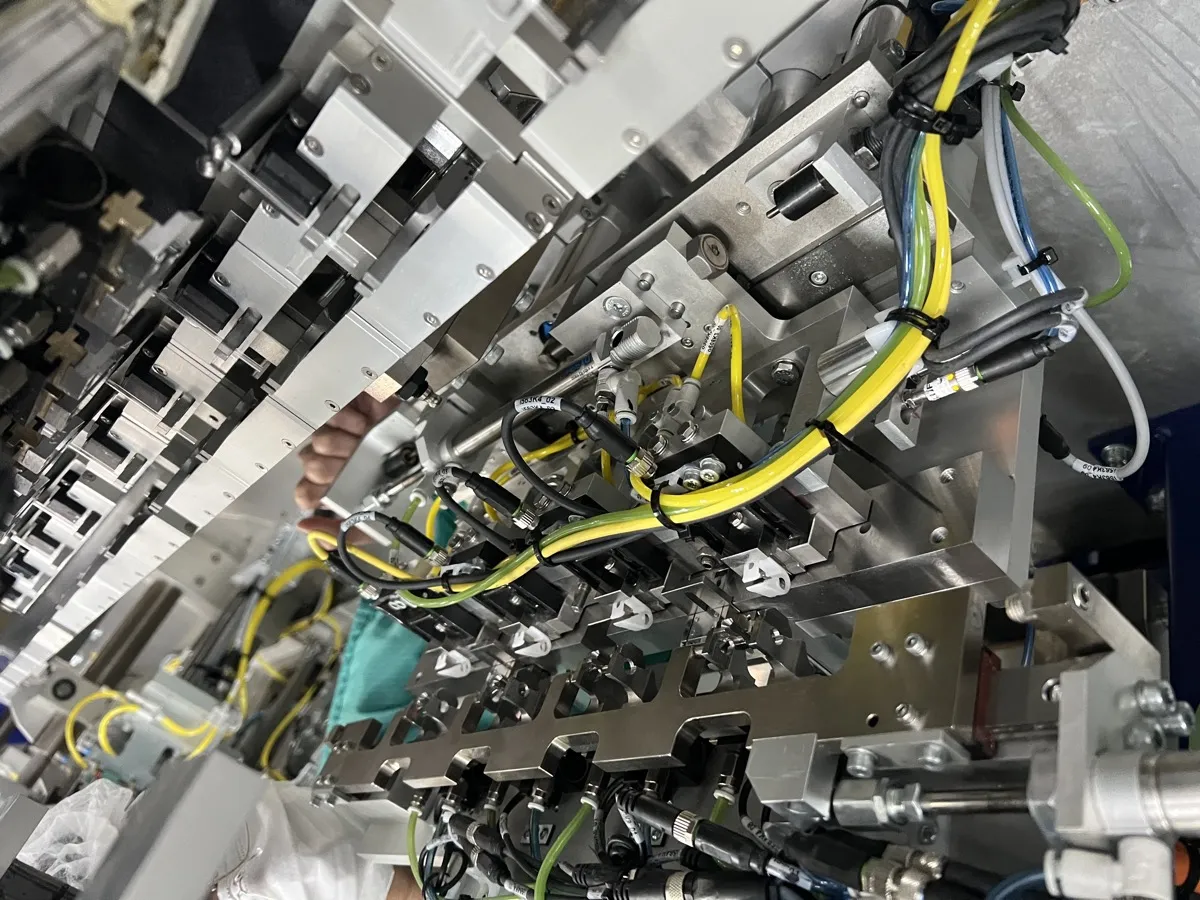
Each robot station handles a specific assembly step – connector insertion, adhesive application, or component placement – with dedicated Schmalz vacuum grippers and pneumatic actuators sized for the part geometry.
Keyence Vision System
The line uses Keyence CV-X420F vision controllers paired with CA-H200M 2-megapixel cameras at each assembly station. The vision system provides:
- Pre-placement position verification with 0.01mm measurement resolution
- Post-placement quality inspection confirming component seating depth and angular alignment
- Component presence and orientation detection using pattern matching and edge detection algorithms
- Barcode and 2D DataMatrix reading via SR-2000 series readers for full traceability
Keyence’s vision software runs inspection routines in under 50ms per station, keeping pace with the robot cycle time without creating a throughput bottleneck.
Recipe Management and Tray Handling
The PLC-based recipe system manages over 15 panel variants on a single line. Recipe changeover takes under 3 minutes and requires no mechanical adjustment:
- One-touch changeover between panel variants via the Mitsubishi GOT2000 HMI
- Automatic adjustment of robot paths, vacuum grip profiles, and vision inspection parameters
- Production tracking by variant and batch with data logged to CSV for MES integration
- Quality data segregation by product type with automatic SPC charting
Incoming components arrive in JEDEC-standard trays loaded into gravity-fed tray magazines. The SCARA robot picks components from the tray grid pattern, and empty trays are automatically stacked and ejected to a return conveyor. Tray changeover is tool-free, using quick-change nest plates for different component tray formats.
Technical Details
SCARA Robot Specifications
The assembly line uses ABB SCARA 4-axis robots (X-Y-Z-R configuration) for high-speed component placement. The four axes provide horizontal reach (X-Y), vertical stroke (Z), and rotational alignment (R) – the optimal kinematic configuration for pick-and-place operations on a flat panel surface.
Key specifications:
| Parameter | Specification |
|---|---|
| Axes | 4 (X-Y-Z-R) |
| Repeat accuracy | +/-0.01 mm |
| Cycle time | < 0.5 seconds per placement |
| Payload | 6 kg |
The +/-0.01mm repeat accuracy ensures that sensor contact pads align precisely with PCB traces on the panel, which is critical for electrical connectivity in the assembled sensor module. This level of precision exceeds what can be achieved with manual assembly, where typical operator placement accuracy is +/-0.2-0.5mm.
Dome Light Illumination System
The vision inspection stations use dome lights (hemispherical diffuse illumination) positioned above the inspection field. Dome lighting provides shadow-free illumination by surrounding the part with diffused light from all angles simultaneously. This elimination of shadows is essential for:
- Accurate edge detection on components with complex geometries, where directional lighting would create shadow artifacts that interfere with dimensional measurement algorithms
- Consistent inspection of reflective metallic surfaces (connector pins, solder joints) that produce specular glare under ring lights or bar lights
- Reliable detection of surface contamination and foreign material, which requires uniform illumination to distinguish genuine defects from lighting artifacts
The dome lights use white LED arrays with diffuser panels at 6500K color temperature, providing stable, repeatable illumination conditions independent of ambient light changes in the production area.
Vacuum End-Effector and XYZ Linear Modules
Panel alignment at the assembly stations uses a combination of vacuum end-effectors and XYZ linear modules:
- Vacuum end-effector: Schmalz vacuum cups with adjustable suction force grip the panel surface without mechanical clamping marks. Vacuum level is monitored by a pressure sensor to confirm grip before the robot initiates movement.
- XYZ linear modules: Motorized linear stages on each axis provide fine positioning with micrometer resolution for panel alignment against reference datums. The linear modules compensate for panel dimensional variations (warpage, edge trim tolerance) that would otherwise cause positional error at downstream assembly stations.
The combination allows the system to handle panels of varying thickness and flatness without dedicated fixtures for each panel variant.
Electric Screwdriver with Torque Control
Selected assembly stations integrate electric screwdrivers for fastening sensor modules to the panel substrate. The screwdrivers provide programmable torque control with real-time torque and angle monitoring:
- Target torque is set per fastener type in the recipe, ranging from 0.1 Nm to 2.0 Nm
- Torque is measured by a rotary torque transducer integrated into the screwdriver spindle
- The PLC records the final torque and total rotation angle for every fastener, logged against the panel serial number
- Fasteners that fall outside the torque or angle window trigger an immediate reject, preventing undertightened (risk of loosening in service) or overtightened (risk of stripped threads or cracked substrate) assemblies
Real-Time Vision Deviation Compensation
The vision system performs real-time deviation compensation on every pick-and-place cycle using a three-step process:
- Image acquisition: The camera captures an image of the target placement location on the panel
- Position and angle calculation: The vision software identifies fiducial marks or component edges in the image, calculates the X-Y position offset and angular deviation (theta) between the actual panel position and the programmed nominal position
- Compensation data transmission: The calculated X, Y, and theta offsets are sent to the SCARA robot controller via high-speed fieldbus communication. The robot adjusts its placement trajectory in real-time to compensate for the measured deviation
This closed-loop compensation cycle executes in under 50ms and corrects for panel positioning drift, thermal expansion of the conveyor, and tray-to-tray variation in component position. The result is consistent placement accuracy regardless of upstream positional variation.
Blue Polycarbonate Safety Enclosure
The assembly line is enclosed in blue-tinted polycarbonate safety panels. The polycarbonate material provides impact resistance (meeting EN 12417 requirements for machine guarding) while allowing operators and maintenance personnel to visually monitor the assembly process without opening safety interlocks. The blue tint reduces glare from the internal LED lighting and dome lights, improving visual comfort for operators stationed adjacent to the line during extended shifts.
Access doors in the enclosure use safety-rated interlocks that halt robot motion when opened. The enclosure also serves as a controlled environment boundary, reducing airborne dust and fiber contamination on the sensor panels during assembly.
Related
This project demonstrates Motionwell’s robotics integration and machine vision inspection expertise. The recipe-driven architecture reflects Motionwell’s approach to custom machine design for the electronics & semiconductor industry.